
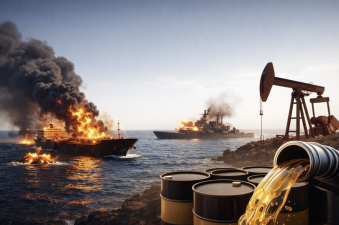
Recent conflict in West Asia has severely disrupted oil and gas supplies through the Strait of Hormuz. This narrow passage handles about one-fifth of the world’s oil and gas demand. Two weeks into the war, the flow has almost stopped, causing the largest supply disruption recorded by the International Energy Agency (IEA). Global oil prices have fluctuated sharply between 70 and120 per barrel. Despite releasing strategic reserves, markets remain volatile due to fears of a prolonged conflict.
Significance of the Strait of Hormuz
The Strait of Hormuz is a critical chokepoint for global energy trade. Nearly 20% of the world’s oil and gas passes through it. Iran’s blockade has caused major supply shortages. Major economies cannot afford a long-term closure. Countries like China, Japan, the EU, and India maintain strategic reserves, but these can only last for weeks or months. The disruption affects both oil and natural gas markets, with LNG prices surging sharply in Asia and Europe.
War Dynamics and Regional Impact
Iran, despite losing its leader, remains resilient and has expanded the conflict across the region. It uses drones and the geography of the strait to challenge superior US military power. Iran’s strategy weaponises oil prices to create economic pressure on the US and its allies. The US and Israel aim to neutralise Iran’s military capabilities but have avoided attacking Iran’s main oil export facilities to keep oil prices stable and maintain economic leverage.
Global Economic and Security Concerns
The conflict threatens global energy security and economic stability. Shipping through the strait may resume only with naval escorts and advanced anti-drone technology. Insurance costs for shipping have soared, and sovereign states may need to provide indemnity against losses and environmental damage. Diplomatic efforts continue, but uncertainty remains high, with risks of prolonged disruption affecting global markets and regional peace.
Strategic Reserves and Energy Security
Countries maintain strategic reserves to buffer supply shocks. China holds over 100 days of oil consumption in reserves. Japan’s reserves cover over 250 days, the EU about 90 days, and India 74 days. However, natural gas reserves, especially in Europe, are critically low. Reduced Russian supplies and loss of LNG from Qatar and UAE worsen the situation. Spot LNG prices have increased by over 50% in two weeks, signalling tightening global energy supplies.
Topics for Prelims:
Strait of Hormuz
- Key maritime chokepoint for global oil and gas trade.
- Handles about 20% of world’s oil and gas demand.
- Geographically narrow and strategically vulnerable.
- Iran’s blockade has caused major supply disruptions.
- Naval escorts and anti-drone tech needed for safe passage.
Global Strategic Oil Reserves
- Maintain oil stockpiles to manage supply disruptions.
- China holds reserves for over 100 days of consumption.
- Japan’s reserves cover more than 250 days.
- EU and India maintain 90 and 74 days respectively.
- Used to stabilise markets during crises.
Iran’s Military Strategy
- Uses drones and geography for asymmetric warfare.
- Blocks Strait of Hormuz despite US military superiority.
- Targets oil shipping to weaponise global oil prices.
- Resilient despite leadership loss and international pressure.
- Focuses on maintaining military threat despite damage.
Questions for Mains:
- Discuss in the light of recent West Asian conflicts, the strategic importance of maritime chokepoints like the Strait of Hormuz in global energy security. [GS-III-Economic Development]
- Critically examine the role of strategic petroleum reserves in managing global oil price volatility during geopolitical crises. [GS-III-Economic Development]
- Explain the impact of asymmetric warfare tactics, such as drone usage, on modern naval security and international relations. Discuss with examples from recent conflicts. [GS-III-Internal & External Security]
- With suitable examples, discuss the challenges faced by global energy markets due to geopolitical tensions and supply disruptions, and comment on the role of international cooperation in addressing these challenges. [GS-II-International Relations]
Answer Hints:
1. Discuss in the light of recent West Asian conflicts, the strategic importance of maritime chokepoints like the Strait of Hormuz in global energy security. [GS-III-Economic Development]
- Strait of Hormuz handles about 20% of global oil and gas trade, making it a critical energy artery.
- Its narrow geography makes it vulnerable to blockades and military confrontations, as seen in recent Iran-US conflicts.
- Disruption in the strait leads to supply shortages, causing global oil price volatility and economic instability.
- Major economies (China, Japan, EU, India) rely on the strait and maintain strategic reserves but only for limited durations.
- Ensuring safe passage requires naval escorts and advanced anti-drone technology, denoting security challenges.
- Prolonged closure can trigger global economic distress, emphasizing the chokepoint’s geopolitical and economic significance.
2. Critically examine the role of strategic petroleum reserves in managing global oil price volatility during geopolitical crises. [GS-III-Economic Development]
- Strategic reserves act as buffers to supply shocks, stabilizing markets during disruptions like the Strait of Hormuz blockade.
- Countries like China (100+ days), Japan (250+ days), EU (90 days), and India (74 days) maintain substantial reserves.
- IEA’s coordinated releases can temporarily ease shortages and calm markets but may not fully counteract fear-driven volatility.
- Reserves help prevent panic buying and extreme price spikes but are limited in duration and cannot replace sustained supply.
- Natural gas reserves are also crucial but less developed globally, increasing vulnerability in LNG markets during crises.
- Strategic reserves need to be complemented by diplomatic and security measures for long-term energy stability.
3. Explain the impact of asymmetric warfare tactics, such as drone usage, on modern naval security and international relations. Discuss with examples from recent conflicts. [GS-III-Internal & External Security]
- Asymmetric warfare allows weaker powers (e.g., Iran) to challenge superior militaries using drones and geography.
- Iran’s use of drones in the Strait of Hormuz disrupts shipping and causes chaos despite many being shot down.
- Drone attacks complicate naval defense, requiring new anti-drone technologies both aerial and underwater.
- Such tactics weaponize economic factors (oil prices) to exert political pressure globally.
- They increase unpredictability and prolong conflicts, impacting regional security and requiring international naval cooperation.
- Examples – Iran’s drone strikes on shipping, US-Israel targeting missile and drone capabilities without hitting oil infrastructure.
4. With suitable examples, discuss the challenges faced by global energy markets due to geopolitical tensions and supply disruptions, and comment on the role of international cooperation in addressing these challenges. [GS-II-International Relations]
- Geopolitical tensions (e.g., Iran-US conflict) cause supply disruptions, leading to price volatility and market uncertainty.
- Closure of critical chokepoints like Strait of Hormuz disrupts 20% of global oil and gas flow, affecting energy security worldwide.
- Reduced LNG supplies from Qatar and UAE, combined with low European gas reserves, exacerbate energy shortages and price spikes.
- International cooperation via IEA strategic reserve releases and potential naval escorts is vital to ensure supply continuity.
- Diplomatic efforts are needed to resolve conflicts and maintain open trade routes, while sovereign states may need to underwrite insurance and environmental risks.
- Global energy market stability depends on multilateral coordination in crisis management, technology sharing, and conflict resolution.