
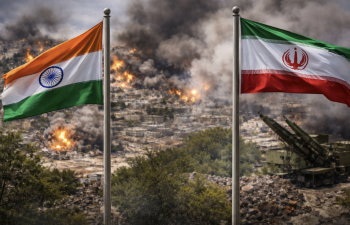
India’s foreign policy is under intense debate due to the ongoing Israeli-American war on Iran in 2026. The conflict began on 28 February and has lasted over three weeks. India’s cautious and calculated response has sparked discussions across political and diplomatic circles. The government’s decision not to officially condole Iran’s Supreme Leader Ayatollah Ali Khamenei’s assassination drew criticism. This situation marks the complex balance India maintains between its strategic interests and ethical diplomacy.
India’s Strategic Interests in Foreign Policy
India’s foreign policy aims to protect national interests. These include sovereignty, territorial integrity, and improving citizens’ living standards. India’s approach is shaped by global interdependence and economic needs. The government must balance relations with powerful allies like the United States and vital regional partners such as Iran and Gulf countries. India depends heavily on Gulf energy supplies and the welfare of millions of Indian expatriates there. Trade and technology ties with the U.S. are also crucial for India’s defence and development.
Government’s Calculated Diplomacy
India’s government prioritises pragmatic decisions over ideological positions. Foreign policy often involves difficult choices that may clash with popular sentiments or moral views. The Modi government follows a selfish foreign policy, focusing on national advantage. It believes the Israeli-American coalition will prevail in the conflict. Hence, India has aligned more with their stance while maintaining minimal diplomatic gestures towards Iran. The timing of Prime Minister Modi’s visit to Israel just before the war raised questions about India’s diplomatic signalling.
Concept of Strategic Autonomy
Strategic autonomy is a key term in India’s foreign policy discourse. It implies independent decision-making free from external pressure. However, critics argue that India’s current policy leans more towards dependency on the U.S. and Gulf states. True autonomy would allow India to express balanced views, such as condoling Iran’s leader’s death without jeopardising other relations. India’s diplomacy in this conflict reflects a cautious strategy to safeguard its broader interests amid geopolitical tensions.
India-Iran Relations Amid Conflict
India and Iran share historical and civilisational ties. Despite India’s restrained stance, Iran has shown goodwill by allowing Indian oil tankers safe passage through the Strait of Hormuz. This gesture puts stress on Iran’s interest in maintaining ties with India. India’s priority remains the safety of its 9,000 citizens in Iran. The government has actively engaged with regional leaders to protect these nationals. The war’s outcome will influence India’s future relations with both Iran and its allies.
Topics for Prelims:
India’s Foreign Policy Principles
- Focus on national interest and sovereignty.
- Balance between ideological and pragmatic choices.
- Importance of economic and strategic partnerships.
- Role of government in defining foreign policy.
- Concept of strategic autonomy versus dependency.
India-Iran Relations
- Historical and civilisational ties between India and Iran.
- India’s cautious stance during the Israel-Iran conflict.
- Safe passage of Indian oil tankers through Strait of Hormuz.
- Protection of Indian nationals in Iran.
- Impact of regional conflicts on bilateral relations.
Geopolitical Dynamics of the Israel-Iran War
- Role of Israeli-American coalition against Iran.
- India’s diplomatic balancing act.
- Influence of Gulf countries on India’s policy.
- Timing and impact of diplomatic visits.
- Global energy security concerns.
Questions for Mains:
- Critically analyse the concept of strategic autonomy in India’s foreign policy with examples from the Israel-Iran conflict. [GS-II-International Relations]
- Explain the challenges India faces in balancing its relations with the United States and Iran, and comment on the implications for regional stability. [GS-II-International Relations]
- With suitable examples, discuss the role of economic interests in shaping India’s foreign policy decisions, especially in conflict zones. [GS-III-Economic Development]
- What are the ethical dilemmas faced by democratic governments in foreign policy formulation? Critically analyse with reference to India’s response to the Israel-Iran war. [GS-IV-Ethics, Integrity and Aptitude]
Answer Hints:
1. Critically analyse the concept of strategic autonomy in India’s foreign policy with examples from the Israel-Iran conflict. [GS-II-International Relations]
- Strategic autonomy means independent decision-making in foreign policy without undue external influence.
- India’s foreign policy often balances pragmatism with national interest, avoiding ideological rigidity.
- In the Israel-Iran conflict, India showed cautious alignment with the U.S.-Israel coalition, reflecting limited autonomy.
- India’s restrained response to Iran’s Supreme Leader’s assassination marks diplomatic caution over assertiveness.
- India prioritized ties with the U.S. and Gulf states due to trade, technology, and expatriate welfare, constraining full autonomy.
- True strategic autonomy would allow balanced gestures (e.g., condolence to Iran) without jeopardizing other relations.
2. Explain the challenges India faces in balancing its relations with the United States and Iran, and comment on the implications for regional stability. [GS-II-International Relations]
- India depends on the U.S. for technology, defence cooperation, and trade, making alignment important.
- Iran is a key energy supplier and strategic partner, with deep historical and civilisational ties to India.
- The Israel-Iran conflict forces India to navigate conflicting interests without alienating either side.
- India’s large diaspora in Gulf countries linked to Iran complicates diplomatic choices.
- Failure to balance could disrupt regional energy security and destabilize West Asian geopolitics.
- India’s cautious diplomacy aims to maintain regional stability while safeguarding national interests.
3. With suitable examples, discuss the role of economic interests in shaping India’s foreign policy decisions, especially in conflict zones. [GS-III-Economic Development]
- Economic interests often override ideological considerations in India’s foreign policy.
- India’s reliance on Gulf energy and remittances from millions of expatriates shapes its cautious stance in the Israel-Iran conflict.
- Trade and technology ties with the U.S. influence India’s alignment with the Israeli-American coalition.
- India’s decision not to overtly support Iran reflects economic pragmatism to avoid sanctions or trade disruptions.
- Protection of Indian nationals abroad is a key economic and humanitarian priority influencing diplomacy.
- Economic interdependence in a globalized world necessitates calculated foreign policy choices in conflict zones.
4. What are the ethical dilemmas faced by democratic governments in foreign policy formulation? Critically analyse with reference to India’s response to the Israel-Iran war. [GS-IV-Ethics, Integrity and Aptitude]
- Democratic governments must balance national interest with moral and ethical principles.
- India’s refusal to officially condole Iran’s leader’s assassination raises questions of ethical diplomacy versus strategic interests.
- Foreign policy decisions may conflict with public sentiment, justice, or morality but serve broader national goals.
- Governments must transparently communicate rationale to maintain democratic accountability.
- India’s pragmatic approach reflects ethical dilemma of choosing between justice and strategic necessity.
- Ethical governance requires weighing consequences on citizens, international reputation, and long-term peace.