
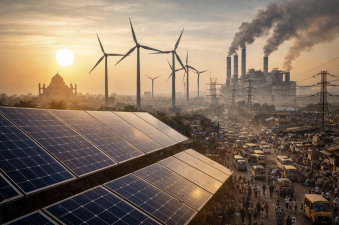
India’s energy sector is at a critical juncture in 2026. Demand is rising sharply due to rapid urbanisation, industrial growth and electrification. Despite strong growth in renewable energy, fossil fuels—especially coal—remain dominant. The government aims to expand clean energy capacity while ensuring energy security and economic growth.
Current Energy Mix and Production
Coal continues to be the backbone of India’s energy supply. In the financial year 2024-25, coal accounted for nearly 79 per cent of domestic energy. Domestic coal production increased by 4.98 per cent to over 1,047 million tonnes. Non-coking coal forms about 93.65 per cent of this output. Coal imports declined by 8.1 per cent but crude oil imports rose to 243.22 million tonnes, maintaining a high import dependence of nearly 89 per cent. Natural gas imports also increased by 12.3 per cent.
Renewable Energy Expansion
India’s renewable energy potential exceeds 4.7 million megawatts (MW). Solar energy contributes about 71 per cent and wind about 25 per cent of this capacity. Electricity generation from renewables more than doubled over the last decade, growing at over 9 per cent annually. Despite rapid expansion, fossil fuels still supply over 96 per cent of total primary energy. The transition to cleaner sources remains uneven and challenging.
Rising Energy Demand Across Sectors
Total Primary Energy Supply grew nearly 3 per cent in 2024-25. Since 2016, final energy consumption increased by around 30 per cent. The residential sector showed the fastest growth, followed by commercial and transport. Renewable electricity generation reached 4.1 million gigawatt hours (GWh) in 2024-25, up from 1.9 million GWh in 2015. Transmission losses fell to 17.52 per cent. Future demand from electric vehicles, cooling and digital infrastructure will require grid upgrades and storage solutions.
Energy Security and Climate Goals
Energy import dependence poses risks due to global price volatility. Coal imports dropped, but crude oil and natural gas imports rose. The government targets 500 GW of non-fossil fuel capacity by 2030 and net-zero emissions by 2070. Financial investments in renewables have increased six-fold in five years. Balancing fossil fuel use with renewable growth is key to India’s energy future and climate commitments.
Topics for Prelims:
Coal in India’s Energy Sector
- Coal accounts for 79% of India’s domestic energy supply (FY25).
- Domestic coal production rose to 1,047 million tonnes in FY25.
- Non-coking coal makes up 93.65% of coal output.
- Coal imports declined by 8.1% to 241.71 million tonnes.
- Coal remains central despite renewable energy growth.
Renewable Energy Growth
- Renewable energy potential exceeds 4.7 million MW.
- Solar energy contributes 71% of renewable capacity.
- Wind energy accounts for 25% of renewable capacity.
- Renewable electricity generation doubled in the last decade.
- Renewables still supply less than 4% of total primary energy.
Energy Demand and Consumption
- Total Primary Energy Supply grew 3% in FY25.
- Final energy consumption rose 30% since FY16.
- Residential sector shows fastest energy demand growth.
- Renewable electricity generation reached 4.1 million GWh in FY25.
- Transmission losses reduced to 17.52%.
Questions for Mains:
- Discuss the challenges and opportunities in India’s transition from coal-based energy to renewable energy sources. [GS-III-Economic Development]
- Critically examine the impact of rising energy demand on India’s infrastructure and climate commitments. [GS-III-Environment & DM]
- Explain the role of energy import dependence in shaping India’s foreign policy and economic security. Discuss with examples. [GS-II-International Relations]
- With suitable examples, discuss the significance of grid modernisation and energy storage in integrating renewable energy into India’s power system. Comment on policy measures supporting this transition. [GS-III-Science & Technology]
Answer Hints:
1. Discuss the challenges and opportunities in India’s transition from coal-based energy to renewable energy sources. [GS-III-Economic Development]
- Coal accounts for nearly 79% of India’s energy supply, indicating deep structural reliance on fossil fuels.
- Challenges include infrastructure inertia, stranded assets, and uneven transition pace despite rapid renewable growth.
- Renewable energy potential exceeds 4.7 million MW, with solar (71%) and wind (25%) as key sectors.
- Falling technology costs, policy support, and private investment drive renewable expansion.
- Opportunities lie in job creation, energy security, reduced pollution, and alignment with climate goals.
- Balancing energy security and economic growth while reducing import dependence is critical.
2. Critically examine the impact of rising energy demand on India’s infrastructure and climate commitments. [GS-III-Environment & DM]
- Total Primary Energy Supply grew by 3% in FY25; final consumption increased 30% since 2016, driven by residential, commercial, and transport sectors.
- Rising demand stresses existing infrastructure, requiring grid modernisation and enhanced transmission to reduce losses (currently 17.52%).
- Increased demand from electric mobility, cooling, and digital infrastructure necessitates storage solutions and capacity expansion.
- Continued coal dominance (79%) challenges climate targets; fossil fuels still provide over 96% of energy supply.
- Meeting energy needs while reducing emissions demands accelerated renewable integration and energy efficiency measures.
- Failure to upgrade infrastructure risks energy insecurity and undermines India’s net-zero by 2070 pledge.
3. Explain the role of energy import dependence in shaping India’s foreign policy and economic security. Discuss with examples. [GS-II-International Relations]
- India’s crude oil import dependence is high at nearly 89%, exposing it to global price volatility and supply risks.
- Natural gas imports rose by 12.3%, while coal imports declined, showing shifting import patterns.
- Energy import dependence influences diplomatic engagements with oil and gas exporting countries (e.g., Middle East, Russia).
- Securing stable energy supplies drives strategic partnerships, diversification of sources, and investments in energy corridors.
- Import dependence impacts economic security by affecting inflation, trade deficit, and currency stability.
- Domestic renewable energy expansion aims to reduce import reliance and enhance strategic autonomy.
4. With suitable examples, discuss the significance of grid modernisation and energy storage in integrating renewable energy into India’s power system. Comment on policy measures supporting this transition. [GS-III-Science & Technology]
- Renewable electricity generation doubled in last decade, reaching 4.1 million GWh in FY25, requiring grid flexibility and stability.
- Grid modernisation reduces transmission losses (currently 17.52%) and manages variable renewable output effectively.
- Energy storage solutions (batteries, pumped hydro) are critical for balancing supply-demand and ensuring reliability.
- Government targets 500 GW non-fossil fuel capacity by 2030, emphasizing smart grids and storage integration.
- Policy measures include financial incentives, credit expansion to renewables (six-fold increase in 5 years), and R&D support.
- Examples – Smart grid pilots, battery storage projects, and renewable energy forecasting tools enhance integration.