
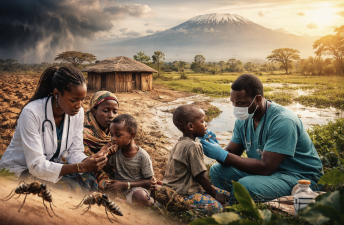
Recent reports show how climate change is reshaping disease outbreaks in Tanzania. Unseasonal heavy rains and floods have led to rising cases of respiratory infections, dengue fever, malaria and cholera. These changes are linked to shifting weather patterns, warmer temperatures and increased humidity. The health system faces new challenges as diseases spread to new areas and intensify unpredictably.
Changing Weather and Health Risks
Tanzania’s rainy season brings both benefits and hazards. Heavy rains cause floods that submerge villages, contaminate water and create mosquito breeding grounds. High humidity helps viruses like influenza and COVID-19 survive longer, increasing respiratory infections. Floods force crowded shelter living, accelerating disease spread. Seasonal disease outbreaks are now less predictable and more severe.
Vector-Borne Diseases and Mosquito Spread
Mosquito-borne diseases such as dengue and malaria are rising. The Aedes mosquito, which transmits dengue, thrives in urban areas with stagnant water in containers and blocked drains. Malaria is spreading to highland areas previously too cool for mosquitoes. Changing rainfall patterns create breeding sites during floods and droughts alike, sustaining mosquito populations year-round.
Public Health Challenges and Community Response
Diagnosis is difficult as dengue symptoms resemble malaria. Public knowledge about mosquito behaviour remains limited, especially the daytime biting of Aedes mosquitoes. Health officials stress the need for community vigilance and awareness to control disease spread. Tanzania’s health system is adapting to new disease patterns but faces challenges due to unpredictability and overlapping outbreaks.
Shifting Disease Geography Due To Climate
Rising temperatures allow mosquitoes to survive longer and expand into new regions. Highland areas in Kilimanjaro, Arusha and Southern Highlands now report malaria outbreaks. Erratic rainfall causes floods and droughts, both increasing mosquito breeding. Climate change thus alters the geography and timing of infectious diseases, requiring dynamic health strategies.
Topics for Prelims:
Aedes Mosquito
- Daytime biting mosquito with white markings.
- Transmits dengue fever virus.
- Thrives in urban stagnant water containers.
- Dengue symptoms include high fever and joint pain.
- Difficult to distinguish from malaria without testing.
Kilombero Valley Floods
- Located in Ifakara district, Tanzania.
- Floodplain of Kilombero River in Rufiji basin.
- Seasonal floods submerge low-lying settlements.
- Floodwaters contaminate water sources.
- Increase risk of respiratory and vector-borne diseases.
Respiratory Infections in Tanzania
- Include influenza and COVID-19 viruses.
- Spread via droplets from coughs and sneezes.
- Increase during wet and humid seasons.
- Symptoms – fever, cough, headache, fatigue.
- Worsened by crowded, poorly ventilated homes.
Questions for Mains:
- Critically discuss how climate change influences the epidemiology of vector-borne diseases like malaria and dengue in East Africa. [GS-III-Environment & DM]
- Examine the role of community awareness and public health infrastructure in managing seasonal infectious disease outbreaks in developing countries. [GS-II-Governance]
- Analyse the impact of changing rainfall patterns on water-borne and vector-borne diseases and suggest adaptive strategies for health systems. [GS-III-Economic Development]
- Estimate the challenges posed by expanding disease geographies due to climate change and discuss policy measures for highland regions in Tanzania. [GS-II-Constitution of India & Polity]
Answer Hints:
1. Critically discuss how climate change influences the epidemiology of vector-borne diseases like malaria and dengue in East Africa. [GS-III-Environment & DM]
- Rising temperatures extend mosquito lifespan and accelerate reproduction, increasing vector populations.
- Changing rainfall patterns create more breeding sites – floods cause stagnant water pools, droughts lead to water storage containers.
- Dengue (Aedes mosquito) is spreading in urban areas due to water-filled containers and blocked drains.
- Malaria is expanding into previously cooler highland regions (Kilimanjaro, Arusha) due to warming climate.
- Unpredictable seasonal outbreaks and shifting geographical zones complicate disease control efforts.
- Climate change alters vector ecology, increasing disease intensity and frequency, demanding adaptive surveillance and response.
2. Examine the role of community awareness and public health infrastructure in managing seasonal infectious disease outbreaks in developing countries. [GS-II-Governance]
- Community awareness is crucial for prevention – understanding mosquito behavior (e.g., Aedes bites during day) and hygiene practices.
- Public health infrastructure enables timely diagnosis, treatment, and outbreak surveillance, reducing morbidity and mortality.
- Crowded living conditions during floods increase transmission; community vigilance can reduce spread through sanitation and ventilation improvements.
- Limited laboratory capacity complicates differentiation between diseases like dengue and malaria, impacting treatment accuracy.
- Health education campaigns empower communities to eliminate breeding sites and seek early medical care.
- Strong governance and resource allocation improve outbreak preparedness and response in resource-constrained settings.
3. Analyse the impact of changing rainfall patterns on water-borne and vector-borne diseases and suggest adaptive strategies for health systems. [GS-III-Economic Development]
- Erratic rainfall causes floods contaminating water sources, increasing water-borne diseases like cholera.
- Floods and droughts both create mosquito breeding grounds, sustaining vector-borne diseases year-round.
- Health systems face unpredictable outbreaks, requiring flexible surveillance and rapid response mechanisms.
- Adaptive strategies include improving water sanitation, vector control, and infrastructure to manage floodwaters.
- Community engagement and health education reduce exposure and transmission risks.
- Integrating climate data with health planning enhances early warning systems and resource allocation.
4. Estimate the challenges posed by expanding disease geographies due to climate change and discuss policy measures for highland regions in Tanzania. [GS-II-Constitution of India & Polity]
- Highland areas previously free from malaria now report outbreaks, stressing local health systems unprepared for vector-borne diseases.
- Lack of immunity in new populations increases vulnerability and severity of outbreaks.
- Infrastructure gaps and limited health workforce in highlands hinder effective disease management.
- Policy measures should include expanding surveillance, vector control programs, and health education in emerging risk zones.
- Intersectoral coordination (health, environment, meteorology) is needed for dynamic risk assessment and response.
- Decentralized health planning and resource allocation empower local authorities to address climate-driven health challenges.