
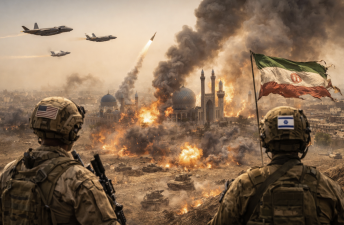
Recent developments in 2026 saw the US and Israel launch a preemptive war against Iran, codenamed Operation Epic Fury and Roaring Lion. This military action aimed to eliminate perceived existential threats from Iran by targeting its leadership and infrastructure. The conflict has caused widespread regional instability and global economic repercussions, particularly affecting energy markets and international trade routes.
Background and Objectives of the War
The US-Israel operation sought to disrupt Iran’s military capabilities by assassinating Supreme Leader Ayatollah Ali Khamenei and bombing key Iranian cities. The goals included weakening Iran’s drone supply to Russia, protecting the petro-dollar system, and reducing China’s oil access from Iran and Venezuela. The operation aimed to shift the power balance in West Asia and free US focus for Indo-Pacific strategies.
Iran’s Response and Regional Escalation
Iran responded asymmetrically, targeting military bases, energy infrastructure, and transport hubs in the Gulf monarchies. Tehran activated the Axis of Resistance and decentralised power to safeguard its institutions. The conflict has led to the effective closure of the Strait of Hormuz, a vital oil transit chokepoint, escalating tensions and disrupting maritime trade.
Global Economic and Strategic Consequences
The war has triggered cancellations of war risk insurance for vessels in West Asia, threatening to halt shipping and increase costs. India faces challenges as over half its oil and gas imports come from West Asia, primarily via the Strait of Hormuz. Rising crude prices will increase India’s import bill, inflation, and reduce growth. Trade disruptions with Gulf countries and remittance declines from millions of Indian expatriates further strain India’s economy.
India’s Foreign Policy and Strategic Stakes
India’s current government’s alignment with Israel and tacit approval of the war risks alienating Iran, a long-term strategic partner. Iran’s support has been crucial for India’s energy security and regional influence, including countering Pakistan’s alliances. India’s failure to adopt a balanced diplomatic approach undermines its leadership in the Global South and compromises national interests.
Topics for Prelims:
Operation Epic Fury and Roaring Lion
- US-Israel joint preemptive military campaign against Iran in 2026.
- Assassination of Iran’s Supreme Leader Ayatollah Ali Khamenei.
- Bombing of 131 Iranian cities targeting military and economic infrastructure.
- Objectives – disrupt Iran’s drone supply to Russia and preserve petro-dollar dominance.
- Triggered regional escalation and closure of Strait of Hormuz.
Iran’s Strategic Response
- Adopted asymmetric warfare and decentralised leadership.
- Activated Axis of Resistance to widen battlefield beyond Iran.
- Struck Gulf monarchies’ military and economic targets.
- Closure of crucial maritime chokepoint, Strait of Hormuz.
- Operation True Promise 4 as a prolonged attrition conflict.
Impact on India’s Economy and Foreign Policy
- India depends on West Asia for over 50% of oil and gas imports.
- Rising crude prices increase import bill and inflation in India.
- Trade disruptions with Gulf countries worth $178.7 billion.
- Over 9 million Indians in West Asia remit $40 billion annually.
- India’s strategic ties with Iran weakened by government’s Israel alignment.
Questions for Mains:
- Critically analyse the strategic objectives of the US-Israel preemptive war on Iran and its implications for global power dynamics. [GS-II-International Relations]
- Comment on the impact of West Asia conflicts on India’s energy security and economic stability, with suitable examples. [GS-III-Economic Development]
- Explain the role of maritime chokepoints like the Strait of Hormuz in global trade and security, and assess the consequences of their disruption. [GS-I-World & Physical Geography]
- With reference to India’s foreign policy, underline the challenges and opportunities in balancing relations with conflicting West Asian powers. [GS-II-Constitution of India & Polity]
Answer Hints:
1. Critically analyse the strategic objectives of the US-Israel preemptive war on Iran and its implications for global power dynamics. [GS-II-International Relations]
- Objective to eliminate Iran’s existential threat by assassinating Supreme Leader Khamenei and bombing key infrastructure.
- Disrupt Iran’s drone supply to Russia, affecting Ukraine conflict dynamics.
- Redraw West Asia power balance to free US strategic bandwidth for Indo-Pacific focus.
- Protect petro-dollar hegemony by undermining Iran and Venezuela’s non-dollar oil trade.
- Attempt to weaken China’s oil lifelines from Iran and Venezuela, despite China’s large oil reserves.
- Triggered regional escalation, closure of Strait of Hormuz, and activation of Iran’s asymmetric and proxy warfare (Axis of Resistance).
2. Comment on the impact of West Asia conflicts on India’s energy security and economic stability, with suitable examples. [GS-III-Economic Development]
- India imports over 50% of its crude oil, LNG, and 90% of LPG from West Asia, mostly via Strait of Hormuz.
- Rising crude prices increase India’s import bill by $13-14 billion per $10 rise, raising inflation and reducing GDP growth.
- Trade disruptions with Gulf countries ($178.7 billion total trade) affect sectors like fertiliser (LNG from Qatar) and cooking gas supply.
- Over 9 million Indians in West Asia remit $40 billion annually, crucial for India’s GDP and consumption; conflict threatens remittances.
- India’s reduced Russian oil imports increase dependence on Gulf and US-controlled Venezuela, raising vulnerability.
- Potential RBI interest rate hikes to combat inflation may suppress private investment and economic growth.
3. Explain the role of maritime chokepoints like the Strait of Hormuz in global trade and security, and assess the consequences of their disruption. [GS-I-World & Physical Geography]
- Strait of Hormuz is a critical chokepoint for 20-30% of global oil trade, connecting Persian Gulf to global markets.
- Closure or disruption leads to global energy supply shocks, price volatility, and economic instability worldwide.
- War risk insurance cancellations by major insurers threaten maritime shipping viability in West Asia.
- Disrupted shipping raises freight premiums, delays supply chains, and impacts global trade flows.
- Regional conflicts near chokepoints escalate geopolitical tensions and invite military deployments.
- For India, disruption threatens over half its energy imports, impacting inflation, growth, and strategic autonomy.
4. With reference to India’s foreign policy, underline the challenges and opportunities in balancing relations with conflicting West Asian powers. [GS-II-Constitution of India & Polity]
- India’s strategic partnership with Israel coexists with long-term energy and regional ties with Iran.
- Aligning overtly with Israel risks alienating Iran, weakening India’s counterbalance to Pakistan and influence in Central Asia.
- India’s failure to de-escalate tensions undermines its leadership role in the Global South and multilateral diplomacy.
- Iran supports India via discounted oil, strategic access (Chabahar port), and countering Pakistan’s alliances.
- Balancing requires principled diplomacy respecting sovereignty, non-interference, and multilateral engagement.
- Opportunities exist to mediate, promote regional stability, and protect diaspora interests amid conflicts.