
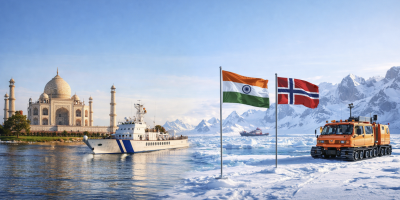
India’s growing interest in the Arctic region reflects new geopolitical and economic realities. The Arctic’s rich mineral and hydrocarbon resources have attracted global attention. India seeks to balance its ties with Russia and the US while exploring opportunities in this emerging strategic zone.
India-Russia Arctic Relations
India values Russia’s Arctic resources, especially hydrocarbons. While India does not prioritise Arctic minerals, it relies on Russia for coal, metals, and ores via established routes like Vladivostok-Chennai. India may seek stakes in Russian Arctic projects similar to China’s involvement in NOVATEK. Cooperation could extend to shipbuilding, transport, and cargo insurance despite sanctions on Russia. India’s superior logistics performance can support Arctic trade growth.
Strategic Shipping and Energy Security
The Northern Sea Route (NSR) offers India an alternative to the Suez Canal for importing Russian energy and minerals. Instability in the Red Sea region makes NSR attractive. India’s Arctic shipping volume is lower than East Asian countries but holds potential for growth. The US views growing Sino-Russian Arctic cooperation as a strategic challenge, influencing India’s Arctic engagement.
Energy Crisis and New Partnerships
Middle East tensions have pushed Asian countries to diversify energy sources. Vietnam secured LNG supplies from Russia’s NOVATEK after rising fuel prices. South Korea began buying Russian oil with US approval on payment security. India and Russia resumed talks on direct LNG exports, potentially expanding India’s energy sources. However, new agreements may have less favourable terms than past contracts.
Trade and Investment Opportunities
India and the Eurasian Economic Union are advancing free trade zone talks to ease business barriers. Russia’s International Advanced Development Zones in the Far East invite foreign investment. China is already interested; India could lead projects in pharmaceuticals, high-tech, agriculture, and minerals. Successful cooperation depends on Indian entrepreneurial initiative and geopolitical balancing.
Topics for Prelims:
Arctic Region
- Located around the North Pole, includes parts of Russia, Canada, USA, Norway, and others.
- Rich in minerals, hydrocarbons, and fisheries.
- Climate change is opening new shipping routes like the Northern Sea Route (NSR).
- Governed by international agreements including the Arctic Council.
- Strategic importance rising due to resource competition and geopolitical interests.
India-Russia Economic Ties
- Long-standing partnership in defence, energy, and trade.
- Russia supplies coal, metals, and hydrocarbons to India.
- Joint projects in LNG and infrastructure are under discussion.
- India uses Vladivostok-Chennai corridor for resource transport.
- Geopolitical factors influence cooperation amid Western sanctions on Russia.
Northern Sea Route (NSR)
- Shipping lane along Russia’s Arctic coast connecting Europe and Asia.
- Reduces shipping time compared to Suez Canal route.
- Climate change is increasing navigability during summer months.
- Used mainly by Russia and China; India is exploring potential use.
- Geopolitical tensions affect security and commercial viability.
Questions for Mains:
- Critically analyse the strategic significance of the Arctic region for India’s energy security and international relations. [GS-II-International Relations]
- With suitable examples, estimate the impact of emerging Arctic shipping routes on global trade and India’s maritime logistics. [GS-III-Economic Development]
- Point out the challenges and opportunities in India-Russia economic cooperation under the current geopolitical scenario, especially in the energy sector. [GS-II-Governance]
- Underlining the role of climate change, discuss how new maritime routes like the Northern Sea Route can alter the geopolitical landscape in the Arctic. [GS-I-World & Physical Geography]
Answer Hints:
1. Critically analyse the strategic significance of the Arctic region for India’s energy security and international relations. [GS-II-International Relations]
- Arctic’s vast hydrocarbon and mineral resources as alternative energy sources for India’s growing demand.
- India’s reliance on Russian Arctic resources and potential LNG imports to diversify energy supply.
- Geopolitical balancing act – India’s ties with Russia vs. strategic partnership with the US amid Arctic cooperation.
- NSR as a strategic shipping route reducing dependency on unstable Middle East and Suez Canal routes.
- Potential for India’s economic collaboration in Arctic projects (shipbuilding, infrastructure, cargo insurance) despite sanctions on Russia.
- Arctic engagement enhances India’s global strategic footprint and energy security resilience.
2. With suitable examples, estimate the impact of emerging Arctic shipping routes on global trade and India’s maritime logistics. [GS-III-Economic Development]
- Northern Sea Route (NSR) shortens Europe-Asia shipping time compared to Suez Canal, reducing costs and transit time.
- India’s current limited Arctic shipping volume but potential to develop NSR-linked transshipment via Chinese ports.
- NSR offers alternative route amid geopolitical instability in Red Sea (Bab el-Mandeb, Suez Canal disruptions).
- India’s superior logistics and transport infrastructure can optimize Arctic trade efficiency.
- Emerging Arctic routes can diversify India’s supply chains for energy, minerals, and fertilizers from Russia.
- Geopolitical factors (US concerns over Sino-Russian cooperation) may influence India’s maritime logistics strategy.
3. Point out the challenges and opportunities in India-Russia economic cooperation under the current geopolitical scenario, especially in the energy sector. [GS-II-Governance]
- Challenges – Western sanctions on Russia affecting joint ventures, trade barriers, and financing (e.g., FESCO Group sanctions).
- Geopolitical pressure from the US and allied countries influencing India’s Indo-Russian Arctic cooperation.
- Opportunities – Resumption of direct LNG talks between India and Russia, potential investments in Indian LNG infrastructure.
- India’s established resource procurement routes (Vladivostok-Chennai) and growing interest in Russian Arctic projects.
- Scope for expanded cooperation in shipbuilding, transport, and cargo insurance despite sanctions.
- Free trade zone talks between India and Eurasian Economic Union enhancing trade facilitation and investment climate.
4. Underlining the role of climate change, discuss how new maritime routes like the Northern Sea Route can alter the geopolitical landscape in the Arctic. [GS-I-World & Physical Geography]
- Climate change reduces Arctic ice, increasing navigability of NSR during summer months.
- NSR shortens Eurasian shipping routes, challenging traditional routes like Suez Canal and Panama Canal.
- Enhanced access to Arctic mineral and hydrocarbon resources intensifies geopolitical competition among Arctic and global powers.
- Growing Sino-Russian cooperation in Arctic infrastructure and maritime patrols challenges US strategic interests.
- New shipping lanes increase strategic importance of Arctic nations and non-Arctic stakeholders (India, China, Vietnam).
- Climate change-driven Arctic accessibility reshapes global trade patterns, security dynamics, and environmental concerns.