
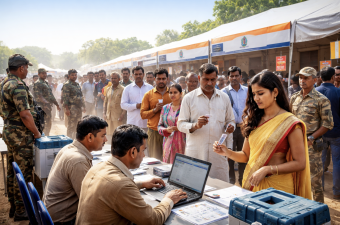
The Election Commission of India (ECI) has approved thousands of auxiliary polling booths for the 2026 Legislative Assembly elections in West Bengal, Tamil Nadu, Kerala, Assam, and Puducherry. This initiative aims to reduce congestion at busy polling stations and ensure voters face minimal wait times. By limiting each booth to a maximum of 1,200 electors, the ECI is emphasizing voter comfort and efficient election management.
The Mechanics of Auxiliary Booths and Rationalization
The 2026 elections focus on the “Rationalization of Polling Stations.” When voter numbers exceed 1,200 in a location, an auxiliary booth is set up nearby, often within the same premises.
- Targeted Urban Intervention: Over 4,600 auxiliary booths in West Bengal alone are placed in high-rise apartments, group housing societies, and urban slum clusters, tackling urban voter disengagement by bringing polling stations closer to voters.
- Infrastructure Standards (AMF): These booths meet Assured Minimum Facilities, including permanent ramps with a 1:12 gradient for accessibility, drinking water, shaded waiting areas, and benches for elderly and PwD voters.
- Technological Integration: The new ECINET 2026 platform offers a one-stop interface for voters to locate their auxiliary booth, simplifying navigation when multiple booths exist in one location.
Strengthening the Democratic Process
Auxiliary booths are more than logistical fixes; they represent a structural reform to deepen democracy.
- Inclusivity and the ‘No Voter Left Behind’ Goal: By reducing barriers, the ECI aims for 100% voter turnout. The proximity of booths especially benefits voters aged 85+ and Persons with Disabilities (PwDs), who also have access to home-voting via Form 12D in 2026.
- Security and Order: Splitting large crowds into smaller groups helps Booth Level Officers (BLOs) and security forces maintain order and prevent crowd-related issues or health emergencies during the April–May polls.
- Electoral Roll Fidelity: The auxiliary booth rollout follows the Special Intensive Revision (SIR) of electoral rolls, ensuring booths are created based on accurate, updated voter data without deceased or relocated electors.
Implications for the Global Democratic Architecture
India’s 2026 election management offers a model for large democracies worldwide.
- The Delhi Declaration 2026: At the India International Conference on Democracy and Election Management, India presented its auxiliary booth model as a best practice for countries facing high population density and logistical challenges.
- Digital Democracy: Mobile voter assistance tools like the cVIGIL app for reporting violations and Voter Information Slips with QR codes complement the physical auxiliary booths, creating a hybrid, efficient election system.
The Election Commission’s expansion of auxiliary booths in 2026 marks a shift from merely conducting elections to truly facilitating voters. By prioritizing a seamless voting experience, the ECI strengthens the democratic process’s legitimacy. This reform exemplifies the administrative evolution of democracy, where procedural improvements directly enhance citizens’ fundamental right to vote.
Last Modified: April 4, 2026