
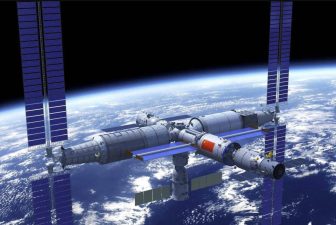
China announced on 22 April 2026 the selection of two Pakistani candidates, Muhammad Zeeshan Ali and Khurram Daud, for astronaut training linked to the Tiangong space station programme. Both candidates serve as pilots in the Pakistan Air Force, and they are scheduled to train at the Astronaut Centre of China in Beijing as reserve astronauts.
Tiangong Space Station
Tiangong is China’s modular space station in low Earth orbit, developed by the China Manned Space Agency (CMSA). The station has been used for crewed missions, scientific experiments, and extravehicular activities since the first module entered orbit in 2021.
Pakistan’s Human Spaceflight Entry
This is Pakistan’s first participation in a human spaceflight programme. The agreement for this cooperation was signed in February 2025 between CMSA and Pakistan’s Space and Upper Atmosphere Research Commission (SUPARCO) in Islamabad, with Prime Minister Shehbaz Sharif present.
Training and Selection Process
- The two Pakistani candidates will undergo intensive training in China before final evaluation.
- One candidate will be selected as a payload specialist after completing training and assessments.
- A payload specialist is a crew member assigned to conduct experiments or operate mission-specific equipment in space.
- The selected astronaut will become the first foreign astronaut to board China’s Tiangong space station.
Planned Mission Profile
The planned mission for the selected Pakistani astronaut is tentatively scheduled for late 2026. The mission includes scientific experiments aboard Tiangong, which is designed for long-duration human spaceflight and microgravity research.
China-Pakistan Space Cooperation
China has described the programme as an international cooperation project on its space station. SUPARCO is Pakistan’s national space agency, and CMSA is China’s state agency for human spaceflight and space station operations.
Last Modified: April 23, 2026