
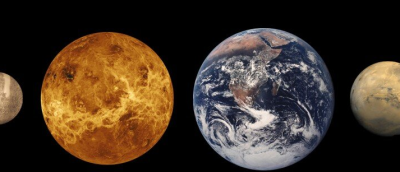
A study published in 2026 by researchers at ETH Zurich reveals that Earth and Mars formed from nearly identical building blocks, drawing on precise isotopic analysis of meteorites originating from Mars and the asteroid Vesta. The research demonstrates that Earth’s composition closely aligns with Mars and Vesta, altering previous models by showing that material from the outer Solar System contributed less than two percent—and potentially zero—to Earth’s mass, down from earlier estimates of up to forty percent. This suggests that the inner and outer Solar System remained largely isolated during planet formation, primarily because Jupiter’s early, rapid growth created a powerful gravitational barrier.
Mechanism of Inner Solar System Formation
The Solar Nebula and Early Segmentation
The Solar System originated approximately 4.6 billion years ago from the collapse of a giant interstellar molecular cloud. As the nebula rotated and flattened into a protoplanetary disk, a temperature gradient developed. The hot inner region closer to the Sun allowed only high-melting-point materials like metals and silicates to condense, leading to the formation of rocky terrestrial planets. The colder outer region, beyond the frost line, permitted the accumulation of volatile gases and ice, giving rise to gas and ice giants.
Jupiter as a Gravitational Barrier
The ETH Zurich study highlights that the mixing of materials between the inner and outer Solar System was strictly limited. As Jupiter grew rapidly in the early stages of the solar nebula, its massive gravitational field cleared a gap in the protoplanetary disk. This gap acted as an effective physical and gravitational barrier, preventing carbonaceous materials from the outer Solar System from migrating inward and mixing with the non-carbonaceous materials of the inner Solar System.
Compositional Predictions for Venus and Mercury
Because the inner Solar System was populated by a homogenous reservoir of material, the study predicts that the unexamined terrestrial planets, Venus and Mercury, share the same isotopic composition as Earth and Mars. This challenges the long-held theory that the terrestrial planets formed from highly diverse mixtures of scattered space debris.
Role of Volatiles and Water Delivery
Endogenous Origin of Volatiles
A major implication of this research concerns the origin of volatile elements, including water, on Earth. Previous theories suggested that Earth formed completely dry and received its water later through heavy bombardments of volatile-rich comets and carbonaceous meteorites from the outer Solar System.
Local Inherent Water
The new isotopic data indicates that volatile elements were already present in the inner Solar System during the active formation phase of the terrestrial planets. Therefore, Earth’s water is largely endogenous, meaning it was inherent to the local building blocks from which the planet originally accreted, rather than being delivered by late-stage outer Solar System arrivals.
Comparative Profiles of Studied Planetary Bodies
The study relied on comparing specific isotopic signatures across distinct celestial bodies in the inner Solar System to map their evolutionary relationships.
| Planetary Body | Classification | Liquid Water Status | Core Isotopic Significance in Study |
| Earth | Terrestrial Planet | Abundant surface liquid water; sustains life. | Baseline for comparison; shows near-zero outer solar system material. |
| Mars | Terrestrial Planet | Evidence of past liquid water; currently frozen or subsurface. | Isotopic signature closely matches Earth, confirming shared local building blocks. |
| Vesta | Main-Belt Asteroid (Protoplanet) | Completely dry; no liquid water. | Serves as an ancient, unaltered relic of the inner Solar System’s original composition. |
IASPOINT Booster Facts for UPSC
Isotopic Analysis and Nucleosynthetic Anomalies
- Isotopic Fingerprinting: Scientists measure stable isotopes of elements like oxygen, chromium, and titanium in meteorites. Because different parts of the early solar nebula had distinct isotopic ratios due to uneven mixing of stellar dust (nucleosynthetic anomalies), these ratios serve as a genetic fingerprint to trace where a space rock formed.
- Non-Carbonaceous (NC) vs. Carbonaceous (CC) Meteorites: Meteorites are broadly split into two reservoirs. NC meteorites represent the inner Solar System (including Earth, Mars, and Vesta), while CC meteorites represent the outer Solar System beyond Jupiter.
Asteroid 4 Vesta
- Characteristics: Vesta is the second-massivest body in the main asteroid belt, located between Mars and Jupiter. It is classified as a protoplanet because it possesses a differentiated interior featuring a crust, mantle, and iron core, similar to terrestrial planets.
- HED Meteorites: Scientists study Vesta using Howardite-Eucrite-Diogenite (HED) meteorites, which fell to Earth after being blasted off Vesta’s surface by ancient collisions.
Planetary Definitions and Criteria
- IAU Criteria: According to the International Astronomical Union (IAU), a celestial body must meet three criteria to be classified as a planet: it must orbit the Sun, possess sufficient mass for its self-gravity to force it into a nearly round shape, and have cleared the neighborhood around its orbit. Mars and Earth satisfy all three, whereas Vesta fails the third criterion.