
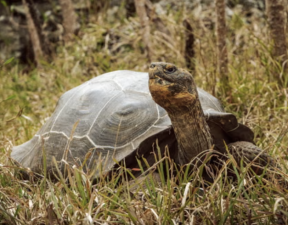
More than 150 giant tortoises have been reintroduced to Floreana Island in Ecuador’s Galapagos archipelago, marking the return of a species that had vanished from the island more than a century ago. The move is part of a long-running rewilding effort aimed at restoring the island’s native ecosystem and reviving ecological functions once performed by the tortoises.
Reintroduction to Floreana
A total of 158 tortoises were carried in crates by park rangers across difficult volcanic terrain before being released on Floreana. The island lies about 1,000 kilometres off Ecuador’s coast and is part of the Galapagos Islands, a UNESCO World Heritage Site known for unique wildlife and its link to Charles Darwin’s theory of evolution.
Ecological Role of Giant Tortoises
Giant tortoises are regarded as ecosystem engineers. They help disperse seeds, regulate vegetation, and support natural habitat regeneration. Their return is expected to aid ecological recovery on Floreana, where the native subspecies Chelonoidis niger niger was driven to extinction in the mid-1800s after invasive mammals were introduced.
Breeding, Quarantine and Identification
The released tortoises came from a breeding centre of the Galapagos National Park. A specialised programme used tortoises with a high genetic load linked to the island’s endemic species, identified on Isabela Island. Before release, each tortoise underwent quarantine and was microchipped for identification.
Floreana Rewilding Programme
Floreana, covering 173 square kilometres, was the first inhabited island in the archipelago. For about a decade, researchers have been working to reintroduce 12 other endemic species to the island as part of a wider conservation and restoration programme. The Galapagos archipelago currently has 13 living species of giant tortoises on other islands.
Last Modified: April 28, 2026