
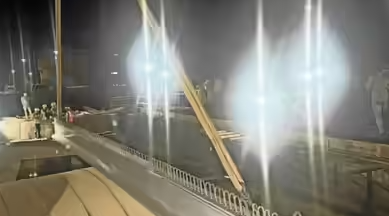
On May 7, 2026, the longest flyover under the Station Area Traffic Improvement Scheme (SATIS) was launched in Kalyan, Maharashtra. Spanning 1,125 meters, the flyover connects Subhash Chandra Bose Chowk to Bailbazar Chowk and aims to decongest the highly congested zones around the Kalyan railway station. Executed by the Smart Kalyan Dombivli Development Corporation Limited (SKDDCL) with structural design vetting from the Indian Institute of Technology Bombay (IIT Bombay), the project employs Malaysian Ultra-High Performance Fibre Reinforced Concrete (UHPFRC) technology. This advanced material enabled engineers to install heavy girders safely over Pandit Jawaharlal Nehru Chowk without halting massive daily pedestrian and vehicular traffic.
Introduction to UHPFRC Technology
Ultra-High Performance Fibre Reinforced Concrete is a new class of concrete developed to address the structural limitations of conventional cement matrices. It incorporates specialized binders, fine aggregates, and high-strength fibers to yield exceptional mechanical properties.
Composition and Material Matrix
Unlike regular concrete, UHPFRC eliminates coarse aggregates entirely. It utilizes an optimized packing design consisting of:
- Portland cement and silica fume.
- Fine quartz sand with particle sizes under 1 mm.
- High-tensile steel fibers or organic polymer fibers (typically 1 to 3% by volume).
- Superplasticizers to reduce water content while retaining high fluid workability.
Core Engineering Properties
- Compressive Strength: It exhibits a compressive strength greater than 150 Megapascals (MPa), compared to 30 to 50 MPa for standard concrete.
- Tensile Ductility: The embedded fibers allow the material to sustain tensile loads even after micro-cracking occurs, avoiding catastrophic brittle failures.
- Impermeability: The dense micro-structure blocks the entry of water, chloride ions, and sulfates, stopping internal steel reinforcement corrosion.
Comparative Structural Analysis
The application of UHPFRC alters infrastructural design parameters by minimizing dead load and maximizing structural life cycles.
| Parameter | Conventional Concrete (M40/M50) | Ultra-High Performance Concrete (UHPC/UHPFRC) |
| Compressive Strength | 40 – 50 MPa | 150 – 250 MPa |
| Tensile Strength | 3 – 5 MPa | 10 – 20 MPa |
| Service Life Durability | 40 – 50 Years | 100+ Years |
| Structural Weight | Heavy due to large cross-sections | Reduced by 50% due to slender profiles |
| Micro-cracking Behavior | Brittle cracking under sustained tension | Pseudo-plastic behavior with micro-crack bridging |
| Chloride Permeability | Moderate to High | Negligible / Extremely Low |
Key Infrastructural Projects and Structural Benefits
The incorporation of Malaysian UHPFRC in the Kalyan SATIS project reflects a broader shift toward using advanced composite materials in Indian public works.
The Mumbai-Pune Missing Link Project
Before its use in Kalyan, this concrete technology was deployed in the Mumbai-Pune Expressway Missing Link project. It was used to construct durable, lightweight precast segments for bridges spanning deep valleys where traditional construction staging was impossible.
Benefits in Dense Urban Construction
- Minimal Traffic Disruption: High early strength allows rapid formwork removal, shortening construction timelines in crowded zones.
- Slender Girder Dimensions: Elevated strength reduces the thickness and weight of girders, allowing longer spans between support pillars.
- Long-Term Economic Savings: The initial high material cost is offset by zero maintenance costs over its century-long operational lifespan.
Station Area Traffic Improvement Scheme (SATIS) Framework
The Kalyan flyover represents a core component of the Station Area Traffic Improvement Scheme, a specialized urban planning model adopted across major Indian transit hubs.
Objectives of SATIS
- Modal Separation: Segregating pedestrian pathways, public bus corridors, auto-rickshaw lanes, and private vehicles into independent vertical or horizontal zones.
- Last-Mile Connectivity: Providing clear transit passages for commuters moving out of high-density railway terminals.
- Pedestrian Prioritization: Building elevated decks, skywalks, and foot overbridges to separate foot traffic from underlying vehicular lanes.
IASPOINT Booster Facts for UPSC
- The Smart Cities Mission connection: SKDDCL, which executed the project, is a Special Purpose Vehicle (SPV) established under the Government of India’s Smart Cities Mission to implement urban renewal projects.
- Rheology of UHPC: The self-compacting nature of UHPFRC is achieved through advanced particle packing theory, which fills almost all microscopic voids within the cement mix.
- Carbon Footprint Dynamics: Although manufacturing UHPFRC requires more cement per cubic meter than standard concrete, its overall environmental impact is lower because structures require half the volume of material and last twice as long.
- First Global Standards: The French Association for Civil Engineering (AFGC) and the US Federal Highway Administration (FHWA) were among the first international bodies to draft structural design recommendations for ultra-high-performance concrete.