
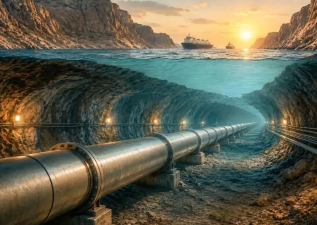
India is accelerating plans to develop the Middle East-India Deep-water Pipeline (MEIDP) to secure a direct, uninterrupted supply of natural gas from the Gulf region. The Ministry of Petroleum and Natural Gas has directed state-run energy enterprises to prepare a detailed feasibility report for this 2,000-kilometre undersea project linking Oman to the Gujarat coast. Estimated to cost approximately ₹40,000 crore ($4.7 to $4.8 billion), the initiative is a response to recent disruptions in the Strait of Hormuz that spiked global spot liquefied natural gas prices and exposed India’s high import vulnerabilities.
Technical Architecture and Project Design
The MEIDP represents a highly ambitious undersea engineering project. It will function as a transnational “Gas Highway,” transferring natural gas directly from production fields in West Asia to heavy industrial hubs along India’s western seaboard.
Physical and Structural Parameters
- Total Length: Around 2,000 kilometres subsea across the Arabian Sea.
- Maximum Operational Depth: The pipeline will descend to depths of up to 3,450 metres below sea level, crossing complex underwater topography like the Murray Ridge.
- Transmission Capacity: Designed to transport 31 million standard cubic metres per day (mmscmd) of natural gas.
- Execution Timeline: Project completion is projected to require five to seven years from the date of formal government clearance.
Institutional Framework and Stakeholders
The project builds upon an early-stage pre-feasibility assessment submitted by the South Asia Gas Enterprise (SAGE), a private sector consortium based in New Delhi. SAGE conducted preliminary technical validation by laying nearly 3,000 metres of test pipeline to assess seabed conditions. For the official detailed feasibility report, the central government has mobilized a consortium of Public Sector Undertakings (PSUs). Each entity holds a distinct responsibility:
| Company Name | Core Operational Mandate in MEIDP |
| Engineers India Limited (EIL) | Conducting the technical and engineering feasibility study for deep-water laying. |
| GAIL (India) Limited | Managing midstream transport integration, pipeline operations, and downstream marketing. |
| Indian Oil Corporation (IOCL) | Participating as a key downstream industrial end-user and joint developer. |
Geopolitical and Strategic Imperatives
The transition of the MEIDP from a theoretical concept to an active national policy priority stems from clear maritime security vulnerabilities.
Bypassing Global Chokepoints
Nearly two-thirds of India’s liquefied natural gas (LNG) imports transit through the Strait of Hormuz, a narrow maritime bottleneck controlled by regional tensions. Maritime blockades and supply chain disruptions in February 2025 demonstrated that physical reliance on tanker shipping routes leaves the Indian economy exposed to sudden supply shocks. By running directly through deep international waters from Oman to Gujarat, the MEIDP eliminates the risk of maritime chokepoints and avoids land-based transit fees or diplomatic friction with neighboring nations.
Diversified Energy Sourcing
The subsea corridor is designed to act as an entry point into a region containing over 2,500 trillion cubic feet of natural gas reserves. Beyond Oman, the infrastructure is structurally positioned to connect India to broader West Asian and Central Asian supply networks through swap contracts and regional linkages. These connections include:
- Qatar
- United Arab Emirates (UAE)
- Saudi Arabia
- Iran
- Turkmenistan
Macroeconomic and Sectoral Impact
India’s domestic natural gas demand stands at approximately 190–195 mmscmd and is projected to reach 290–300 mmscmd by 2030. The MEIDP offers long-term financial insulation against volatile spot energy markets.
Direct Beneficiary Industries
- Fertilizer Production: The fertilizer sector consumes nearly 50 mmscmd of natural gas as a critical primary feedstock for urea manufacturing. Stable pipeline pricing directly reduces central subsidy burdens.
- City Gas Distribution (CGD): Securing 31 mmscmd of continuous gas allows for steady expansion of piped natural gas (PNG) for households and compressed natural gas (CNG) for transport across urban centers.
- Power Generation and Heavy Industry: Provides cleaner, cost-competitive fuel for steel, power plants, and refining complexes, supporting India’s goal to increase the share of natural gas in its primary energy mix from ~6% to 15%.
Bridging the Infrastructure Gap with Global Peers
The pipeline helps address a strategic energy infrastructure gap between India and other major manufacturing economies. A comparative overview highlights the structural necessity for expanded pipeline networks and dedicated reserves:
| Parameter / Metric | India | China |
| Total Gas Pipeline Network | ~16,848 km (Core GAIL Network) | 90,000+ km |
| Natural Gas Share in Energy Mix | ~6% | ~9% (Global Average: 23%+) |
| Strategic Gas Storage Capacity | 2 to 2.5 bcm (~10–12 days of consumption) | Target of 80 bcm by end-2026 (~20% of annual use) |
IASPOINT Booster Facts for UPSC
- Project Nomenclature: The project is formally tracked as the Middle East-India Deep-water Pipeline (MEIDP).
- Nodal Promoting Entity: South Asia Gas Enterprise (SAGE), a joint venture between the New Delhi-based Siddho Mal Group and a UK-based deep-water technology firm, initiated the original route design.
- Technological Milestone: If completed, the pipeline’s 3,450-metre depth will make it one of the deepest offshore transnational pipelines in global maritime history.
- Alternative to Onshore Routes: The project replaces old conceptual land routes like the Iran-Pakistan-India (IPI) and Turkmenistan-Afghanistan-Pakistan-India (TAPI) pipelines, which faced persistent geopolitical gridlock.
- The SAGE Route Landing Point: The planned subsea route originates at the Middle East Compression Station near Oman/UAE and lands at Porbandar, Gujarat.