
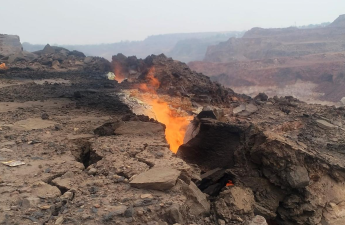
A collaborative study by researchers from the United Kingdom and India—including the CSIR-Central Institute of Mining and Fuel Research (CIMFR)—published in the journal Communications Earth & Environment (May 2026), has uncovered critical insights into the century-old underground fires raging in the Jharia Coalfields of Dhanbad district, Jharkhand. The study reveals that these subsurface blazes burn significantly hotter, cause deeper structural collapses, and release exponentially higher volumes of greenhouse gases (GHGs) than previously estimated by global monitoring frameworks. Mechanics of Subsurface Combustion and Vertical Collapse Underground coal fires initially ignite via spontaneous combustion—a process where historical, open-cast, or unscientific mining practices expose deep coal seams to atmospheric oxygen. This triggers an exothermic (heat-releasing) oxidation reaction that, once self-sustained, can smolder unchecked for decades.
1. The Chimney Effect of Collapse Structures
As underground fire fronts advance, they completely consume the solid coking coal seams, hollow out the subsurface, and destabilize the overlying rock layers (strata). This triggers severe subterranean structural failure, creating massive, localized collapse structures.
- These vertical cavities measure up to 10 meters in diameter and extend over 100 meters vertically to the surface.
- Acting as high-efficiency mechanical chimneys, they draw in fresh oxygen from surface cracks while venting superheated, toxic gases directly into the atmosphere.
2. Extreme Thermal Thresholds
By combining rigorous field observations at the Ena, Bastacolla, and Tisera collieries with advanced computer simulations of heat flow dynamics, researchers discovered that isolated subterranean collapse cavities can reach localized temperatures approaching 4,000°C. This far exceeds conventional thermodynamic assumptions for subsurface coal fires, which typically range between 500°C and 1,000°C.
3. Mineralogical Evidence: “Birianiite”
The existence of these ultra-high temperatures was confirmed by the discovery of unique geological materials formed inside the burning pits:
- Paralava: Overlying rock layers that completely melted under extreme heat and subsequently re-solidified.
- “Birianiite”: A nickname coined by the research team for a newly documented, glass-enveloped, highly heterogeneous fused rock. It reflects a multi-layered, chaotic mixture of diverse geological ingredients cooked under extreme heat, visually mimicking the layered appearance of the popular Indian rice dish, biryani.
Global Warming Potential and Environmental Audit Gaps The primary breakthrough of the study lies in quantifying the climate-altering impact of the Jharia coalfield fires, positioning a localized mining hazard as a global environmental crisis.
- Massive Fugitive Emissions: The study estimates the global warming potential of the fugitive emissions escaping Jharia at up to 748.72 million tonnes of CO2-equivalent (MT CO2-eq) annually. For context, this localized emission rate is nearly double the entire annual territorial greenhouse gas footprint of the United Kingdom.
- The Concept of Fugitive Emissions: Fugitive emissions refer to gases or vapors that escape unpredictably from uncontrolled or unpressurized sources (such as spontaneous mine blazes, open tailings, or structural leaks) rather than an intentional smokestack or exhaust pipe.
- The Global Audit Blindspot: Because these emissions are diffuse, irregular, and hard to quantify via satellite or direct metering, they are seldom captured in official national and global greenhouse gas audits. This omission creates a significant margin of error in international climate models and carbon budget calculations.
Socio-Economic and Local Hazards
| Impact Category | Specific Manifestation in Jharia | Consequence to the Ecosystem & Population |
| Air Quality & Health | Chronic venting of CO2, CO, CH4, and nitrogen oxides (NOx). | Jharia features among India’s most polluted zones; high local incidence of asthma, tuberculosis, and respiratory allergies. |
| Geological Risk | Mining-induced land subsidence and sudden sinkhole formation. | Destruction of surface infrastructure, homes, railway lines, and forced relocation of entire communities. |
| Resource Depletion | Continuous smoldering of prime coking coal seams. | Irreversible destruction of billions of dollars worth of high-grade metallurgical coal needed for domestic steel production. |
IASPOINT Booster Facts for UPSC
- Geographical Profile of Jharia: It is located in the Dhanbad district of Jharkhand within the Damodar River Valley. Covering approximately 280 square kilometers, it holds the largest accumulation of high-grade coking coal in India, with estimated reserves hovering around 19.4 billion tonnes.
- Coking Coal vs. Thermal Coal: Coking (or metallurgical) coal is a high-carbon, low-ash, low-moisture bituminous coal. When heated in the absence of air, it undergoes carbonization to form coke, an indispensable reducing agent used in blast furnaces to convert iron ore into steel. Thermal coal contains higher impurities and is strictly used to generate electricity in thermal power plants.
- Historical Context: Organized mining at Jharia began under British colonial rule in 1894. The first documented underground fire was reported in 1916.
- CSIR-CIMFR: The Central Institute of Mining and Fuel Research is a constituent laboratory under the Council of Scientific and Industrial Research (CSIR). Located in Dhanbad, it provides R&D inputs for safe, sustainable, and eco-friendly mining operations and fuel utilization.
- Advanced Monitoring Modalities: Because direct borehole drilling is dangerous in fire zones, scientists deploy modern remote sensing tools—such as Sentinel-1 Synthetic Aperture Radar (SAR)—combined with ground-based IoT sensor networks to track thermal anomalies and surface deformation in real-time.