
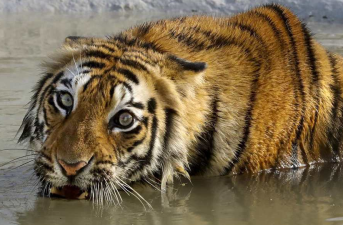
The Union Minister for Environment, Forest and Climate Change officially announced a federal plan to reintroduce Royal Bengal Tigers into the Buxa Tiger Reserve in West Bengal, aiming to establish a stable, breeding resident population after nearly 40 years of local absence. The reintroduction project will follow the strict statutory guidelines of the National Tiger Conservation Authority. To create a viable habitat, administrative preparations include speedier rehabilitation of local forest villages from the core zone and artificial augmentation of the prey base. While the reserve was declared completely tigerless in past national censuses, transient tigers from neighboring states and Bhutan have been tracked in camera traps, verifying the habitat’s long-term ecological connectivity.
Project Architecture and Management Strategy
Source Stock and Translocation Ratio
The conservation program targets the introduction of three to six Royal Bengal Tigers (Panthera tigris tigris) during its initial active phase. To maximize reproductive viability, the release stock will maintain a strict sex ratio of two females to one male. The source individuals will be translocated via specialized transport loops from genetically contiguous populations in neighboring Northeast and Eastern India landscapes:
- Manas National Park (Assam)
- Kaziranga National Park (Assam)
- Valmiki National Park (Bihar)
Habitat Modification and Prey Augmentation
National assessment data showed that low prey abundance was a key constraint within the reserve. The West Bengal Forest Department is implementing targeted adaptive habitat management. This includes the mass introduction of spotted deer (Axis axis) and other wild ungulates to elevate prey density. Forest management is also clearing invasive weeds to encourage the growth of native grasses preferred by herbivores.
Core Area Inviolate Management and Relocation
Under the Wildlife (Protection) Act of 1972, maintaining an undisturbed core area is mandatory for large carnivore reintroductions. Buxa Tiger Reserve contains 37 forest villages, with 15 settlements located entirely inside the critical core habitat. To reduce human-wildlife conflict and biotic pressure, villages are being relocated in phases with comprehensive financial compensation. The villages of Gangutia and Bhutia Busty have completed relocation, while settlements such as Jainti, 28th-29th Mile, Santlabari, and Raimatang are designated as high priority for future rehabilitation.
Geographical and Ecological Profile of Buxa
Territorial Boundaries and Landscape Corridors
Buxa Tiger Reserve is located in the Alipurduar district of West Bengal and spans an area of approximately 760 square kilometers. Established in 1983 as India’s 15th tiger reserve, its geographical positioning creates a vital international wildlife corridor:
- Northern Border: Connects with the international boundary of Bhutan, running contiguous with the Phibsoo Wildlife Sanctuary.
- Eastern Border: Adjoins the interstate boundary of Assam, linking directly with the Kochugaon and Manas forest divisions.
- Migratory Corridors: Functions as a critical landscape link for the seasonal migration of the Asian Elephant (Elephas maximus) and other large mammals moving between the Eastern Himalayas, the North Bengal floodplains, and the Brahmaputra river basin.
Topographic and Vegetative Diversity
The altitude across the reserve drops from 1,750 meters along the northern Sinchula hill range down to 60 meters in the southern Gangetic plains. This rapid elevation change supports multiple forest subtypes classified under the champion and seth system:
| Habitat Zone | Dominant Flora | Ecological Traits |
| Bhabar Tract | Sal (Shorea robusta), Chilauni, Chikrasi | Highly porous boulder-strewn soil; water sinks deep underground. |
| Terai Tract | Tall Savannah Grasslands, Cane brakes | Low-lying, waterlogged alluvial soils with high water tables. |
| Riverine Forests | Khair (Senegalia catechu), Sissoo (Dalbergia sissoo) | Found along high-energy Himalayan torrents like the Jayanti River. |
Conservation Status and Challenges
Historical Sighting Timeline
The reserve has lacked a resident breeding tiger population for decades. The National Tiger Census surveys of 2010, 2014, and 2018 documented zero resident tigers. However, transient animals utilize the transboundary corridor. A camera trap captured a male tiger on December 11, 2021, marking the first visual proof in nearly forty years. Additional transient movements were captured by forest camera traps on January 15 and 16, 2026, confirming that tigers from Bhutan or Assam routinely pass through the northern hilly tracts.
Industrial and Infrastructure Threats
The long-term success of the reintroduction program depends on addressing several ongoing anthropogenic disturbances:
- Dolomite Mining: Historical open-cast dolomite mining in the Jainti hills caused severe slope instability, topsoil erosion, and habitat fragmentation before legal interventions halted major operations.
- Railway Network: The New Jalpaiguri-Alipurduar broad-gauge railway line cuts directly through the southern buffer split of the reserve, causing regular wildlife casualties due to train strikes.
- Commercial Traffic: Heavy commercial vehicles running on the roads connecting India with Bhutan generate persistent acoustic pollution and disrupt the nocturnal movement of carnivores.
IASPOINT Booster Facts for UPSC
- The Buxa Formation: The northern hills of the reserve are part of the famous geological Buxa Formation, which extends into Sikkim. It is renowned for its unique stromatolite-bearing dolomite limestone structures.
- The Historic Buxa Fort: Located at an altitude of 867 meters on the Sinchula range, this fort was used by the British East India Company to detrain freedom fighters. It was later used as a high-security detention camp where Netaji Subhas Chandra Bose was briefly imprisoned.
- Co-Predator Dynamics: Apart from tigers, Buxa protects a diverse array of wild felines, including the Indian Leopard (Panthera pardus), Clouded Leopard (Neofelis nebulosa), Leopard Cat, and the Asian Golden Cat.
- NTCA Translocation Mandate: The National Tiger Conservation Authority requires a pre-feasibility study, an assessment of absolute wild prey base density, and a formal conflict-mitigation plan before approving any large carnivore translocation within India.
- Umbrella Species Concept: The tiger serves as an umbrella species in Buxa. Protecting its large territorial range automatically safeguards lower trophic levels, including rare avian species like the Great Hornbill and the Bengal Florican.