
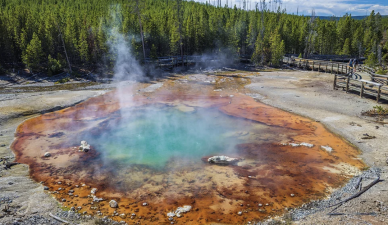
The Echinus Geyser, the world’s largest acidic geyser, has resumed activity in Yellowstone National Park after a long dormant phase. Located in the Norris Geyser Basin, the geyser first erupted on 7 February and then again on 9, 12 and 15 February. Its activity intensified on 16 February, with eruptions occurring every two to five hours. The renewed activity has attracted scientific attention because the geyser had remained inactive since 2020.
Key Features of Echinus Geyser
- Echinus is an acidic geyser formed by a mixture of acidic gases and neutral waters.
- Its eruptions usually last two to three minutes.
- The water column rises about six to 10 metres during each burst.
- After each eruption, the water level drops sharply and takes about an hour to recover.
Scientific Significance
The geyser’s unusual chemistry produces red colours in the surrounding area. These colours are linked to iron, aluminium and arsenic compounds. Unlike some acidic geysers, Echinus is not acidic enough to damage the surrounding rock. Scientists note that its eruption pattern resembles the behaviour seen in late 2017, when it also became active for a limited period before falling silent again.
Location and Naming
Echinus is around 66 feet wide and is surrounded by rocks that resemble sea urchins. The geyser was named after this appearance by mineralogist Albert Charles Peale during a visit in 1878. In the late 20th century, it erupted frequently and was one of the more accessible geysers for visitors in Yellowstone.
Future Eruption Outlook
The US Geological Survey has indicated that continued eruptions are not very likely into the summer. Scientists believe the geyser often wakes for a month or two before returning to dormancy. The recent absence of eruptions suggests that Echinus may already have entered another quiet phase.
Last Modified: April 28, 2026