
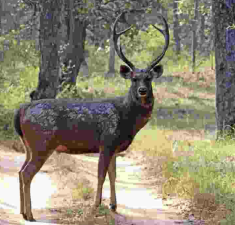
The Wildlife Wing of the Himachal Pradesh Forest Department has recorded sambar deer in high-altitude protected areas of Chamba district for the first time through camera traps. The species, usually linked with lower Shivalik hills and moist deciduous forests, was documented in Kalatop-Khajjiar Wildlife Sanctuary and Gamgul Wildlife Sanctuary. The finding is for Himalayan wildlife studies and has been noted as an indicator of changing species movement in the region.
First High-Altitude Record
Camera traps captured adult and sub-adult male sambar deer visiting a waterhole, mainly during evening and night hours. Kalatop-Khajjiar Wildlife Sanctuary lies at an average elevation of over 2,500 metres, while Gamgul Wildlife Sanctuary exceeds 3,000 metres. This is the first recorded presence of the species in such high-altitude protected habitats in Chamba district.
Ecological Significance
Officials have linked the presence of sambar to dense coniferous forests, perennial water sources and relatively undisturbed habitat. These conditions may be supporting large herbivores at higher elevations. The records may indicate either an undetected resident population or a gradual range expansion towards the higher Himalayas. Ecological connectivity with nearby forest tracts in the Dalhousie Forest Division may also be contributing to movement.
Wildlife Diversity in Chamba
An important feature of the Kalatop-Khajjiar landscape is the recording of three deer species in the same area – sambar deer, musk deer and barking deer. These species usually occupy different habitats. Chamba district has about 985 sq km of protected forest area, including Kalatop-Khajjiar, Kugti, Tundah, Sechu Tuan Nala and Gamgul wildlife sanctuaries, which support diverse Himalayan fauna.
Conservation Importance
Sambar deer is the largest deer species in South Asia and is a key herbivore in forest ecosystems. It also serves as prey for large carnivores such as leopards and tigers. The species is listed as Vulnerable on the IUCN Red List and is protected under Schedule III of the Wildlife (Protection) Act, 1972. Habitat loss, hunting and forest fragmentation have caused population declines in several regions.
Last Modified: April 28, 2026