
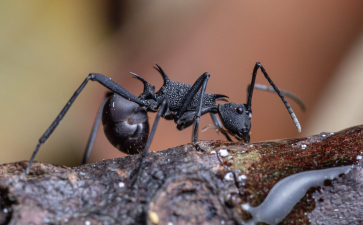
Garbhanga Reserve Forest on the outskirts of Guwahati has yielded a newly identified ant species, underlining the ecological value of urban-adjacent forests. The species, named Polyrhachis garbhangaensis, belongs to the rare mucronata group of spiny ants and was formally described in an international myrmecology journal on 30 January. The discovery adds to India’s known ant diversity and marks Assam as an important centre for Polyrhachis species.
Discovery and Taxonomy
- The ant was first collected during field surveys in August 2023.
- It was found in Garbhanga Reserve Forest, a 117 sq km green corridor linking Guwahati with Rani Reserve Forest.
- The species is only the third member of the mucronata group recorded in India.
- Assam now has 21 recorded Polyrhachis species, showing high regional diversity.
Distinctive Features
- The Assamese Spiny Ant is about 5.6 mm long.
- It has a bright yellow-orange abdomen, unlike many related black species.
- Its curved body spines are likely a defence against predators.
- The species is visually distinctive and scientifically because of its rarity.
Ecological Significance
- The find shows that forest patches near cities can still support undocumented wildlife.
- The research was linked to studies on how urban expansion affects ant and spider communities around Guwahati.
- Scientists also recorded an ant-mimicking spider in the same area.
- The observation suggests mimicry and predator-prey interactions are shaping local forest ecosystems.
Conservation Relevance
- The discovery strengthens the case for protecting peri-urban forests.
- Such green corridors act as habitats, biodiversity refuges, and ecological links between forest blocks.
- It also shows that degraded-looking forest edges may still contain rare and unknown species.
- Conservation of these areas is important for both biodiversity and urban environmental health.