
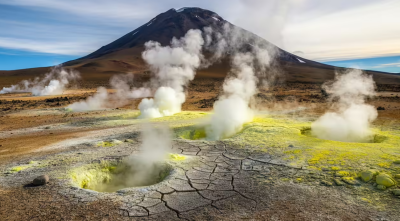
Mount Uturuncu, a 6,008-meter-high dormant stratovolcano in southwestern Bolivia, is drawing renewed attention from volcanologists and geologists. Recent satellite images and ground sensor data indicate ongoing seismic activity, persistent gas emissions, and a unique pattern of surface deformation. Although the volcano has not experienced a complete eruption for approximately 250,000 years, these active subterranean shifts reveal that the volcanic system remains dynamic. The ongoing ground movements make Mount Uturuncu a critical subject for real-time volcanic monitoring, hazard modeling, and risk assessment within the Central Andes region.
Geographical and Geological Framework
Location and Topography
Mount Uturuncu is located in the San Pablo de Lípez Municipality, Sur Lípez Province, within the Potosí Department of southwestern Bolivia. It stands as the tallest peak in southern Bolivia, rising over 1,510 meters above the surrounding Altiplano high plateau. The volcano features two distinct summit peaks situated about 1 kilometer apart, separated by a high saddle. Several high-altitude lakes, including Laguna Celeste and Mama Khumu, are fed by the runoff from its slopes.
Tectonic Setting
The volcano forms part of the Central Volcanic Zone of the Andean Volcanic Belt. This volcanic zone is generated by the eastward subduction of the oceanic Nazca Plate beneath the continental South American Plate. Mount Uturuncu is positioned roughly 100 kilometers east of the main volcanic front.
Altiplano-Puna Volcanic Complex
Uturuncu sits at the center of the Altiplano-Puna Volcanic Complex, a massive volcanic province spanning parts of Bolivia, Chile, and Argentina. This complex is underlain by the Altiplano-Puna Magma Body, which is the largest known partial-melt magma reservoir in the Earth’s continental crust, covering nearly 50,000 square kilometers.
Understanding the Zombie Volcano Status
Definition of a Zombie Volcano
A zombie volcano refers to a volcanic system that exhibits active signs of life, such as ground inflation, earthquakes, and gas release, despite lacking recent historical eruptions or being classified as geologically dead. Mount Uturuncu fits this classification due to its 250,000-year eruptive dormancy combined with its current restless state.
Subsurface Mechanics and Fluid Dynamics
Recent seismic tomography and rock-physics modeling published in the Proceedings of the National Academy of Sciences journal indicate that the current unrest is not driven by an immediate, explosive accumulation of magma near the surface. Instead, the surface activity is caused by a dynamic network of high-pressure hydrothermal fluids and geothermal gases migrating upward through the upper crust. The deeper magma body serves as the primary heat engine, warming these fluids and forcing them into shallow pathways.
Sombrero Topography
Interferometric Synthetic Aperture Radar satellite data shows a large-scale deformation footprint measuring 70 kilometers in diameter. The ground displays a “sombrero” pattern characterized by a central uplift at the main peak at a rate of 1 to 2 centimeters per year, coupled with the subsidence of the surrounding outer slopes. This structural bending resembles the shape of a traditional sombrero hat and is caused by the localized accumulation and expansion of pressurized geothermal gases searching for an exit.
Volcanic Material and Features
Lavas and Inclusions
The volcanic edifice is a complex of lava domes and flows composed primarily of dacite and silicic andesite. Geological field samples show that these lavas contain:
- Norite nodules and crustal xenoliths.
- Secondary rock fragments such as hornfels, sandstones, and limestones from the underlying basement rock.
- Glacial striations and traces of former glaciation on the summit lavas, which confirms the absence of Holocene or recent lava flows.
Active Fumarole Fields
The summit of Mount Uturuncu hosts two active fumarole fields. These vents constantly discharge sulfurous gases. The recorded temperatures of these emissions remain relatively low, measuring below 80°C, which points toward a hydrothermal origin rather than direct magmatic venting.
Comparative Analysis of Andean Volcanic Centers
The following table contextualizes Mount Uturuncu by comparing it with other major volcanic systems within the Altiplano-Puna region.
| Volcanic Center | Location | Type | Status / Key Feature |
| Mount Uturuncu | Bolivia | Stratovolcano | Zombie volcano; 70-km sombrero deformation field driven by hydrothermal fluids. |
| Mount Ojos del Salado | Chile / Argentina | Stratovolcano | Highest active volcano in the world; exhibits active fumarolic activity. |
| La Pacana | Chile | Caldera | Supervolcano system; source of massive ancient ignimbrite eruptions. |
| Llullaillaco | Chile / Argentina | Stratovolcano | High-altitude active volcano; notable for archaeological sanctuary sites at the summit. |
IASPOINT Booster Facts for UPSC
- Altiplano Plateau: The Altiplano high plateau, where Uturuncu is located, is the second-largest high-altitude plateau on Earth, surpassed in dimension only by the Tibetan Plateau.
- Magma Composition: Dacite, the dominant rock type of Uturuncu, is an igneous, volcanic rock intermediate in composition between andesite and rhyolite, often associated with explosive Plinian eruptions.
- InSAR Technology: Interferometric Synthetic Aperture Radar is a remote sensing technique that uses radar images of the Earth’s surface to map ground deformation down to millimeter scales, proving vital for tracking zombie volcanoes.
- Volcanic Explosivity Index: The surrounding calderas of Cerro Guacha and Pastos Grandes have recorded historic supereruptions reaching a Volcanic Explosivity Index of 8, which represents the maximum scale of volcanic devastation.
- Eduardo Avaroa National Reserve: The volcano lies just northeast of the Eduardo Avaroa Andean Fauna National Reserve, a major ecological protection zone in Bolivia known for its hypersaline lakes and flamingo populations.