
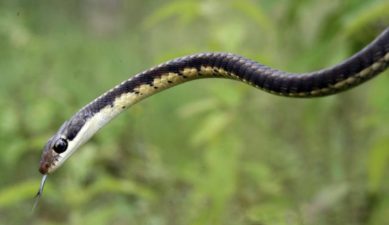
A rare species called the Common Bronzeback Tree Snake was recently spotted in the Belrayan range of Dudhwa Tiger Reserve in the Lakhimpur Kheri district of Uttar Pradesh. The snake was identified by wildlife monitor Nazirun Nisha during a routine bird survey in the grassland-forest mosaic. Forest officials noted that the presence of this arboreal reptile indicates a healthy ecosystem and successful wildlife conservation efforts within the reserve.
Taxonomic and Physical Profile
The Common Bronzeback Tree Snake possesses distinct biological and physical features that help it adapt to its habitat.
- Scientific Name: Dendrelaphis tristis
- Family: Colubridae
- Physical Structure: It has a long, slender body with a pointed head and an elongated flat snout. The head is noticeably broader than the neck, featuring large eyes with rounded pupils.
- Coloration: The dorsal side is grey-brown with a distinct shiny bronze-colored line running straight down its back. The underbody and sides are yellowish-white or pale yellow-orange. A prominent white or yellow spot is located on the top of its head.
- Defense Mechanism: When the snake feels threatened, it inflates its neck to reveal bright blue scales beneath its outer skin.
Habitat, Distribution, and Behavior
The species interacts with its environment through specific behavioral patterns and geographic distribution.
- Geographic Range: It is native to South Asia and parts of Southeast Asia. It is found across India, Sri Lanka, Bangladesh, Nepal, and Bhutan.
- Habitat Preferences: It is a diurnal (active during the day) and fully arboreal species. It populates dry deciduous forests, wet montane forests, semi-evergreen forests, and the Himalayan foothills. It also adapts to human-dominated landscapes like urban parks and rural gardens.
- Dietary Habits: The snake is non-venomous and entirely harmless to humans. It preys primarily on tree-dwelling geckos, garden lizards, frogs, small birds, and insects, balancing the local pest population.
- Reproduction: It is an oviparous (egg-laying) reptile. Females deposit a clutch of 6 to 8 eggs inside tree hollows or rotting vegetation, typically during April and May.
Ecological Context of Dudhwa Tiger Reserve
The discovery adds to the documented herpetological diversity of the Terai region.
Wildlife and Landscape Diversity
Dudhwa Tiger Reserve is located along the Indo-Nepal border in Uttar Pradesh. It comprises three distinct protected areas: Dudhwa National Park, Kishanpur Wildlife Sanctuary, and Katarniaghat Wildlife Sanctuary. The reserve features a dynamic landscape of alluvial plains, marshy grasslands, and moist deciduous Sal (Shorea robusta) forests.
Hydrological Network
The reserve is fed by the Sharda, Geruwa, Suheli, and Mohana rivers, which are tributaries of the Ghaghara River. These water bodies sustain the local oxbow lakes and provide microhabitats for diverse reptile species, including the Mugger crocodile, Gharial, Python, and the recently documented long-snouted vine snake (Ahaetulla longirostris).
Species Status Summary
| Parameter | Details |
| Scientific Name | Dendrelaphis tristis |
| Common Names | Common Bronzeback, Daudin’s Bronzeback, Indian Bronzeback Tree Snake |
| Diet | Non-venomous carnivore (frogs, lizards, birds) |
| Reproductive Mode | Oviparous |
| IUCN Red List Status | Least Concern |
| Recent Sighting Location | Belrayan Range, Dudhwa Tiger Reserve (Uttar Pradesh) |
IASPOINT Booster Facts for UPSC
- The genus Dendrelaphis belongs to the vine snake subfamily Ahaetuliinae, making it a close relative of the flying snakes (Chrysopelea).
- Dudhwa National Park is the only place in Uttar Pradesh that holds a surviving population of the Indian One-horned Rhinoceros, re-introduced under translocation programs.
- The Terai-Bhabar region, where the snake was found, belongs to the Upper Gangetic Plains biogeographic province.
- Unlike the Common Bronzeback which lays eggs (oviparous), the long-snouted vine snake (Ahaetulla longirostris) found in the same reserve is ovoviviparous, meaning it retains eggs inside the body until they are ready to hatch into live young.