
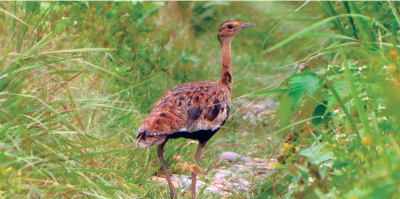
The Bengal florican is a rare bustard of the seasonally inundated alluvial grasslands of the Gangetic-Brahmaputra plains in India and Nepal. It is one of the most distinctive birds of these landscapes, known for the male’s courtship display involving vertical leaps, wing movements and vocalisations. The species survives in small, fragmented populations and is now under severe pressure from habitat loss and land-use change.
Species Profile and Habitat
The Bengal florican inhabits open grasslands dominated by species such as Imperata cylindrica, Saccharum spontaneum, Saccharum bengalense and Desmostachya bipinnata. It depends on grassland mosaics for foraging, display and nesting. The male has black plumage, a crest, elongated display feathers and visible white wing patches in flight. Its lekking behaviour, where males display together to attract females, is a key breeding feature.
Distribution in India and Neighbouring Regions
Major Indian strongholds include:
- Dudhwa National Park in Uttar Pradesh.
- Manas, Kaziranga, Orang and Dibru-Saikhowa National Parks in Assam.
- Grassland fragments such as Bhairabkunda Reserve Forest, Amarpur, Majuli and Sadiya.
- Riverine grasslands in Arunachal Pradesh.
A notable population also survives in the Kokilabari Agriculture Farm near Manas National Park. Outside India and Nepal, the only other surviving population of the second subspecies is found in the Tonle Sap floodplain of Cambodia.
Threats to Survival
The species faces multiple pressures:
- Conversion of grasslands for agriculture.
- Annual burning and fire mismanagement.
- Overgrazing and encroachment.
- River course changes and floodplain alteration.
- Habitat fragmentation from infrastructure development.
- Spread of invasive plant species.
These changes have reduced the open habitat structure needed by the bird.
Conservation Significance and Community Role
The Bengal florican is an indicator of healthy grassland ecosystems and a flagship species for South Asian grassland conservation. Community-led protection has helped reduce hunting and egg collection around Manas and Kokilabari. Joint Forest Management Committees in Bhairabkunda and community reserves in the Dibang valley have also supported local stewardship. Long-term conservation requires landscape-level planning, regulated fire, invasive species control and protection of agricultural margins and floodplain dynamics.
Last Modified: April 28, 2026