
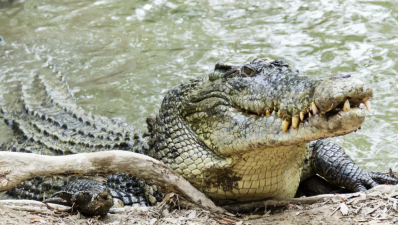
Odisha’s saltwater crocodile population has increased to 1,858, marking a rise of 32 from the previous estimate. The annual census covered river systems and estuarine habitats around Bhitarkanika National Park and Wildlife Sanctuary, Gahirmatha Wildlife Sanctuary, the Mahanadi deltaic area, and the Devi river mouth region. The survey also tested a pilot drone-based method for future population estimation.
Annual Crocodile Census in Odisha
The estimation was conducted from 8 to 10 January 2026 across 54 segments with 24 census teams. Boat-based surveys were carried out during both day and night. Odisha continues to hold India’s largest natural population of saltwater crocodiles, also known as Crocodylus porosus.
Population Breakdown
The count of 1,858 crocodiles included:
- 531 hatchlings
- 442 yearlings
- 365 juveniles
- 167 sub-adults
- 353 adults
Most crocodiles, 1,424, were recorded in the Kanika Wildlife Range. Rajnagar Wildlife Range accounted for 292 crocodiles. The Mahanadi delta in Mahakalpada Range had 99 crocodiles, while Gahirmatha Wildlife Range recorded 43.
Survey Method and Drone Trial
Hatchlings, yearlings and juveniles were mainly counted at night using spotlights. Larger crocodiles were counted during the day. The drone-based pilot survey was conducted in December to assess flight height, timing, transect design, detection rate and animal response. The aim is to standardise drone use in future surveys.
Conservation Significance
The use of drones and cameras is expected to improve accuracy, reduce observer bias and strengthen spatial data on crocodile distribution. Odisha’s long-term conservation efforts have made Bhitarkanika one of the most important saltwater crocodile habitats in Asia.
Last Modified: April 27, 2026