
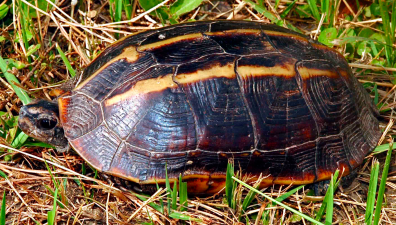
The Udanti Sitanadi Tiger Reserve (UTSR) in Gariaband district, Chhattisgarh, recorded the presence of the rare Himalayan Tricarinate Hill Turtle (Melanochelys tricarinata). Typically restricted to the foothills of the Himalayas, this discovery in central India indicates a healthy, undisturbed forest ecosystem and an intact habitat. Alongside this reptile, field biologists also documented other rare fauna such as the Malabar pied hornbill and the smooth-coated otter. This surge in rare species sightings follows intensified protection protocols, including over 80 anti-poaching operations deployed across the reserve over the past four years.
Taxonomy and Physical Characteristics
The Himalayan Tricarinate Hill Turtle possesses unique morphological traits adapted for a predominantly terrestrial lifestyle.
Distinctive Features
- Carapace Structure: The upper shell (carapace) is elongated, highly arched, and characterized by three distinct, longitudinal ridges or keels. The shell color ranges from dark brown to black.
- Plastron: The lower shell (plastron) is yellow or orange-brown, flat, and lacks a hinge mechanism.
- Facial Markings: The turtle displays a prominent red or orange stripe running from the nostril, past the eye, to the back of the neck, which fades as the animal ages.
- Limbs: Unlike aquatic turtles, its webbed feet are highly reduced. Instead, it has club-like limbs with sharp claws suited for walking on land and digging through leaf litter.
Ecological Niche and Distribution
Understanding the geographical reach and behavioral traits of this reptile reveals its adaptive capabilities across different biomes.
Habitat Preference
The species is primarily terrestrial, rarely entering deep water bodies. It inhabits primary subtropical and tropical deciduous forests, riverine grasslands, and dense bamboo thickets. It spends daytime hours hidden under deep leaf litter, fallen logs, or rock crevices to regulate its body temperature and avoid predators.
Geographic Range
- Primary Range: Historically documented across the Terai arc landscape, spanning the foothill regions of northern India (Uttarakhand, Uttar Pradesh, West Bengal, and Assam), southern Nepal, and parts of Bhutan and Bangladesh.
- New Record: The discovery in the Udanti Sitanadi Tiger Reserve establishes its southern-most distribution limit in central India, suggesting that the species may have contiguous populations through the Eastern Ghats and central highlands.
Conservation Status and Threats
The survival of the Tricarinate Hill Turtle is challenged by environmental degradation and anthropogenic pressures.
| Listing Authority | Protective Status / Classification | Legal / Trade Implications |
| IUCN Red List | Endangered | Reflects a high risk of extinction in the wild due to rapid population decline. |
| Wildlife (Protection) Act, 1972 | Schedule I | Grants the highest level of legal protection in India, mandate strict penalties for hunting or trade. |
| CITES | Appendix I | Completely bans international commercial trade of the species and its body parts. |
Major Survival Threats
- Habitat Fragmentation: Conversion of sub-Himalayan grasslands and deciduous forests into agricultural lands, highways, and human settlements isolates populations.
- Forest Fires: Seasonal surface forest fires destroy the leaf-litter microhabitat, incinerating these slow-moving terrestrial turtles.
- Illegal Wildlife Trade: The species is poached for its unique aesthetic value to supply the illegal exotic pet market in domestic and international circuits.
- Traditional Medicine: Local communities occasionally hunt the turtle for its meat and shell, mistakenly believing it possesses medicinal or aphrodisiac properties.
Udanti Sitanadi Tiger Reserve Profile
The reserve serves as a critical biodiversity node in the central Indian landscape.
Geographical and Ecological Setup
- Location: Situated in the Gariaband district of Chhattisgarh, sharing a border with Odisha. It was formed by combining the Udanti Wildlife Sanctuary and the Sitanadi Wildlife Sanctuary.
- Forest Type: Dominated by Tropical Dry Deciduous and Tropical Moist Deciduous forests. The reserve is famous for its dense stands of Sal (Shorea robusta) and Teak (Tectona grandis) trees.
- Drainage: The Udanti River flows from west to east through the Udanti sanctuary, and the Sitanadi River originates from the Sitanadi sanctuary, eventually feeding the Mahanadi River system.
Key Fauna Co-inhabiting the Reserve
- Wild Water Buffalo (Bubalus arnee): The reserve holds the last surviving pure-bred wild water buffalo population in central India, which is also the state animal of Chhattisgarh.
- Malabar Pied Hornbill (Anthracoceros coronatus): A large canopy bird that relies on old-growth fruit trees, serving as an indicator of a mature forest structure.
- Smooth-Coated Otter (Lutrogale perspicillata): A semi-aquatic mammal requiring clean, unpolluted river corridors, proving the health of the reserve’s perennial water streams.
IASPOINT Booster Facts for UPSC
- Terrestrial vs Aquatics: Unlike most Indian freshwater turtles belonging to the Geoemydidae family that bask on logs in water, the Tricarinate Hill Turtle is completely terrestrial and can drown if trapped in deep, fast-flowing water.
- The Terai Arc Landscape: This is an international transboundary conservation zone stretching across India and Nepal, covering 15 protected areas. It is the historical stronghold of the Tricarinate Hill Turtle.
- Mahanadi Linkage: The rivers draining the Udanti Sitanadi Tiger Reserve flow into the Mahanadi River. This hydrological link explains how aquatic and semi-aquatic species migrate between Central India and the Eastern Ghats of Odisha.
- Anti-Poaching Tech: The 80 operations conducted in UTSR utilized smart patrolling systems like M-STrIPES (Monitoring System for Tigers – Intensive Patrolling and Ecological Status), which uses GPS and remote sensing to map patrol routes and track wildlife encounters in real-time.