
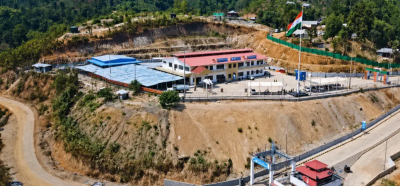
Union Home Minister Amit Shah is set to launch the Land Port Management System (LPMS) in New Delhi on June 9, 2026. Designed as a state-of-the-art digital platform, the system integrates operations across all land ports in the country to establish a unified, technology-driven border management ecosystem. The initiative aims to align land port operations with the digital standards currently functional at Indian airports and seaports. Alongside the platform launch, newly developed stakeholder accommodation facilities will be inaugurated at the Dawki Land Port in Meghalaya and the Srimantapur Land Port in Tripura to strengthen field infrastructure.
Overview of Land Port Management System
The platform serves as a centralized electronic architecture developed under the guidance of the Ministry of Home Affairs. It functions as a neutral, open digital system that automates logistics and regulatory workflows for both cross-border cargo processing and passenger movement. By transitioning from manual paperwork to digital data handling, the system eliminates transit delays, improves administrative transparency, and strengthens border security.
Core Functional Modalities
- End-to-End Digital Workflows: The system digitizes critical processes including advanced slot booking for vehicles, integrated online payment systems, and single-window regulatory clearances.
- Real-Time Logistics Tracking: Stakeholders can monitor the exact status and location of cargo consignments, minimizing cargo dwell time at border terminal yards.
- Resource and Warehouse Management: The system incorporates specialized modules for the optimal allocation of storage yards, weighing scales, and warehouse spaces based on automated traffic forecasts.
National Platform Integrations
To ensure regulatory compliance and operational harmony, the platform is integrated with existing national digital frameworks:
| Integrated National System | Function and Role in Border Management |
| ICEGATE | The Indian Customs Electronic Gateway allows automated filing of shipping bills, bills of entry, and export-import manifests directly from the platform. |
| ULIP | The Unified Logistics Interface Platform harmonizes transport sector data across different ministries, enabling multi-modal cargo monitoring. |
| Motor Vehicle Ecosystem | Integrates commercial transport data, vehicle registration details, and interstate/international transit permits for immediate gate verification. |
Growth Metrics of India’s Land Border Trade
The digital transformation matches a massive escalation in cross-border land operations over the last decade.
Key Statistical Indicators
- Export-Import (EXIM) Value: Trade through land ports expanded from approximately Rs 5,000 crore in fiscal year 2014-15 to Rs 82,800 crore in fiscal year 2024-25.
- Cargo Traffic Volumetrics: The annual movement of cross-border cargo transport units expanded from 1.1 lakh vehicles to 6.69 lakh vehicles over the same ten-year timeline.
- Passenger Movement: Annual international commuter traffic passing through designated land checkpoints climbed from 1.7 lakh individuals to 25.8 lakh individuals.
Institutional Framework: Land Ports Authority of India
The Land Ports Authority of India (LPAI) is the statutory body tasked with creating, maintaining, and managing Integrated Check Posts (ICPs) along India’s land borders. Established under the Land Ports Authority of India Act, 2010, the body functions under the Department of Border Management, Ministry of Home Affairs. LPAI currently operates 15 functional land ports distributed across five international border stretches.
Geographical Distribution of Active Land Ports
- India-Bangladesh Border: Petrapole (West Bengal), Agartala (Tripura), Dawki (Meghalaya), Srimantapur (Tripura), Sutarkandi (Assam), Sabroom (Tripura)
- India-Nepal Border: Raxaul (Bihar), Jogbani (Bihar), Rupaidiha (Uttar Pradesh)
- India-Bhutan Border: Darranga (Assam)
- India-Myanmar Border: Moreh (Manipur)
- India-Pakistan Border: Attari (Punjab), Passenger Terminal Building (PTB) at Dera Baba Nanak (Punjab) for Kartarpur Sahib Corridor
- Inland/Riverine Ports: Mankachar (Assam), Golakganj (Assam)
Strategic Impact on Border Security and Economy
The deployment of the system directly targets security vulnerabilities and transaction inefficiencies. It replaces traditional gate logs with automated records, reducing human error and preventing unauthorized entries. The inclusion of protocols to interface with Full Body Truck Scanners ensures high-throughput scanning without slowing down logistics chains. By eliminating bureaucratic friction, the platform lowers transaction costs for Indian exporters, enhancing regional connectivity with neighboring South Asian and Southeast Asian countries in alignment with the Vision 2047 master plan.
IASPOINT Booster Facts for UPSC
- Statutory Origin: LPAI is not a constitutional body; it is a statutory enterprise created by the Land Ports Authority of India Act, 2010.
- Parent Ministry: LPAI reports directly to the Department of Border Management under the Ministry of Home Affairs, not the Ministry of Ports, Shipping and Waterways or Ministry of Commerce.
- NCTF Mandate: The digitalization of land checkpoints through platforms like LPMS fulfills an explicit policy mandate laid down by the National Committee on Trade Facilitation (NCTF), chaired by the Cabinet Secretary.
- The Kartarpur Exception: The Passenger Terminal Building at Dera Baba Nanak is a specialized land port facility managed by LPAI strictly dedicated to visa-free pilgrim transit, differing from dual-use commercial cargo ports like Petrapole.
- First Integrated Check Post: Attari in Punjab, located along the international boundary line with Pakistan, was the very first Integrated Check Post commissioned in India (2012).