
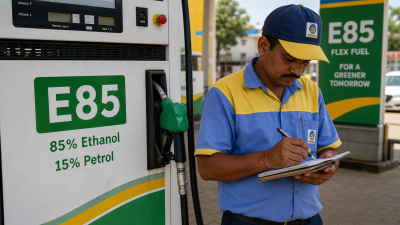
Recent policy action has accelerated India’s move beyond E20. The government authorised E100 use and launched E85 at 48 PSU retail outlets, with plans for 500 stations by December 2026 and 5,000 by 2027. Excise exemption for 22–30% blends was also announced.
What is the immediate issue
India is scaling ethanol blending beyond E20 to E25 and higher blends (E85, E100). The shift requires regulatory authorisation, fuel‑retail rollout, vehicle compatibility and pricing signals to secure consumer uptake and protect the existing vehicle fleet.
Why it matters
- Energy security: reduces crude oil import dependence and foreign exchange outflow (cumulative savings ~₹1.13 lakh crore by June 2026).
- Climate: reported cumulative reduction of ~544 lakh tonnes CO₂ to date.
- Rural economy: creates demand for feedstock and additional income streams for farmers.
- Industrial transition: affects automobile design, fuel infrastructure and refinery operations.
India’s ethanol programme: current status and milestones
- Nationwide E20 achieved five years ahead of schedule.
- Regulatory: formal authorisation given for E100; Central Motor Vehicles Rules amended to recognise E85 and E100 for flex‑fuel vehicles.
- Market rollout: E85 launched at 48 PSU outlets; target 500 outlets by December 2026 and 5,000 by 2027.
- Fiscal: higher blends (22–30%) exempted from central excise duty to align tax treatment with E20.
- Industry response: Maruti Suzuki and Hero MotoCorp have introduced flex‑fuel compatible vehicles; Toyota, Suzuki, MG and Hyundai announced imminent E100‑compatible models.
Policy and regulatory framework
- Fuel standards and vehicle rules updated to recognise multi‑grade ethanol fuels and flex‑fuel vehicles (FFVs).
- Fiscal incentives include excise exemptions for higher blends to reduce retail price gap with petrol.
- Implementation strategy combines PSU retail rollout, manufacturer commitments and planned infrastructure upgrade timelines.
- Reports (KPMG) call for a multi‑grade ethanol ecosystem and policy continuity to attract investment across the value chain.
Economic implications
- Foreign exchange savings and import substitution are immediate fiscal benefits (₹1.13 lakh crore saved cumulatively).
- Consumer economics depend on relative price. Brazil’s empirical “70 per cent rule” suggests ethanol becomes attractive when its price is ≤70% of petrol; current E85 price in Delhi (~₹82.12/litre) is ≈80% of E20 petrol (~₹102/litre), weakening consumer incentive.
- Vehicle costs may rise for buyers of E100/E85‑capable models; older vehicles may suffer reduced mileage (5–12% reported) and performance issues if non‑compliant.
- Feedstock dependence on first‑generation sources constrains price flexibility and raises food‑security and land‑use concerns.
Environmental benefits
- Reduced lifecycle CO₂ emissions relative to fossil petrol; cumulative reduction reported at ~544 lakh tonnes.
- Potential co‑benefits in urban air quality from cleaner burning, depending on blend and engine calibration.
- Net environmental outcome depends on feedstock lifecycle, land‑use change and adoption of second‑generation ethanol technologies.
Technological challenges and automobile industry readiness
- Engine compatibility: higher ethanol shares increase corrosion risk, affect ignition and fuel‑system materials unless engines are designed or adapted (FFVs required).
- Fuel economy: non‑compliant vehicles show 5–12% mileage reduction; calibration and onboard sensors are needed for multi‑grade use.
- Manufacturing response: early FFV models announced by major OEMs, but market penetration remains low relative to the total fleet.
- Standards and testing: need for nationwide certification protocols, warranty norms and consumer protection frameworks to prevent litigation and loss of confidence.
Social and consumer aspects
- Consumer confidence is fragile: a survey reports 43% of prospective buyers may delay or reconsider purchases due to fuel‑blend uncertainty.
- Choice at pump matters. Consumers should be able to select petrol or ethanol based on price and performance—this option supports adoption.
- Two‑wheelers and older vehicles face particular risks; targeted communication and retrofit policies will be necessary.
Infrastructure and supply‑chain requirements
- Retail outlets need separate storage, corrosion‑resistant piping, accurate metering and safety upgrades for higher ethanol blends.
- Logistics: ethanol is hygroscopic and requires secure supply chains and blended distribution planning.
- Scale: planned expansion from 48 to 5,000 E85 outlets in two years requires coordinated capital expenditure by OMCs, state governments and private partners.
- Refining and blending capacity must be aligned with agricultural production and second‑generation scaling plans.
Comparative analysis: Brazil and India
| Dimension | Brazil | India |
|---|---|---|
| Policy horizon | Multi‑decade, progressive mandates and incentives | Rapid recent policy push with recent authorisations and fiscal exemptions |
| Vehicle ecosystem | Widespread FFVs; consumer familiarity | FFVs entering market; fleet penetration limited |
| Price signalling | Ethanol often priced ≤70% of petrol, creating clear consumer incentive | Current E85 ~80% of petrol price in Delhi; weaker incentive |
| Implementation approach | Phased rollout, pump‑level choice, local feedstock supply chains | Ambitious rollout targets for outlets, centralised policy push; feedstock and infrastructure gaps |
Key challenges for transition beyond E20
- Vehicle compatibility across a large existing fleet and two‑wheeler dominance.
- Consumer economics: bridging price gap to meet behavioural thresholds (≈70% rule).
- Feedstock sustainability: reduce first‑generation dependence; scale second‑generation ethanol (agri‑residue, cellulosic routes).
- Rapid infrastructure rollout with safety and quality controls.
- Manufacturer incentives and warranty frameworks to speed FFV adoption.
- Regulatory clarity and predictable, long‑term policy to attract investment.
Way forward: priority actions
| Challenge | Recommended action |
|---|---|
| Consumer price incentive | Use targeted subsidies or tax adjustments so ethanol retail price approaches the 70% parity; monitor regional parity metrics. |
| Fleet readiness | Mandate FFV options in new models; fiscal incentives for FFV purchase; develop retrofit standards for high‑use vehicles. |
| Feedstock security | Accelerate R&D and commercialisation of second‑generation ethanol; diversify feedstock basket and create contracting frameworks for farmers. |
| Infrastructure | Public‑private investment programme for E85/E100 pumps; strict safety and metering standards; phased geographic rollout tied to supply nodes. |
| Technical assurance | Fund engine calibration research, set certification protocols, and define warranty and liability rules for manufacturers and retailers. |
| Public acceptance | Clear consumer information campaigns on costs, mileage expectations and fuel choice at pumps; targeted outreach for two‑wheelers and commercial fleets. |
Model Questions
- Critically examine the economic, environmental and technological implications of India’s shift beyond E20 to higher ethanol blends such as E85 and E100. [GS-III: Environment & DM]
- Analyse the policy initiatives taken by the government to promote higher ethanol‑petrol blends. What governance and implementation challenges must be addressed to meet targets for E85 and E100 rollout? [GS-II: Governance]
- Drawing lessons from Brazil, evaluate strategies India should adopt to overcome challenges in its ethanol fuel transition. What key differences must India address? [GS-III: Economic Development]
- Assess the opportunities and challenges the ethanol transition poses for consumers and the automobile industry, focusing on vehicle compatibility, cost implications and consumer acceptance. [GS-III: Science & Technology]
The shift reduces crude import dependence and has delivered cumulative forex savings (~₹1.13 lakh crore) and CO₂ reductions (~544 lakh tonnes). Technological implications include engine material and calibration needs, possible 5–12% mileage loss for non‑compliant vehicles, and the necessity of FFVs. Environmental outcomes depend on feedstock lifecycle; second‑generation ethanol is essential to avoid land‑use and food‑security pressures. Policy must align pricing, infrastructure and R&D to realise benefits.
Policy measures include legal authorisation for E100, CMVR amendments for E85/E100, excise exemption for 22–30% blends, and an E85 retail rollout plan (48 outlets → 5,000). Governance challenges are ensuring supply‑chain alignment, state coordination for retail upgrades, dynamic pricing to make ethanol attractive, feedstock sustainability, manufacturing and warranty frameworks for FFVs, and regulatory capacity for certification and safety oversight.
Brazil offers long‑term policy, phased implementation, pump‑level consumer choice and widespread FFVs. India should adopt phased regional rollouts, ensure consumer price parity (aim for ~70% rule), mandate pump choice, and incentivise FFVs. Key differences: India’s mixed vehicle fleet, high two‑wheeler share, dependence on first‑generation feedstock and tighter land constraints require faster development of 2G ethanol, tailored incentives for two‑wheelers and robust rural contracting mechanisms.
Opportunities include lower fossil fuel exposure and potential running‑cost savings if ethanol is priced advantageously. Challenges are engine compatibility, material corrosion, ignition tuning, warranty liabilities and higher up‑front costs for FFVs. Consumer acceptance hinges on clear price incentives, reliable mileage data, pump choice and manufacturer guarantees. Industry mitigation includes R&D for multi‑fuel engines, certification standards and coordinated rollout of FFV models with clear consumer communication.