
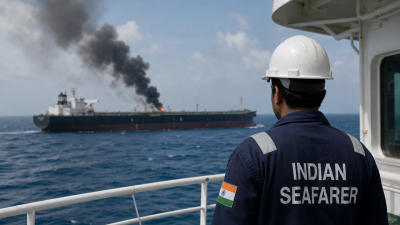
On 10 June 2026 the Palau‑flagged tanker MT Settebello was struck in the Gulf of Oman. Three Indian seafarers died. India has lodged a strong protest with the United States, issued deployment restrictions and intensified naval surveillance under Operation Sankalp.
Geopolitical context and strategic significance
The Strait of Hormuz and Gulf of Oman are critical sea lanes for energy and trade. Recent attacks on merchant shipping have raised risks to commerce and maritime labour. The UN maritime agency has verified multiple attacks and confirmed seafarer fatalities since the crisis began.
Vulnerability of Indian seafarers
- India has about 3.5 lakh seafarers globally; over half are actively serving. A large share works on foreign‑flagged ships.
- Nearly 18,000 Indian seafarers remain deployed across the Gulf region; around 325 operate west of the Strait and over 200 are stranded in the Gulf of Oman.
- Most Indian seafarers are employed on vessels flying Flags of Convenience (Palau, Panama, Marshall Islands). FOC status affects flag‑state responsibility and access to legal remedies.
- Case example: MT Settebello (Palau flag) carried 24 Indian crew; three crew members — Aditya Sharma, Shivanand Chaurasiya, Patnala Suresh — were killed after a US military missile strike.
India’s response: diplomatic, operational and welfare measures
Diplomatic
- India lodged a strong protest with the United States over attacks affecting vessels with Indian crew. MEA coordinates diplomatic engagement and seeks accountability.
Operational security
- Operation Sankalp (initiated 2019) continues to deploy Indian Navy warships for escorts and presence in the Gulf of Oman, Strait of Hormuz and Gulf of Aden.
- Government has intensified maritime domain awareness (continuous surveillance) and coordination between Navy, Coast Guard, DGS and MEA.
Policy and regulatory
- The Directorate General of Shipping issued an advisory restricting maritime recruitment agencies from deploying Indian seafarers to conflict areas until further notice; crew changes permitted only in emergencies with consent.
Welfare
- Seafarers Welfare Fund Society is releasing Rs 10 lakh to each family of deceased seafarers. Government agencies are engaged in repatriation, counselling and monitoring of stranded crew.
Legal and institutional framework
International rules: UNCLOS sets maritime law but some key actors have not ratified it. IMO provides safety and shipping regulation but enforcement depends on member states. Flag state responsibility and port state control are central legal concepts.
| Stakeholder | Legal responsibility | Operational role |
|---|---|---|
| Flag state | Primary regulatory and investigatory duty | Issuance of certificates; compliance oversight |
| Coastal state | Jurisdiction in territorial sea; security measures in EEZ limited | Maritime surveillance; local escorts |
| India (State of nationality) | Diplomatic protection; welfare of nationals | Naval deployments; consular assistance; advisories |
| IMO / UN | Regulatory frameworks and norms | Standards, reporting, coordination |
Challenges in protection
- Jurisdictional complexity: FOC vessels complicate India’s legal reach and access to investigations.
- Geopolitical friction: Military operations and blockades by powerful states increase the risk to merchant shipping.
- Enforcement gaps: International institutions rely on state compliance; accountability is weak when major powers are involved.
- Information asymmetry: Conflicting claims about vessel behaviour impede timely and transparent incident response.
- Livelihood trade‑offs: Deployment restrictions protect lives but reduce employment and remittance flows for families dependent on seafaring income.
Socio‑economic implications
- Human cost: Deaths and injuries cause immediate loss of income and long‑term family vulnerability.
- Remittances and livelihoods: Disruptions to deployment affect household incomes and coastal economies that depend on maritime employment.
- Mental health and labour supply: Risk exposure increases psychological stress among seafarers and may reduce future labour supply to high‑risk routes.
- Insurance and costs: Increased premiums, contractual disruptions and legal uncertainty raise costs for seafarers and ship operators.
Way forward: policy recommendations
- Diplomatic strategy: Persist with bilateral demarches and seek transparent investigations; pursue multilateral engagement at IMO and UN to press for accountability and clearer norms on attacks against merchant shipping.
- Strengthen maritime domain awareness: Invest in sensors, shared intelligence, information‑sharing platforms with friendly navies and commercial operators.
- Address FOC challenges: Advocate internationally for stronger flag‑state accountability, minimum standards for crew welfare and mandatory incident cooperation by flag states.
- Bilateral security cooperation: Conclude or deepen maritime security agreements with Gulf littoral states, and institutionalise naval coordination for escorts and information exchange.
- Regulatory measures at home: Tighten oversight of maritime recruitment agencies, mandate conflict‑zone insurance and pre‑deployment risk briefings, and formalise contingency repatriation plans.
- Comprehensive welfare framework: Expand insurance coverage, fast disbursal mechanisms, psychosocial support, and long‑term rehabilitation for families of affected seafarers.
- Skill diversification and employment support: Offer training to broaden employment options for seafarers and reduce concentration on conflict‑prone routes.
- Invest in legal capacity: Build specialised legal teams to pursue diplomatic protection, coordinate with flag states and support criminal or civil claims on behalf of victims.
Model Questions
- Critically examine the challenges faced by India in protecting its seafarers amid the Gulf maritime conflict, with special reference to vessels flying Flags of Convenience. [GS-II: International Relations]
Cover jurisdictional limits posed by FOC vessels; geopolitical and military risks in the Gulf; enforcement gaps at IMO/UNCLOS level; India’s diplomatic responses, DGS advisory and Operation Sankalp; operational and welfare measures and their constraints.
- Analyse the socio‑economic implications of the Gulf maritime conflict on Indian seafarers and their families. Evaluate the efficacy of existing welfare mechanisms. [GS-III: Economic Development]
Discuss loss of life and income; remittance and household impacts; stranded crew and employment disruption; SWFS financial assistance, DGS measures, repatriation and counselling; gaps in insurance, long‑term rehabilitation and policy remedies.
- Discuss the evolution and objectives of India’s maritime security initiatives such as Operation Sankalp. How can India strengthen engagement with international maritime bodies to enhance seafarer safety? [GS-III: Internal & External Security]
Outline Operation Sankalp’s deployments and aims; maritime domain awareness and naval coordination; bilateral security arrangements with littoral states; advocacy at IMO/UNCLOS for stronger enforcement; practical steps for information sharing and joint escorts.
- Analyse the ethical and state‑duty dimensions of protecting nationals working on foreign‑flagged vessels in international waters. What obligations does India hold under diplomatic protection? [GS-IV: Ethics, Integrity and Aptitude]
Examine moral duty to protect citizens; limits imposed by international law and FOC regimes; duty to provide welfare and justice; balancing non‑intervention with protective action; transparency, accountability and restitution measures.
Last Modified: June 16, 2026