
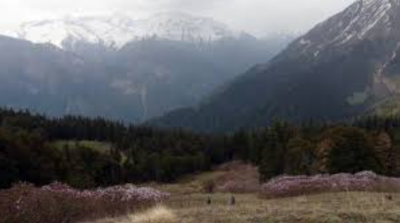
The Hindu Kush Himalaya (HKH) faces a compounded climate emergency in 2026: persistent El Niño is driving above‑normal temperatures and below‑normal monsoon rainfall. Reduced winter snowpack, accelerated glacier melt and episodic cloudbursts are raising drought, heat‑stress, landslide and GLOF risks across mountain and downstream populations.
Current issue
The HKH — the “Third Pole” — supplies freshwater to over 240 million mountain residents and more than 1.6 billion downstream. The 2026 outlook projects below‑normal monsoon rainfall and above‑normal temperatures. This removes the cryospheric water buffer and increases reliance on rainfall and groundwater while raising the frequency and intensity of climate hazards.
Why it matters for governance and security
Changes in HKH hydrology affect drinking water, food production, energy security and infrastructure across multiple states and countries. Transboundary river basins and shared infrastructure make risk management a governance and diplomatic challenge. Disaster response, long‑term planning, and investment choices for irrigation, hydropower and transport must adapt to higher hazard frequency and uncertain water supply.
Geographical significance: the Water Tower of Asia
Transboundary span and basin network
The mountain chain stretches ~3,500 km across eight countries: Afghanistan, Bangladesh, Bhutan, China, India, Myanmar, Nepal and Pakistan. It hosts headwaters of ten major transboundary rivers (Indus, Ganga, Brahmaputra, Mekong, Yangtze, Yellow among them) and underpins freshwater services for vast downstream populations.
The cryospheric water buffer
Glaciers, seasonal snow and permafrost provide regulated base flows by releasing meltwater in pre‑monsoon months. This cryospheric buffer supports agriculture, hydropower and industry. Currently diminished snowpack reduces seasonal buffering and raises inter‑annual water variability.
Meteorological drivers and primary hazards
El Niño and thermal anomalies
El Niño has weakened monsoon moisture inflow while elevating surface temperatures. Warming raises the freezing level, accelerates glacier mass loss and increases evaporation, compounding drought pressure and reducing sustained base flows.
Reduced winter snow cover
Winter accumulation is below historical averages. Lower snowpack means smaller spring melt volumes and an early loss of stored water that traditionally sustains rivers before monsoon onset.
Cloudbursts and extreme precipitation
Atmospheric instability produces intense, short‑duration rainfall events. These cloudbursts on dry and denuded slopes produce severe runoff, flash floods and rapid slope failure despite an overall drier seasonal total.
Atmospheric brown clouds
Black carbon deposition decreases glacier albedo, increasing solar absorption and melt rates. Regional emission mitigation therefore affects cryospheric stability.
Compounding climate cascades
Glacial Lake Outburst Floods (GLOFs)
Rapid melting feeds moraine‑dammed lakes. Remote sensing shows over 5,000 glacial lakes in the HKH, with hundreds classified as high‑risk. Trigger mechanisms include heavy rain, ice avalanches and seismic events. GLOFs produce fast, high‑energy floods that destroy infrastructure and settlements downstream.
Landslides and slope instability
Permafrost thaw and thermal weakening reduce slope cohesion. Intense rain on destabilised slopes triggers landslides, debris flows and rockfalls. These block channels and sever transport and electricity corridors.
Agrarian and ecological drought
High temperatures and erratic rainfall create soil moisture deficits. Impacts include crop failure, drying of natural springs (dharas), increased forest‑fire incidence and shifts in vegetation zones with loss of alpine biodiversity.
Socio‑economic vulnerabilities
| Impact Dimension | Primary Vulnerability Drivers | Downstream Consequences |
| Water security | Drying springs; loss of seasonal snow and glacier runoff. | Acute drinking water scarcity; depletion of shallow aquifers; higher sanitation risks. |
| Agriculture | Shifts in sowing windows; moisture stress; increased crop failure. | Reduced food security; livelihood distress; seasonal migration. |
| Hydropower & infrastructure | Increased siltation; GLOF and landslide threats. | Dam damage risk; disrupted energy supply; higher maintenance and capital costs. |
| Ecosystem integrity | Range shifts; biodiversity loss; forest fire incidence. | Loss of ecosystem services; impacts on tourism and pastoral systems. |
India’s stakes and operational challenges
India depends on HKH headwaters for irrigation, municipal supply and hydropower across large northern plains and Himalayan states (Uttarakhand, Himachal Pradesh, Sikkim, Arunachal Pradesh, Jammu & Kashmir, and parts of north Bihar and West Bengal downstream). Key challenges: protecting springs and catchments, integrating climate risk in hydropower and road design, managing sedimentation and GLOF risk, sustaining rural water supply under declining aquifers, and balancing development with hazard exposure.
Institutional frameworks and transboundary cooperation
ICIMOD coordinates scientific monitoring across the HKH. Within India, NDMA, Ministry of Jal Shakti, Central Water Commission, Ministry of Environment, Forest & Climate Change and the National Mission for Sustaining the Himalayan Ecosystem constitute core domestic agencies. Effective management requires data sharing, joint early‑warning protocols, harmonised hazard maps and cooperative mechanisms among HKH countries for GLOF monitoring, river flows and disaster response.
Mitigation and adaptation — practical measures
- Enhanced monitoring: High‑resolution satellite surveillance of glaciers and glacial lakes; routine field surveys of critical lakes and moraine dams.
- Early‑warning systems: Deploy cascade EWS for GLOFs, flash floods and landslides with real‑time telemetry, downstream sirens and community alerting.
- Spring‑shed management: Identify and rehabilitate recharge zones, conserve upper catchment vegetation, and use local spring inventories for target interventions.
- Climate‑resilient agriculture: Promote water‑efficient irrigation, drought tolerant varieties, revised cropping calendars and insurance schemes tied to agro‑climate indices.
- Infrastructure resilience: Integrate climate risk in siting and design of hydropower, roads and bridges; include sediment management, setback zones and contingency planning.
- Ecosystem‑based adaptation: Reforestation, wetland protection and community pasture management to stabilise slopes and maintain base flows.
- Emission controls: Reduce black carbon through improved cookstoves, cleaner fuels and industrial emission standards to slow cryospheric warming.
- Regional cooperation: Strengthen ICIMOD’s role, establish transboundary data protocols, joint GLOF inventories and shared early‑warning corridors.
- Community engagement: Local hazard mapping, participatory relocation where necessary, capacity building for search‑and‑rescue and water governance at village level.
Model Questions
- Examine the geographical significance of the Hindu Kush Himalaya as the “Third Pole” and critically analyse the compounding climate risks the region faces in the 2026 outlook. [GS-III: Environment & DM]
- Discuss the meteorological drivers behind accelerated climate hazards in the Hindu Kush Himalaya and explain the cascading consequences such as GLOFs and landslides. [GS-III: Science & Technology]
- Analyse socio‑economic vulnerabilities of mountain and downstream communities due to HKH climate impacts and recommend resilience measures for water security, agriculture and hydropower infrastructure. [GS-III: Economic Development]
- Highlight challenges of transboundary cooperation in addressing HKH climate risks and outline the role of regional and international institutions in monitoring, adaptation and disaster risk reduction. [GS-II: International Relations]
The answer should define the HKH as the Third Pole, state its transboundary span and role in headwaters of major Asian rivers and population dependent figures. Analyse 2026 drivers—El Niño, above‑normal temperatures, below‑normal monsoon, reduced snowpack—and link these to hazards: accelerated glacier melt, GLOFs, cloudbursts, landslides, and water insecurity, with implications for agriculture and hydropower.
Cover El Niño’s disruption of monsoon and thermal anomalies raising freezing levels; role of reduced winter snow and permafrost thaw; influence of black carbon; and atmospheric instability causing cloudbursts. Explain cascade mechanisms: rapid melt forms unstable glacial lakes, moraine failure causes GLOFs; thaw and intense rain reduce slope strength, producing landslides and channel blockage.
Identify vulnerabilities: drying springs, aquifer depletion, crop failures, migration, siltation and GLOF risk to dams. Recommend targeted measures: spring‑shed recharge and community water management, climate‑resilient cropping and insurance, sediment management and climate‑screening of hydropower projects, contingency energy planning and livelihood diversification to reduce exposure and economic losses.
List cooperation challenges: multi‑state river basins, data gaps, political sensitivities and asymmetric capacities. Outline institutional roles: ICIMOD for scientific coordination, joint early‑warning systems and shared GLOF inventories; bilateral and regional platforms for data sharing; donor and UN support for capacity building; and legal/institutional arrangements for joint disaster preparedness and adaptive water management.