
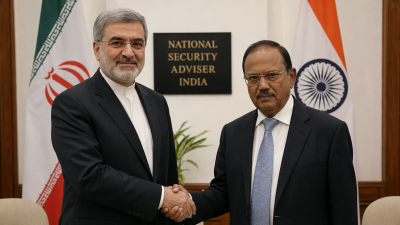
On 22 June 2026 NSA Ajit Doval met Ghadir Nezamipour, Deputy Secretary for Defence Affairs at Iran’s SNSC, in New Delhi during the BRICS NSA meeting. The visit — the first by a senior Iranian official after the US‑Iran peace agreement — foregrounded Chabahar, energy ties and non‑traditional security cooperation.
What is current
Senior India–Iran security dialogue resumed at the NSA level. Discussions covered the evolving West Asia security environment, BRICS cooperation, and revival of Chabahar Port projects. Iran will also participate in the BRICS energy ministers’ meeting in Gurugram, indicating a parallel diplomatic and economic track.
Why this matters
For governance: improved regional stability reduces risk to Indian citizens and assets. For economy: Chabahar restores a trade route to Afghanistan and Central Asia. For security: bilateral engagement expands cooperation on counter‑terrorism and cybersecurity. For foreign policy: reduced external constraints permit more direct strategic engagement with Tehran.
Strategic significance of India–Iran ties
- Geography: Iran provides direct maritime access to Afghanistan and Central Asia via the Gulf of Oman, bypassing Pakistan.
- Energy: Iran remains a supplier of hydrocarbons and a partner in energy diplomacy within BRICS forums.
- Regional stability: A less volatile Iran lowers spill‑over risks in West Asia that affect Indian trade, diaspora safety and energy security.
Connectivity: Chabahar Port
- Project status: India signed a 10‑year contract in May 2024 to operate the Shahid Beheshti terminal through India Ports Global Ltd (IPGL).
- Operational constraints: US sanctions were reimposed on 29 September 2025; a six‑month exemption for India ended on 26 April 2026, stalling expansion and normal operations.
- Outlook: Following the US‑Iran peace deal and a 14‑point MoU for de‑escalation, sanctions on Chabahar are expected to be lifted and talks to expand the port are likely to resume.
- Significance: Restored operations will facilitate trade with Afghanistan and Central Asia, offer an alternative trans‑shipment route, and support regional development projects.
Security and defence cooperation
- High‑level dialogue: NSA‑level engagement addresses regional security dynamics and modes of cooperation.
- Counter‑terrorism: Shared concerns over militant networks and transit routes; scope for information‑sharing and capacity building.
- Cybersecurity and emerging technologies: Non‑traditional threats are on the BRICS NSA agenda; India and Iran can explore norms, threat intelligence exchange and joint capacity measures.
- Limitations: Direct military cooperation remains calibrated by India’s relations with other West Asian actors and global partners.
Energy cooperation
- Engagement channels: Iran is sending Petroleum Minister Mohsin Paknejad and a Deputy Energy Minister to the BRICS energy ministers’ meeting in Gurugram.
- Opportunities: Renewed access could expand crude and LNG supply options, joint ventures, and investment in downstream projects.
- Constraints: Commercial transactions require banking arrangements and insurance solutions that were previously affected by sanctions; these must be re‑established.
Multilateral engagement: BRICS platform
- Agenda fit: The 16th BRICS NSA Meeting addressed non‑traditional security challenges — cybersecurity, terrorism, and emerging technologies — providing a framework for practical cooperation.
- Diplomatic utility: BRICS allows India and Iran to coordinate on security and energy within a multilateral setting, reducing transaction costs of bilateral negotiations and opening multistate modalities.
Impact of the US–Iran peace agreement
- De‑escalation: The 14‑point MoU for de‑escalation creates a more predictable regional environment.
- Sanctions relief: Expected lifting of sanctions on Chabahar would unblock infrastructure work, financial flows and insurance cover for logistics and investment.
- Space for engagement: Normalisation between the US and Iran reduces external pressure on India to limit its ties with Tehran, widening policy options.
Challenges and risks
- Geopolitical balancing: India must manage relations with Gulf states, Israel and the US while deepening ties with Iran.
- Financial and commercial mechanics: Restoring banking channels, trade insurance and shipping lines will take time and technical negotiation.
- Security spill‑overs: Local instability in Iran or Afghanistan can still disrupt projects and supply chains.
- Domestic politics: Public and parliamentary scrutiny on strategic ties with Iran may influence policy choices.
Opportunities
- Revive Chabahar: Restart construction, increase cargo throughput and operationalise trans‑Afghan corridors.
- Energy diversification: Secure long‑term hydrocarbon supplies and explore joint ventures in gas and petrochemicals.
- Security cooperation: Institutionalise counter‑terrorism and cyber dialogues, and use BRICS to pilot cooperative measures on non‑traditional threats.
- Regional connectivity: Use Chabahar to integrate Central Asian markets and support Afghan reconstruction and trade.
Policy instruments and implementation considerations
- Institutional mechanisms: Use the NSA channel, MEA, Ministry of Ports, and IPGL for coordinated action.
- Financial solutions: Negotiate banking routes, use escrow arrangements, and explore multilateral insurance facilities.
- Legal and contractual clarity: Ensure contracts include force majeure and sanctions‑contingency clauses.
- Stakeholder management: Consult domestic industry, state governments, and partner countries in Afghanistan and Central Asia.
Implications for India’s West Asia policy
- Strategic autonomy: Reduced sanctions pressure increases India’s freedom to pursue its interests.
- Energy and trade security: Diversified routes and suppliers lower dependence risks.
- Diplomatic scope: Multilateral engagements like BRICS create alternative platforms to address shared non‑traditional threats.
Model Questions
1. The Chabahar Port project exemplifies India’s strategic vision for regional connectivity and economic diplomacy. Discuss its significance for India, challenges faced, and the potential impact of recent geopolitical developments on its future. [GS-II: International Relations]
Chabahar provides a maritime link to Afghanistan and Central Asia, bypassing Pakistan, aiding trade and regional influence. Challenges included US sanctions, banking and insurance barriers, and regional instability. The US‑Iran peace deal and expected lifting of sanctions create scope to resume expansion, restore operations under IPGL, and deepen transit and development projects, contingent on re‑establishing financial channels and on‑ground security.
2. Beyond economic engagements, analyse the evolving dimensions of India‑Iran strategic and security cooperation, particularly in the context of the changing security environment in West Asia and multilateral platforms like BRICS. [GS-II: International Relations]
India‑Iran ties now span counter‑terrorism, cybersecurity and strategic dialogue alongside connectivity and energy. NSA‑level talks and BRICS meetings provide institutional space for cooperation on non‑traditional threats. The US‑Iran de‑escalation reduces external constraints, enabling deeper security exchanges, information‑sharing and joint measures within multilateral fora while India balances other regional partnerships.
3. Examine the role of multilateral forums like BRICS in addressing contemporary non‑traditional security challenges, citing recent India‑Iran engagement as an example. [GS-II: International Relations]
BRICS offers a platform for dialogue on cybersecurity, terrorism and emerging technologies outside Western security architectures. The 16th BRICS NSA Meeting chaired by India brought Iran into conversations on non‑traditional threats, enabling confidence‑building, shared threat assessments and potential technical cooperation. Such multilateral channels reduce bilateral transaction costs and allow coordinated responses across diverse member states.
4. The recent US‑Iran peace agreement holds implications for India’s foreign policy objectives in West Asia. Evaluate its potential impact on India‑Iran relations and regional stability. [GS-II: International Relations]
The peace agreement’s 14‑point MoU aims to de‑escalate West Asia, improving predictability for Indian interests. For India, it likely permits lifting of Chabahar‑related sanctions, reactivation of energy and connectivity projects, and wider diplomatic space with Tehran. It also reduces immediate regional spill‑over risks, but India must continue balancing relations with Gulf states, Israel and the US while securing financial and logistical mechanisms for projects.
Last Modified: June 23, 2026