
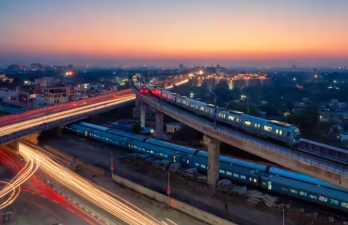
India has shifted from fragmented execution to integrated, data‑driven infrastructure planning. Public capital expenditure rose to ₹12.21 lakh crore (FY2026‑27). PM GatiShakti, NIP and NMP are central to lowering logistics costs, closing regional gaps and improving India’s global manufacturing competitiveness.
What is current and why it matters
Current focus
PM GatiShakti provides a GIS-based National Master Plan integrating 44 Central Ministries and all States/UTs with 1,600+ data layers. The National Infrastructure Pipeline (₹111 lakh crore) and National Monetisation Pipeline (NMP 2.0) provide project roadmaps and financing pathways. Public capex has moved from project maintenance to large-scale asset creation.
Why it matters for governance and economy
Integrated planning reduces inter-departmental duplication, shortens project cycles and lowers logistics costs. Higher asset creation supports manufacturing, trade and regional development while monetisation mobilises funds for new greenfield investment without increasing fiscal deficits.
Vision and strategic shift
Viksit Bharat @2047: Long-term framework directing infrastructure priorities—connectivity, industrial corridors and social services. Paradigm shift: From siloed, ad‑hoc projects to a single-platform, data-driven approach that synchronises land use, utilities and transport planning.
Institutional framework and integrated planning
PM GatiShakti National Master Plan
– GIS platform with 1,600+ spatial layers to plan transport, utilities and land use. – Network Planning Group (NPG) evaluates big-ticket projects and enforces multimodal synchronisation. – Selected spatial data accessible to private sector for PPP logistics and facility planning. – Operational benefits include avoidance of repeated road cutting and coordinated Right of Way decisions.
Complementary instruments
– National Infrastructure Pipeline (NIP): Forward-looking ₹111 lakh crore roadmap; execution tracked through PAIMANA (1,900+ central projects worth ₹41.50 lakh crore). – National Monetisation Pipeline (NMP 2.0): Structured monetisation of brownfield assets across highways, railways, power transmission and warehousing to finance greenfield projects. – National Logistics Policy (NLP): Introduced Unified Logistics Interface Platform (ULIP) to integrate digital systems of transport, ports and customs. – Harmonized Master List: DEA-maintained list for infrastructure sub-sectors determining eligibility for institutional credit and ECB.
Financing mechanisms and capital outlay
– Public capital expenditure increased from ~₹2 lakh crore (FY2014‑15) to ₹12.21 lakh crore (FY2026‑27), shifting emphasis to asset creation. – Funding pattern under NIP: Central Government 39%, States 40%, Private sector 21%. – NMP enables value unlocking from existing assets, reducing the need for direct fiscal financing for greenfield projects.
Transportation network expansions
Roads and Bharatmala Pariyojana
– India’s road network totals about 63.73 lakh km; National Highways expanded from 91,287 km to 1,46,566 km. – Bharatmala focuses on Economic Corridors, Inter-corridors, Feeder Routes and Expressways. Key corridors: Delhi–Dehradun (213 km; elevated wildlife corridor), Ahmedabad–Dholera (109 km), Dwarka Expressway (airport connectivity via shallow tunnel).
Rural roads — PMGSY
– 99.6% of eligible rural habitations connected with all‑weather roads. – Allocations rose from ₹386 crore to ₹19,000 crore. Between 2014 and 2026, 4.11 lakh km of rural roads and 10,293 bridges completed.
Indian Railways
– Electrification reached 99.6% of route km (69,873 route km). – Over 162 Vande Bharat semi‑high-speed services; higher-capacity 16/20‑coach and sleeper variants operational. – Dedicated Freight Corridors (Western and Eastern DFCs) separate freight and passenger traffic to raise freight speeds and corridor capacity.
Civil aviation — UDAN
– UDAN operationalised unserved and underserved airstrips, expanding regional connectivity and increasing terminal capacities at regional gateways.
Maritime and inland waterways — Sagarmala and NWs
– Port modernisation, connectivity and port‑linked industrialisation; major public ports saw ~7% cargo volume growth. – Inland waterways (eg. NW‑1) provide energy‑efficient bulk transport. – First large automobile multimodal cargo terminal commissioned at Maruti Suzuki, Manesar, linked to Haryana Orbital Rail Corridor.
Digital, urban and rural welfare infrastructure
Digital infrastructure
– BharatNet connects village panchayats with high‑speed fibre. – GatiShakti Sanchar Portal centralises Right of Way approvals to expedite 4G/5G rollout and standardise timelines.
Rural water and urban housing
– Jal Jeevan Mission: Household tap connections (FHTC) with community-managed systems, greywater measures and rainwater harvesting to ensure sustainability. – Pradhan Mantri Awas Yojana: PMAY‑U and PMAY‑G deliver disaster‑resilient houses with geotagging-based monitoring, subsidies and interest subventions.
Socio-economic impact
– Logistics and competitiveness: Integrated corridors and ULIP help lower logistics costs toward targeted levels, improving export competitiveness. – Regional inclusion: PMGSY, UDAN and rail upgrades improve market access, reduce travel time and enable labour mobility. – Employment: Construction and operation phases generate direct and indirect jobs across manufacturing, services and logistics. – Human development: Access to water, housing and connectivity supports education, healthcare and livelihoods.
Environmental considerations
– Wildlife-sensitive design integrated in corridors (eg. Delhi–Dehradun elevated wildlife corridor). – Rail electrification supports decarbonisation of transport. – JJM includes water conservation and greywater management. – GIS planning used for routing renewable energy transmission (e.g. 13 GW corridor from Leh to Kaithal) to reduce land and ecological impact.
Challenges and way forward
| Challenge | Prescriptive measure |
| Attracting sustained private finance beyond 21% target | Standardise PPP contracts, create blended-finance vehicles, develop infrastructure bonds and strengthen regulatory predictability. |
| Land acquisition and clearances | Use centralised GIS land records, fast-track RoW clearances, and compensate through transparent valuation and rehabilitation. |
| Inter‑governmental coordination | Mandate NPG review for large projects, use GatiShakti as single source of truth and institute dispute-resolution timelines. |
| Asset maintenance and utilisation | Adopt lifecycle costing, ring-fence maintenance funding, and monetise non-core assets for upkeep finance. |
| Climate resilience and equitable reach | Design for climate stress, prioritise last‑mile connectivity, and allocate project scores by social and regional inclusion metrics. |
| Technology and data governance | Harden data security, provide controlled private access to spatial layers, and institutionalise periodic GIS updates. |
Model Questions
- Critically examine how PM GatiShakti represents a change in India’s infrastructure planning and execution. What institutional mechanisms ensure multimodal coordination and reduced project duplication? [GS-II: Governance]
- Assess the roles of public capital expenditure, the National Infrastructure Pipeline and the National Monetisation Pipeline in financing India’s infrastructure push towards Viksit Bharat @2047. [GS-III: Economic Development]
- Analyse the socio-economic effects of recent expansions in roads, railways, civil aviation and rural welfare schemes on bridging regional disparities and improving quality of life. [GS-I: Indian Society]
- Identify the main challenges to sustaining India’s infrastructure growth and propose measures to future‑proof the strategy, including financing, governance and environmental resilience. [GS-III: Economic Development]
Answer must explain the shift from siloed projects to a GIS-based master plan integrating 44 ministries and States/UTs; describe the Network Planning Group, PAIMANA tracking, private-sector access to spatial data, and RoW standardisation via GatiShakti Sanchar. Discuss outcomes: reduced road cutting, faster clearances, coordinated multimodal corridors and implications for implementation timelines and PPP planning.
Answer should quantify the rise in public capex to ₹12.21 lakh crore, outline NIP’s ₹111 lakh crore roadmap and PAIMANA monitoring, and explain how NMP monetises brownfield assets to fund greenfield projects without adding to fiscal deficits. Include funding pattern (Central 39%, States 40%, Private 21%) and limits/risks of monetisation dependence.
Answer must link Bharatmala and DFCs to market access, cite PMGSY connecting 99.6% habitations and rural roads/bridges statistics, note rail electrification and Vande Bharat services, UDAN’s regional air connectivity, and JJM/PMAY effects on basic services. Assess impacts on employment, mobility, access to services and regional development.
Answer should list challenges: mobilising private finance, land and clearances, inter-state coordination, asset maintenance, equitable distribution and climate risks. Propose measures: blended finance and bonds, GIS-based land tools, NPG enforcement, lifecycle maintenance funds, inclusion metrics and climate-adaptive design and monitoring.