
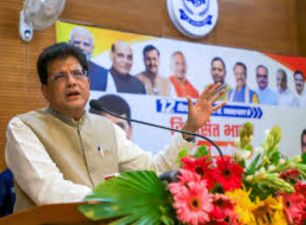
Union Commerce Minister Piyush Goyal said India’s FTAs with developed economies aim to boost long‑term growth by expanding trade, attracting investment, fostering innovation, creating jobs and upgrading quality standards. The TEPA with EFTA commits USD 100 billion and one million jobs over 15 years. India pairs its young workforce and competitive costs with foreign capital and technology to enter higher segments of global value chains.
Issue and significance
What is the issue?
India is negotiating and implementing new‑generation FTAs with developed economies that combine tariff liberalisation with binding investment commitments, services mobility and enforceable sustainable‑development provisions.
Why it matters for governance and economy
Economic growth: FTAs can enlarge market access, attract long‑term capital and improve export competitiveness. Industrial policy: They aim to upgrade domestic manufacturing and promote higher value addition. Regulatory alignment: New clauses on environment, labour and standards affect domestic regulation and compliance costs. Strategic relations: FTAs deepen interdependence with advanced economies and affect supply‑chain resilience and geopolitical ties.
Rationale and objectives
- Long‑term growth: Expand exports and diversify markets to sustain GDP growth.
- Investment attraction: Secure stable, phased capital inflows tied to manufacturing and services.
- Employment: Create jobs by scaling manufacturing and services exports.
- Technology and standards: Obtain technology transfer, joint R&D and higher product standards.
- Upgrading manufacturing: Move from assembly to high‑value production through GVC integration.
Core pillars of new‑generation FTAs
Binding investment pledges
New FTAs include explicit investment commitments. TEPA with EFTA commits USD 100 billion and one million jobs over 15 years, split as USD 50 billion in the first 10 years and USD 50 billion in the last 5 years.
Integration into global value chains
Tariff reductions and clearer rules of origin enable access to quality inputs. This supports domestic firms to enter higher tiers of supply chains and capture greater value addition.
Skill and technology transfer
Agreements provide for joint research, co‑development and standards harmonisation in clean energy, pharmaceuticals and digital infrastructure. MRAs and skills mobility expand human capital exposure.
Key agreements and status
| Agreement | Partner / Bloc | Status | Major features |
| Trade and Economic Partnership Agreement (TEPA) | EFTA (Switzerland, Norway, Iceland, Liechtenstein) | Effective from October 1, 2025 | USD 100 billion investment; 1 million jobs over 15 years; 99.6% tariff lines covered; first Indian deal with a legally binding trade and sustainable development chapter. |
| Comprehensive Economic and Trade Agreement (CETA) | United Kingdom | Signed in July 2025 | Aims to double bilateral trade by 2030; market access for textiles, leather and gems. |
| India‑EU FTA | European Union | Concluded January 2026 | Broad coverage of goods, services mobility and sustainable development standards. |
| India‑Australia ECTA | Australia | Implemented December 2022 | Zero‑duty access for 96% of Indian exports; post‑study work visas for Indian students. |
| India‑New Zealand FTA | New Zealand | Announced December 2025 | Structural cooperation, agricultural exceptions, and service pathways. |
| India‑US Interim Agreement Framework | United States | Framework delivered February 2026 | Work programme to reduce non‑tariff barriers and improve supply‑chain integration. |
Structural protections for domestic industry
Exclusion lists
Sensitive items such as primary agricultural products, dairy, soya, coal and gold are excluded from tariff concessions to protect livelihoods and small producers.
Product‑specific rules of origin
Strict rules prevent transhipment. Preferential origin verification uses EUR.1 movement certificates or authorised origin declarations to qualify for preferential rates.
Services mobility and MRAs
Negotiations prioritise Mode 1 (cross‑border digital delivery) and Mode 4 (temporary movement of persons). MRAs for nurses, architects and accountants smooth credential recognition.
Operational challenges in FTA utilisation
- Low utilisation: Only 20–30% of eligible Indian exports claim FTA benefits. Partner utilisation ranges 60–70%.
- Cost of compliance: Low MFN tariffs in developed markets often make compliance cost higher than tariff savings.
- Inverted duty structures: Higher duties on raw materials than finished goods discourage domestic value addition.
- Widening trade deficits: Bilateral deficits with major partners have increased in some sectors.
- Non‑tariff barriers: Standards, SPS rules and measures such as the EU’s Carbon Border Adjustment Mechanism create compliance friction.
Measures to enhance FTA utilisation and policy response
- Simplify compliance: Streamline RoO procedures and digitalise certificate issuance.
- Awareness and capacity building: Target MSMEs with training, export clinics and helplines.
- Address inverted duties: Rationalise tariffs on inputs and consider targeted duty relief for processing industries.
- Standards diplomacy: Negotiate MRAs, mutual recognition of conformity assessment and phase‑in periods for new standards.
- Investment facilitation: Create single‑window clearances for FTA‑linked projects and monitor phased investment commitments.
- Services push: Secure deeper commitments on Mode 1 and Mode 4 to exploit India’s IT and professional services strengths.
- Sustainable trade tools: Use trade and sustainable development chapters to align domestic firms with global ESG requirements.
- Diversification: Expand partner base and seek sectoral FTAs to reduce bilateral imbalances.
Role of technology, skill transfer and GVC integration
- Joint R&D: FTAs encourage co‑location of research centres and collaborative projects in pharmaceuticals, clean energy and digital tech.
- Technology diffusion: Foreign capital brings process and product technologies that raise productivity and quality.
- Skills mobility: Mode 4 provisions and MRAs increase exposure to international professional practices.
- Standards harmonisation: Alignment with global standards eases market access for high‑value goods and services.
- Manufacturing upgrade: Access to intermediate goods and capital enables movement up the value chain.
Model Questions
- Evaluate India’s strategic rationale behind signing new‑generation Free Trade Agreements with developed economies. Discuss the potential economic benefits and the core pillars supporting this approach. [GS-III: Economic Development]
- Despite expanding its FTA network, India faces operational challenges in maximising benefits. Analyse these challenges and suggest measures to improve FTA utilisation by domestic industries. [GS-III: Economic Development]
- Discuss mechanisms used in India’s FTAs to protect sensitive domestic sectors while pursuing deeper market access. Give examples. [GS-II: Governance]
- “India’s engagement via FTAs uses its young workforce and competitive costs alongside partner capital and technology.” Explain how technology and skill transfer under FTAs can integrate India into higher segments of global value chains. [GS-III: Science & Technology]
Answer should state objectives: growth, investments, jobs, quality upgradation. Explain core pillars: binding investment pledges (TEPA USD100bn), GVC integration, skill and technology transfer, services commitments (Mode 1 and Mode 4). Provide expected benefits: higher export value, manufacturing upgrade, R&D co‑operation, and stronger supply‑chain resilience. Mention safeguards for sensitive sectors.
Answer should identify low utilisation (20–30%), inverted duty structures, compliance costs vs MFN tariffs, NTBs (CBAM, SPS), and rising bilateral deficits. Recommend measures: simplify RoO and digital certificates, MSME capacity building, tariff rationalisation on inputs, negotiate MRAs and mutual recognition, active standard diplomacy, and single‑window investment facilitation for FTA projects.
Answer should list mechanisms: exclusion lists for agriculture/dairy/coal/gold, product‑specific Rules of Origin (EUR.1 / origin declarations), phase‑in tariff schedules, safeguard clauses, and MRAs for regulated professions. Cite examples: TEPA exclusions and India’s retention of agricultural safeguards; mention legally binding sustainable‑development chapter in TEPA.
Answer should explain joint R&D, co‑development, and co‑investment that bring advanced processes. Link MRAs and Mode 4 to skill mobility. Show how access to high‑grade inputs and standards harmonisation enable domestic firms to meet global specifications and move to high‑value stages in GVCs. Use TEPA and EU FTA as illustrative frameworks.