
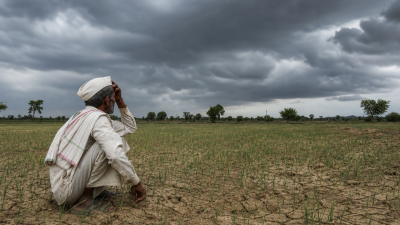
As of 17 June 2026 India is experiencing a stalled southwest monsoon with a 40% rainfall deficit for 4–17 June. Large cloud‑free areas persist over central and western India. Strong El Niño, delayed onset for Mumbai and priority monitoring of 150–200 districts have raised governance and food‑security concerns.
Current status
What is happening
- Nationwide deficit: A 40% aggregate rainfall shortfall (39.7 mm received against 65.9 mm normal for 4–17 June).
- Regional pattern: Central India 63–65% deficit; East & Northeast 43% deficit; Southern Peninsula 14% deficit; Northwest India 5% surplus.
- Progress and outlook: Monsoon stalled over large central/western tracts. IMD expects further advance into parts of Telangana, Odisha, Jharkhand, Bihar and Chhattisgarh around 23 June. A Western Disturbance will affect northwest India briefly.
- Associated extremes: Isolated heatwaves in parts of Madhya Pradesh, Vidarbha and Telangana; isolated heavy rain in northeast and sub‑Himalayan West Bengal and Sikkim.
Why it matters for governance and economy
- Agriculture: Delay and deficit threaten timely kharif sowing in rain‑fed areas and may reduce yields for paddy, pulses, oilseeds and cotton.
- Rural livelihoods and prices: Lower output risks farmer distress, wage loss and upward pressure on food inflation.
- Water security and urban supply: Reservoir fills and groundwater recharge will be affected, complicating municipal and industrial water planning.
- Disaster management: Coexistence of heatwaves and isolated heavy rain raises multi‑hazard response needs for states and NDMA.
| Region | Rainfall anomaly | Immediate implication |
|---|---|---|
| Central India | 63–65% deficit | Major risk to kharif sowing; demand for contingency crop and irrigation support |
| East & Northeast | 43% deficit | Transitional risk; isolated heavy rains may still cause local floods |
| Southern Peninsula | 14% deficit | Lower but manageable risk; irrigation buffers useful |
| Northwest India | 5% surplus | Reduced drought pressure; benefits for rabi cropping residue replenishment |
Factors influencing the 2026 monsoon variability
- El Niño: Strong El Niño conditions are present. APCC indicates a ~99% probability of strong El Niño for July–December, which favours suppressed Indian monsoon convection and delayed progression.
- Large‑scale circulation: Weak monsoon trough and stalled low‑level westerlies over central-west India explain cloud‑free satellite signatures.
- Regional drivers: Interaction with a Western Disturbance and intra‑seasonal oscillations causes spatial contrasts (northwest surplus vs central deficit).
Impacts
Economic and agricultural impacts
- Kharif sowing: Delay reduces sowing window for paddy, soybean, cotton and pulses. Rain‑fed districts face highest exposure.
- Output and prices: Lower acreage and yields can reduce aggregate production and raise food inflation; input loans and credit flow may be disrupted.
- Insurance and fiscal stress: Greater claims under crop insurance (PMFBY) and increased need for input subsidies, procurement budgets and relief funds.
Social, health and environmental impacts
- Livelihoods: Daily wage loss and delayed agri‑employment; migration pressures may rise if deficits persist.
- Health: Heatwaves elevate heat‑stress morbidity; erratic rainfall may influence vector‑borne disease patterns.
- Water and ecosystems: Low recharge affects groundwater, wetland health and irrigation reservoirs, with long‑term ecological consequences.
Government preparedness and response
- Operational monitoring: IMD provides forecasts and advisories. 150–200 districts placed under priority monitoring by the Ministry of Agriculture.
- Contingency planning: States instructed to prepare crop‑wise contingency plans for low‑rain districts; measures include staggered sowing, short‑duration varieties and contingency irrigation.
- Existing instruments: Use of PMFBY for damage compensation; MGNREGS for water‑conservation employment; PMKSY for irrigation access; SDRF and NDMA for disaster support.
Challenges in management and forecasting
- Predictability limits: Strong ENSO signals increase seasonal uncertainty but produce spatially heterogeneous impacts; models differ on regional response.
- Data and resolution: Need for higher‑resolution regional models and better ocean–atmosphere coupling to predict intra‑seasonal breaks and stalled phases.
- Implementation gaps: District‑level planning and rapid disbursal of relief/inputs remain uneven across states.
- Water governance: Fragmented water management and over‑extraction of groundwater reduce adaptive capacity.
Way forward — policy and operational measures
- Short‑term (operational): Fast‑track crop‑wise contingency actions: promote short‑duration/drought‑tolerant varieties, staggered sowing, and subsidised micro‑irrigation kits. Use targeted input support and expedited PMFBY settlements.
- Medium‑term (institutional): Strengthen district climate outlook forums, align SDRF/State funds to monsoon‑risk triggers, and expand climate risk insurance coverage for smallholders.
- Long‑term (structural): Invest in watershed rejuvenation, urban and rural rainwater harvesting, recharge zones, and scalable water‑use efficiency under PMKSY and MGNREGS. Promote diversified livelihoods to reduce monoculture risks.
- Science & forecasts: Upgrade IMD modelling capacity, assimilate high‑resolution ocean and land observations, expand ensemble seasonal forecasts and downscaling for district‑level advisories.
- Research and seed systems: Accelerate varietal development through ICAR/SAUs for heat and moisture stress; improve seed distribution and extension outreach.
Model Questions
- Analyse the geographical and atmospheric factors responsible for the 2026 southwest monsoon variability and regional disparities in rainfall. [GS-III: Environment & DM]
- Examine the socio‑economic consequences of delayed and deficient monsoon rainfall on India’s agriculture and economy, and assess government mitigation measures. [GS-III: Economic Development]
- Discuss how global climate phenomena such as El Niño affect Indian monsoon predictability and the challenges for long‑range forecasting. [GS-III: Science & Technology]
- In view of rising monsoon variability, evaluate policy measures to strengthen water security and agricultural resilience in India. [GS-III: Environment & DM]
The answer should explain El Niño influence on monsoon circulation, weak low‑level westerlies, stalled monsoon trough and intra‑seasonal oscillations. Discuss satellite evidence of cloud‑free central/west India, regional deficits (Central 63–65%, East/Northeast 43%, Southern 14%, Northwest +5%), and immediate climatological implications like delayed onset and heatwaves.
Cover impacts on kharif sowing, yields, farmer incomes, rural employment and food inflation. Discuss fiscal and institutional responses: state contingency plans, priority monitoring of 150–200 districts, PMFBY, MGNREGS water works, PMKSY irrigation support and SDRF/NDMA roles. Evaluate adequacy and implementation challenges.
Explain ENSO teleconnections and how strong El Niño tends to suppress monsoon convection. Address model uncertainties, multi‑factor interactions (IOD, MJO), data‑assimilation limits and need for higher spatial resolution and ensemble forecasting to improve seasonal and intra‑seasonal predictions.
Recommend integrated measures: watershed development, recharge and rainwater harvesting, micro‑irrigation, diversified cropping and drought‑tolerant varieties, district‑level contingency planning, enhanced forecasts, better crop insurance, and strengthened intergovernmental coordination for rapid resource allocation.