
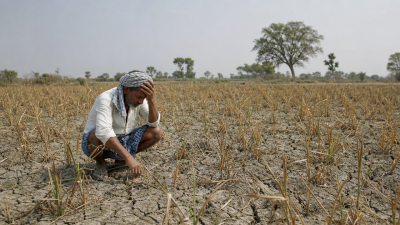
India faces a high-probability El Niño event with forecasts showing likely persistence into early 2027. IMD projects a below‑normal monsoon (~92% of LPA) and current monsoon deficits are large; implications extend from kharif sowing to food prices, rural livelihoods and water security.
What is the current issue
El Niño probability: WMO indicates 82% chance of onset between May–July 2026; NOAA estimates 96% chance of persistence into early 2027. IMD projects monsoon at ~92% of long‑period average with 84% probability of below‑normal or deficient rainfall. Nationwide monsoon deficit has widened to 43%; Central India shows a 63% deficit.
Why it matters for governance, economy and society
– Governance: Need for rapid district‑level contingency planning, crop risk assessment and resource reallocation. – Economy: Agriculture employs 47% of workforce but is only 18% of GDP; weak kharif output can raise food inflation and affect RBI forecasts. – Social: Rainfed farmers, women, Adivasi and Dalit households face disproportionate livelihood and credit risks. – Environment: Heatwaves and groundwater stress increase vulnerability to monsoon shortfalls.
Impact on rainfed agriculture
Crop and regional exposure
- Crops at risk: Rice, maize, soybean, pulses, millet, cotton and sugarcane — crops sown or reliant on early monsoon soil moisture.
- Worst‑hit regions: Central India and the Deccan plateau — Rajasthan, Gujarat, Maharashtra, Karnataka, Uttar Pradesh, Madhya Pradesh, Chhattisgarh, Telangana.
- Heat stress interaction: Severe heatwaves raised crop water demand and evapotranspiration before monsoon onset, worsening irrigation gaps and depleting groundwater.
Economic implications
- Food inflation risk: Shortfalls in kharif output can push prices of pulses, cereals and edible oils; food inflation was 4.2% in April 2026.
- Macroeconomic risk: RBI flags abnormal weather as a downside risk to growth and inflation forecasts.
- Rural incomes: Reduced wage and farm income from rainfed agriculture will affect rural demand and poverty indicators.
Social vulnerability
- Women: Represent 62.9% of agricultural workers but hold only 12.8% of land — limits access to formal credit and insurance.
- Marginal groups: Adivasi and Dalit cultivators depend heavily on rainfed plots and informal finance; limited PMFBY uptake and low asset buffers raise distress risk.
- Labour migrants: Failed crops may force distress migration, with social and urban governance consequences.
Government preparedness and current measures
- Policy actions: Strengthening of PMFBY, contingency crop plans, secured fertiliser stocks, and identification of 196 priority districts for crop risk assessment.
- Administrative focus: Central and state plans to advise alternative crops, adjust sowing windows and activate relief mechanisms where needed.
Policy gaps and implementation challenges
- Finance and legal access: Community institutions face hurdles accessing climate finance and lack formal legal recognition.
- Insurance and credit: Women cultivators and marginal farmers have limited registration, reducing PMFBY reach and formal credit flow.
- Groundwater governance: Pre‑existing groundwater stress and depleted buffer stocks weaken resilience to a deficient monsoon.
- Data and planning: District‑level heat and water risk maps are not yet institutionalised across states for routine planning.
Community‑led resilience: evidence and limits
- Example: Swayam Shikshan Prayog (Marathwada) demonstrated durable drought adaptation through local water harvesting, crop diversification and women’s leadership.
- Why durable: Local ownership, tailored cropping solutions, and on‑ground water budgeting sustain outcomes beyond project cycles.
- Scaling constraints: Lack of legal status, access to predictable finance and formal integration into district plans limit replication.
Mitigation measures: operational and policy options
| Timeframe | Measures | Purpose |
|---|---|---|
| Immediate | Priority sowing advisories, contingency crop support, targeted input and fertiliser distribution, cash relief in affected blocks | Protect sowing, reduce distress sales, maintain supply chains |
| Short term (seasonal) | Activate PMFBY payouts, expand seed distribution for short‑season/less water‑intensive crops, waive/soften loan servicing for smallholders | Support incomes, ensure replanting where feasible |
| Medium term | Institutionalise district heat and water risk maps, fund community water budgeting as a permanent service, legal recognition of women cultivators | Improve targeted planning, equitable access to credit/insurance |
| Long term | Decentralised water storage, groundwater recharge, crop diversification, extension for climate‑smart practices, easier access to climate finance for community organisations | Build structural resilience of rainfed systems |
Climatic interactions and implications for planning
- El Niño mechanism: Warm central‑eastern Pacific weakens monsoon circulation, reducing rainfall over India.
- Indian Ocean Dipole (IOD): A positive IOD may emerge later in the season and could partially offset El Niño drying; this makes seasonal outcomes uncertain and justifies flexible planning.
- Heatwave interaction: Earlier heatwaves increased crop water demand and groundwater extraction, lowering resilience to monsoon deficits.
- Planning implication: Dynamic, real‑time advisories, satellite‑based soil‑moisture monitoring, and flexible crop insurance triggers improve operational response.
Operational priorities for states and central agencies
- District risk mapping: Mandate heat and water risk maps, with real‑time dashboards for agriculture and relief departments.
- Community budgets: Fund local water budgeting teams as a recurring service linked to gram panchayat plans.
- Women’s recognition: Register women cultivators in land and beneficiary databases to enable credit and insurance access.
- Climate finance: Simplify accreditation and disbursement rules for self‑help groups and community institutions to receive state and national climate funds.
- Market measures: Strengthen buffer stocks, expedite import decisions if domestic shortfall threatens prices, and monitor supply chains for pulses and edible oils.
Model Questions
1. Analyse the multifaceted impact of the anticipated El Niño 2026 on India’s rainfed agriculture, economy and vulnerable social groups. What are the immediate and projected challenges for food security and livelihoods? [GS-III: Economic Development]
India faces a likely weak monsoon (IMD ~92% LPA, 84% chance of below‑normal rain) with large deficits in Central India. Immediate challenges: delayed sowing, reduced kharif acreage, crop stress for rice, maize, pulses; income loss for rainfed farmers. Projected effects: food inflation, pressure on rural wages, heightened distress migration. Vulnerable groups—women, Adivasi and Dalit cultivators—face limited credit/insurance and higher livelihood risk.
2. Evaluate India’s preparedness to mitigate El Niño 2026 impacts on agriculture, noting policy measures and critical gaps. Suggest measures to enhance long‑term resilience of rainfed farming. [GS-II: Governance]
Preparedness: PMFBY strengthened, contingency crop plans, fertiliser stocks and 196 priority districts identified. Gaps: community institutions lack legal recognition and climate finance access; women cultivators remain unregistered; district risk maps not institutionalised. Measures: institutionalise heat/water risk maps, fund community water budgeting, legally recognise women cultivators, simplify climate finance for local groups, and align PMFBY outreach to marginal rainfed holders.
3. Discuss whether community‑led resilience models deliver more durable drought adaptation than top‑down approaches, with examples and policy implications for El Niño 2026. [GS-I: Indian Society]
Community models (e.g., Swayam Shikshan Prayog) achieve durable outcomes through local water harvesting, crop diversification and women’s leadership. They fit local agro‑ecology and sustain behaviour change. Top‑down programmes deliver resources but often lack local legitimacy and continuity. Policy implication: legally integrate community institutions, channel predictable funds, include local adaptations in district agricultural plans to scale durable resilience.
4. Examine the scientific basis of El Niño and its interaction with the Indian Ocean Dipole and heatwaves. What are the implications for agricultural planning and water management in 2026? [GS-III: Environment & DM]
El Niño weakens monsoon circulation via atmospheric teleconnections, reducing rainfall over India; WMO/NOAA indicate high probability and persistence. A positive IOD may partially offset drying later in the season, creating uncertainty. Recent heatwaves increased evapotranspiration and groundwater stress. Implications: adopt flexible sowing windows, contingency short‑duration crops, district heat/water risk maps, satellite soil‑moisture monitoring and institutionalised community water budgeting.
Last Modified: June 27, 2026