
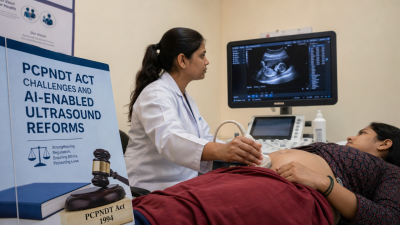
India faces a policy dilemma: strict PCPNDT controls that criminalise use of ultrasound outside registered centres aim to prevent sex-selective abortion, while advances in portable and AI-enabled ultrasound offer diagnostic benefits for rural healthcare. Debate now centres on targeted legal reform plus technical safeguards.
What is the issue?
- Legal constraint: PCPNDT Act prohibits ultrasound use outside registered facilities; offence carries minimum three months’ non-bailable imprisonment.
- Technological change: Portable and AI-enabled ultrasound devices, and high-frequency linear probes, can expand diagnostic access but are restricted by law.
- Policy tension: Need to allow safe medical use while preventing prenatal sex determination and female foeticide.
Why it matters
- Governance and law: Enforcement of PCPNDT is central to protecting the sex ratio and ensuring rule of law.
- Public health: Restrictions delay early diagnosis (cancer, obstetric and other conditions), especially in rural areas with few specialists.
- Technology and ethics: AI systems can assist non-specialists but raise privacy, accountability and misuse risks.
- Social impact: Persistent son preference and illegal networks show law alone cannot solve gender bias.
PCPNDT Act: objectives and key provisions
- Objective: Prevent pre-conception and pre-natal sex determination and address female foeticide.
- Mandatory registration: All genetic clinics, ultrasound centres and laboratories must register.
- Prohibitions and records: Prohibits communication of fetus sex; requires strict record-keeping and regulates purchase/use of machines.
- Criminal sanction: Use of an ultrasound machine outside a registered facility is a criminal offence with minimum three months’ non-bailable imprisonment.
Enforcement challenges and evidence of persistence
- Illegal networks: Cases persist; an organised racket using portable ultrasound for sex determination was uncovered in Karnataka (October 2025).
- Judicial concern: Supreme Court has called for strict enforcement, pointing to persistent male preference.
- Operational limits: Monitoring and inspection capacity is uneven across states; covert operations exploit gaps in oversight.
Impact of PCPNDT restrictions on healthcare access
- Delayed diagnostics: Restrictions on portable devices limit timely screening and referral in remote primary-care settings.
- Workforce constraints: Rural areas lack radiologists; inability to deploy AI-assisted devices to support front-line health workers increases morbidity.
- Opportunity cost: Foregone early detection of cancers and obstetric complications increases healthcare costs and adverse outcomes.
Role and capabilities of portable and AI-enabled ultrasound
- Portable devices: Improve reach; suited for community camps, primary health centres and outreach.
- High-frequency linear probes: Physically incapable of fetal sex determination; suited to superficial imaging (breast, thyroid, vascular).
- AI-enabled systems: Aid image acquisition, quality control and interpretation; can constrain output to purpose-specific diagnostics and hide or disable views that reveal fetal sex.
| Dimension | High-frequency linear probe | Conventional abdominal probe |
|---|---|---|
| Typical use | Superficial organs, breast, vascular | Obstetric and abdominal imaging |
| Risk of fetal sex determination | Minimal to none | High unless technical or policy safeguards applied |
| Suitability for community use | High with training | Low without strict supervision |
Proposed legal and technical reforms
- Targeted amendment: Legalise supervised community-based use of high-frequency linear probes that cannot determine fetal sex.
- AI and technical safeguards: Amend Act to permit AI-enabled and technically safeguarded ultrasound systems under certified protocols to prevent sex disclosure.
- Regulatory clarity: Define which devices and configurations are exempt from facility-only rules; set certification and audit requirements.
- Maintaining deterrence: Retain strict penalties for deliberate misuse and illegal sex disclosure networks.
Governance, ethical and operational safeguards
- Device certification: Mandatory technical standards for probes and AI features (disable sex-revealing views; encrypted logs; tamper-proof audit trails).
- Clinical governance: Operator certification, supervised rollout, referral pathways, and periodic audits by authorised PCPNDT authorities.
- Data protection: Local storage controls, minimal data retention, access logs, and patient consent protocols.
- Accountability: Clear legal responsibility for manufacturers, deployers and operators; penalties for circumvention.
- Pilot and evaluation: Phased pilots in selected districts with independent evaluation of health outcomes and misuse risk.
- Demand-side measures: Strengthened public awareness, social protection and incentives to reduce son preference.
Implementation risks and mitigation
- Risk: Technical circumvention and black-market devices. Mitigation: Device registration, supply-chain checks, and market surveillance.
- Risk: Inadequate training leading to misdiagnosis. Mitigation: Standardised curricula, tele-supervision by radiologists, and AI quality checks.
- Risk: Data misuse. Mitigation: Strong data-security rules and penalties for breaches.
Way forward: practical steps for policy-makers
- Legislate selectively: Amend PCPNDT to permit defined community use of non-sex-determining probes and to recognise certified AI safeguards.
- Technical rulebook: Issue device and software standards, certification process and mandatory audit schedules through a notified authority.
- Pilot rollouts: Implement time-bound pilots with monitoring, then scale based on evidence.
- Strengthen enforcement: Maintain criminal sanctions for deliberate sex determination while improving inspection capacity and inter-agency action against rackets.
- Public engagement: Combine legal reform with intensified social campaigns to reduce son preference and demand-side drivers of sex selection.
Model Questions
1. Critically analyse the effectiveness of the PCPNDT Act, 1994, in curbing female foeticide in India despite its stringent provisions. [GS-I: Indian Society]
The PCPNDT Act establishes registration, record-keeping and criminal penalties to prevent sex determination. Effectiveness is limited by persistence of son preference, covert networks, weak inspections and variable state enforcement. Legal deterrence reduced visible misuse but displaced practices to portable devices and illegal clinics. Comprehensive impact needs stronger local enforcement, social change measures, supply-chain controls, and integration with health access initiatives to remove incentives for sex selection.
2. Examine how portable and AI-enabled ultrasound technologies present both opportunities and regulatory challenges for the PCPNDT framework. [GS-III: Science & Technology]
Portable and AI-enabled ultrasound widen access, enable early detection and support non-specialists through guided acquisition and interpretation. Challenges include risk of misuse for sex determination, data privacy, operator competence and regulatory fit with PCPNDT provisions that criminalise out-of-facility use. Policy must distinguish device capabilities, require technical safeguards (disabled sex views, audit trails), certification and supervised deployment to reconcile access with prevention goals.
3. What reforms have been proposed to reconcile preventing sex-selective practices with enabling advanced diagnostic ultrasound, and what are their public-health implications? [GS-II: Governance]
Proposed reforms include legalising community use of high-frequency linear probes (incapable of sex determination) and amending PCPNDT to incorporate certified AI-enabled systems with technical safeguards. Public-health implications: improved early detection and referrals in rural areas, reduced morbidity from delayed diagnosis, and better use of scarce radiology resources. Success depends on certification, operator training, enforcement against misuse and parallel social measures reducing son preference.
4. Discuss the ethical challenges in integrating AI-enabled ultrasound within the PCPNDT regime and suggest governance measures to address them. [GS-IV: Ethics, Integrity and Aptitude]
Ethical issues include risk of enabling sex determination, data privacy, algorithmic accountability, unequal access and shifting clinical responsibility. Governance measures: mandatory technical safeguards (disable sex-revealing outputs), device certification, transparent validation of AI models, operator training, strict data-protection norms, audit trails and legal accountability for manufacturers and operators. Phased pilots and independent evaluation can manage risks while protecting patient welfare.
Last Modified: June 27, 2026