
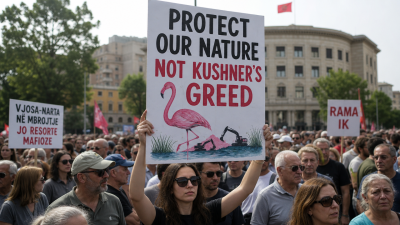
As of now, thousands of Albanians are conducting daily protests in Tirana against a Jared Kushner‑linked luxury coastal project. The “Flamingo Revolution” combines environmental, governance and sovereignty concerns over development on Sazan Island and the Vjosa‑Narta Protected Landscape.
What is the issue?
The project is a USD 1.6 billion luxury coastal development associated with Affinity Partners and Atlantic Incubation Partners. Planned infrastructure includes 800 guest rooms, villas, golf course, casino, water park and residential units. Sites proposed for development include Sazan Island and the Vjosa‑Narta Protected Landscape. Critics say 2024 law amendments removed ecosystem safeguards and allowed construction in areas covered by the EU Natura 2000 network.
Why it matters
- Environment: Vjosa‑Narta is a wetland hosting flamingos, Dalmatian pelicans and loggerhead sea turtles. Reported clearing of coastal pines and sand dunes in Pishë Poro‑Narta in late April 2026 risked habitat loss and erosion.
- Governance: Protests demand Prime Minister Edi Rama’s resignation and allege favouritism and corruption. Albania’s anti‑corruption agency has opened an investigation into land ownership and approvals.
- International relations: The European Parliament urged an immediate moratorium on permits and construction until 2024 amendments are repealed and EU environmental standards met.
- Economy and society: Government presents the project as growth and jobs‑oriented; opponents cite long‑term ecological and livelihood risks to fishing and tourism.
Environmental stakes and legal framework
Protected area status: Vjosa‑Narta is part of a Natura 2000 network area that imposes precautionary obligations under EU environmental law. Removal of ecosystem protections in domestic law alters the regulatory baseline. EIA and permitting: International practice requires comprehensive Environmental Impact Assessment, public consultation and adherence to mitigation hierarchy. Reports of unauthorised heavy machinery operations point to weak enforcement of permitting and monitoring.
Governance, accountability and public mobilisation
- Transparency: Questions concern land titles, procurement and tender transparency. Effective oversight requires open land registries and publication of contracts and EIAs.
- Institutions: Role of anti‑corruption agency, parliamentary committees and judiciary is central for checks and balances. Independent investigations can restore procedural legitimacy.
- Civic action: Daily protests show sustained public mobilisation. The flamingo emerged as a focal symbol linking biodiversity loss to democratic accountability.
International actors and implications
Foreign investment (Affinity Partners) is central. The European Parliament’s resolution shows EU institutions can exert political and conditional pressure, especially given Albania’s EU candidate status. State defence of the project, and claims of foreign interference by the Prime Minister, politicise external engagement and complicate investor‑state relations and accession dynamics.
Economic claims, risks and risk mitigation
- Government claim: Project will generate investment, tourism and jobs.
- Risks: Environmental degradation, loss of ecosystem services, reputational costs, possible suspension of EU accession assistance, and investor‑state litigation if procedural norms are later enforced.
- Mitigation options: Immediate moratorium on construction in protected zones, independent EIA and biodiversity offsets only as last resort, transparent stakeholder consultations, conditional approvals tied to verifiable safeguards.
Policy and legal options for India‑relevant learning
| Dimension | Specific measures |
|---|---|
| Legislative safeguards | Restore statutory ecosystem protections; align domestic law with international obligations where applicable. |
| Regulatory practice | Strengthen EIA rules, mandatory public hearings, real‑time monitoring of permits and site activity. |
| Transparency | Publish land records, investor contracts and EIAs; use digital registries and grievance portals. |
| Accountability | Empower anti‑corruption bodies and auditors; judicial review of major land use changes. |
| Diplomatic management | Manage foreign investment through clear standards; use accession and multilateral processes to enforce environmental norms. |
Model Questions
1. How does the ‘Flamingo Revolution’ illustrate the trade‑offs between large‑scale tourism infrastructure and conservation of coastal wetlands? [GS-III: Environment & DM]
The case shows a direct trade‑off: large investment promises jobs and revenue but threatens biodiversity and ecosystem services in wetlands. Key issues include weakened legal protections, inadequate EIA and enforcement, habitat loss for species like flamingos, and long‑term risks to fisheries and coastal resilience. Policy choices should require moratoria, rigorous EIA, compensatory conservation only after avoidance and restoration, and stakeholder consent.
2. Analyse the governance and accountability failures evident in the protests against the Albanian coastal project. [GS-II: Governance]
Failures include legislative rollback of protections, opaque land approvals, alleged collusion between elites and investors, and reported unauthorised site works. Institutional responses—anti‑corruption probe and parliamentary scrutiny—are necessary but delayed. Remedy requires transparent records, strengthened oversight bodies, timely public consultation, judicial review of law changes, and sanctions for procedural violations to restore legitimacy and public trust.
3. Evaluate the role of international actors — investors and EU institutions — in shaping national environmental policy in cases like Albania. [GS-II: International Relations]
Foreign investors bring capital and commercial pressure; their engagement can incentivise infrastructure but may sidestep local safeguards. EU institutions can use political leverage and accession conditionality to enforce standards, as seen in the European Parliament’s moratorium call. Effective governance requires alignment of investment frameworks with international environmental norms, clause‑based conditionality in contracts, and multilateral oversight mechanisms.
4. Discuss the ecological importance of protecting sites such as Vjosa‑Narta and consequences of weakening protections. [GS-III: Environment & DM]
Coastal wetlands provide breeding habitat, migratory stopovers, carbon sequestration and coastal protection. Vjosa‑Narta supports flamingos, pelicans and turtles; degradation would cause species decline, loss of fisheries, increased erosion and diminished tourism value. Weakening protections risks irreversible biodiversity loss and socioeconomic harm. Safeguards should prioritise avoidance, strict impact mitigation and legally binding conservation measures.
Last Modified: June 30, 2026