
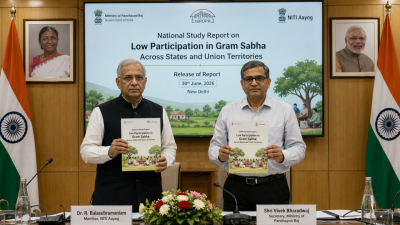
A National Study Report on low Gram Sabha participation was released in New Delhi on 30 June 2026 by Dr R. Balasubramaniam (NITI Aayog), with the Secretary, Ministry of Panchayati Raj present. The NIRD&PR study surveyed about 7,790 respondents across ~400 Gram Panchayats in 26 States and UTs, including PESA and women-led panchayats.
Key facts from the report
- Release and authorship: Report prepared by NIRD&PR for the Ministry of Panchayati Raj; released by Dr R. Balasubramaniam.
- Sample and coverage: c.7,790 respondents in ~400 Gram Panchayats across 26 States/UTs; included PESA and women-led Gram Panchayats.
- Scope: Analyses determinants of low Gram Sabha attendance — awareness, communication, inclusiveness, institutional responsiveness, governance, infrastructure, citizen perceptions.
- Objective: Provide evidence-based measures to strengthen participatory democracy and grassroots governance under Article 243A.
- Digital tools noted: eGramSwaraj and SabhaSaar (AI meeting tool in 23 languages) referenced as operational supports.
Constitutional and legal framework
Article 243A and the place of Gram Sabha
Article 243A makes the Gram Sabha the basic unit of village-level participatory democracy. The 73rd Constitutional Amendment gave statutory status to Panchayats and established Gram Sabha as a forum of direct citizens’ participation for oversight, planning and social accountability.
PESA and special legal provisions
PESA (1996) extends Part IX to Scheduled Areas. It grants Gram Sabhas specific powers over natural resources, customary institutions and local governance in tribal areas. Effective Gram Sabha functioning is necessary to realise PESA’s objective of local self-rule.
Causes of low Gram Sabha participation
- Awareness deficit: Limited citizen knowledge of Gram Sabha functions, rights and decision-making authority.
- Poor communication: Late or absent notices, unclear agendas, and inadequate use of local languages reduce turnout.
- Exclusion and social barriers: Gender norms, caste hierarchies and mobility constraints restrict participation of women and marginalised groups.
- Institutional non-responsiveness: Low follow-up on resolutions and weak implementation discourage future attendance.
- Governance deficits: Opacity in accounts, limited disclosure of plans and limited citizen voice reduce trust.
- Infrastructure constraints: Lack of accessible meeting spaces, basic amenities and scheduling that conflicts with livelihoods.
- Perception of ineffectiveness: Citizens view attendance as time-consuming without tangible outcomes.
Implications for participatory democracy and PRI functioning
Weak Gram Sabha attendance undermines direct accountability, reduces community oversight of expenditure and assets, weakens inclusive planning and skews resource allocation. It limits social audit, constrains local priority-setting and diminishes legitimacy of Gram Panchayat decisions. Long-term effects include poorer service delivery, reduced trust in local institutions and weaker rural governance outcomes.
Digital governance tools and operational limits
- eGramSwaraj: Platform for planning, financial transparency, asset registry and progress tracking. It can publish notices, minutes and resolution status.
- SabhaSaar: AI meeting tool available in 23 languages. It can structure agendas, transcribe minutes, and create searchable resolution logs.
- Constraints: Digital divide, network reliability, digital literacy, language coverage gaps and data privacy concerns may limit uptake.
- Practical use: Combine digital tools with analog outreach (public announcements, community volunteers) and ensure offline access to minutes and decisions.
Special contexts: PESA areas and women-led Gram Panchayats
PESA areas require respect for customary institutions and legally mandated Gram Sabha powers over mining, forest produce and land alienation. Barriers include limited legal awareness and state capacity to enforce PESA. Women-led panchayats face sociocultural resistance, safety and mobility constraints. Interventions must include legal empowerment, targeted communication, capacity building, safe meeting logistics, and resources to act on Gram Sabha resolutions.
Policy recommendations and implementation roadmap
| Stakeholder | Key actions |
|---|---|
| Ministry of Panchayati Raj | Issue operational guidelines on Gram Sabha notice period, mandatory agenda items, publication of minutes; fund capacity building and infrastructure grants. |
| State governments | Adapt guidelines to local conditions, enforce PESA provisions, integrate Gram Sabha compliance in performance metrics and provide logistical support. |
| Gram Panchayats | Fixed annual schedule of Gram Sabhas, use local language notices, maintain public registers, track and publish resolution implementation status. |
| Technology providers | Localise eGramSwaraj and SabhaSaar interfaces; enable offline access and low-bandwidth modes; ensure data protection. |
| Civil society and media | Run awareness drives, mobilise marginalised groups, monitor attendance and follow-up, support social audits. |
| NIRD&PR and academic bodies | Provide training curricula, standard operating procedures, impact evaluation frameworks and periodic studies to track progress. |
Monitoring and evaluation metrics
- Attendance metrics: Percentage turnout, gender and marginalised group participation per Gram Sabha.
- Outcome metrics: Percentage of Gram Sabha resolutions implemented; time-to-action after resolution.
- Transparency metrics: Proportion of panchayats publishing notices, minutes and accounts publicly.
- Quality metrics: Citizen satisfaction scores; number of social audits conducted; frequency of scheduled Gram Sabhas held.
- Digital metrics: Digital access rates to eGramSwaraj/SabhaSaar outputs and proportion of panchayats using digital tools.
Model Questions
1. Critically examine the constitutional significance of Gram Sabhas under Article 243A and analyse the key factors responsible for low participation as indicated by recent studies. [GS-II: Constitution of India & Polity]
Gram Sabha is the constitutionally recognised forum for direct democracy at village level under Article 243A and the 73rd Amendment. Low participation stems from low awareness, poor notice and agenda systems, socio-cultural exclusion, weak follow-up on resolutions, governance opacity, infrastructure deficits and adverse perceptions about effectiveness. Restoring attendance requires legal enforcement, information disclosure, inclusive logistics and demonstrable implementation of Gram Sabha decisions.
2. Discuss how the National Study Report’s recommendations, combined with digital governance tools, can strengthen accountability and citizen participation in Panchayati Raj Institutions. [GS-II: Governance]
The report recommends clearer notice norms, agenda disclosure, minutes publication, capacity building and infrastructure support. Digital tools (eGramSwaraj, SabhaSaar) can automate notices, transcribe minutes, track resolution status and increase transparency. Effective use needs localisation, offline options, data protection and complementary community outreach. Together these measures can improve oversight, expedite implementation and rebuild trust between citizens and PRIs.
3. Analyse special challenges to Gram Sabha participation in PESA areas and women-led Gram Panchayats and propose targeted policy measures for inclusiveness. [GS-II: Social Justice]
PESA areas face weak enforcement of customary rights, low legal awareness and state capacity gaps; women-led panchayats confront patriarchy, mobility and safety issues. Targeted measures include legal awareness campaigns, protecting PESA powers, dedicated funds for tribal governance, training for women representatives, safe meeting arrangements, childcare support during meetings and quotas for marginalised representation in Gram Sabha agendas and monitoring bodies.
4. Evaluate the institutional roles needed for implementation of the report’s recommendations, describing coordination mechanisms between central agencies, states, PRIs and civil society. [GS-II: Governance]
Implementation requires Ministry of Panchayati Raj to issue operational guidelines and fund interventions; states to adapt and enforce; PRIs to operationalise schedules and disclosures; NIRD&PR to provide training and evaluation; NITI Aayog to align Gram Sabha outcomes with national programmes. Formal coordination can use joint task forces, state-level action plans, MIS dashboards, periodic reviews and civil society partnerships for mobilisation and monitoring.
Last Modified: June 30, 2026