
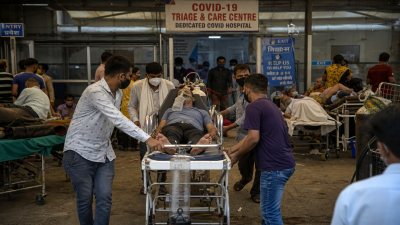
India’s second COVID-19 wave remains a key governance lesson. Rapid case escalation triggered cascading failures across oxygen, ambulances, beds and funerary services. Recent analyses stress early risk communication, incident-command arrangements, community triage and system-wide resilience to reduce avoidable mortality and social disruption.
What is the issue
India’s 2021 second wave exposed how a pandemic becomes a systems crisis. Interconnected failures in oxygen supply, logistics, hospital capacity and patient flow amplified mortality. Gaps in surveillance, rural capacity and emergency financing worsened the shock.
Why it matters
Failure to manage cascading system risks affects governance, public trust, economic activity and security. Dense population, rapid urbanisation and internal migration increase transmission risk. Preparedness deficits leave India vulnerable to future outbreaks and cross-border spread.
Nature of pandemics as systems crises
- Interdependence: Health services, supply chains, transport, data systems and civic functions are mutually dependent. A breakdown in one cascades quickly.
- Speed and scale: Exponential case growth rapidly overwhelms capacity unless surge measures are ready.
- Equity impact: System failures disproportionately affect the poor and rural populations.
Challenges exposed during the second wave
- Infrastructure overload: Acute oxygen shortages; ICU and bed shortages in several cities and districts.
- Human resources: Local shortages of trained clinical staff and logistic personnel.
- Coordination gaps: Fragmented patient referral and bed allocation systems.
- Information deficits: Delayed risk communication and weak community triage guidance.
- Financing and surge capacity: Limited emergency funds and procurement bottlenecks for PPE, oxygen equipment and testing.
Key crisis-management lessons
- Early risk communication: Timely, clear public messaging reduces panic and inappropriate care-seeking.
- Incident-command structures: A single, accountable command and control system speeds referrals, allocations and evacuation planning. A virtual incident command system, supported by the EU, proved operationally useful for bed allocation and patient transfers.
- Community-level triage: Triage must begin at household level. Evidence-based home-triage guidelines developed by medical college alumni reduced preventable morbidity.
- Systemic resilience: Build capacity across accessibility, affordability, quality and equity rather than single-point fixes.
- Surge-readiness: Maintain surge stocks for oxygen, ventilators, PPE, testing and modular ICU capacity.
Governance and institutional reforms
- Clear accountability: Define vertical and horizontal roles for centre, states and urban local bodies under incident-command arrangements.
- Data-driven coordination: Real-time bed and oxygen dashboards, interoperable through National Digital Health Mission standards, for rapid allocation.
- Integrated logistics: Centralised procurement and rapid mobilisation mechanisms for oxygen and critical supplies during surges.
- Leadership and communication: Political and administrative leadership can sustain supply chains and public compliance. Recent recognition of large-scale vaccine delivery shows capacity for mass mobilisation.
Preparedness, policy initiatives and financing
- Programmes: Ayushman Bharat and National Digital Health Mission aim to expand primary care, create health IDs and enable data flow for surge response.
- Disease surveillance: Strengthen integrated surveillance (including genomic surveillance) and rapid reporting from rural networks and urban centres.
- Rural health infrastructure: Invest in PHCs, rural oxygen plants, oxygen piping, and trained staff to reduce urban pressure.
- Emergency financing: Create pre-authorised contingency funds and rapid procurement frameworks to buy equipment and deliver services during spikes.
- Global assessment: A WHO report finds global preparedness insufficient; India must address vulnerabilities linked to density and migration.
| Sector | Observed failure | Priority reform |
|---|---|---|
| Oxygen supply | Shortages, logistic delays | Decentralised oxygen plants, buffer stocks, transport corridors |
| Hospital capacity | Bed and ICU shortages | Modular surge wards, bed-tracking dashboards, cross-district patient transfers |
| Community care | Late presentation, limited home management | Home-triage protocols, ASHA training, telemedicine support |
Operational measures: community triage and risk communication
- Home-triage tools: Simple vital-sign checklists and oxygen-saturation thresholds for families to decide escalation. Promote via primary health workers and mobile SMS/IVR.
- Primary care strengthening: Equip PHCs with pulse oximeters, basic oxygen delivery and referral protocols.
- Communication strategy: Single authoritative channels, local-language content, myth-busting and clear escalation steps for mild, moderate and severe illness.
- Community actors: Use ASHAs, panchayats and local NGOs for outreach, monitoring and transport coordination.
Technological integration and human factors
- Telemedicine: Scale teletriage for early clinical assessment and remote monitoring to ease hospital load.
- Artificial Intelligence: Use AI for case forecasting, resource allocation and anomaly detection in surveillance, with human oversight.
- Digital health standards: NDHM interoperability supports rapid sharing of test results, vaccination records and bed availability across jurisdictions.
- Limitations: Technology requires broadband reach, data privacy safeguards and trained users; do not replace frontline staff.
Financing, supply chains and human resources
- Pre-positioned funds: Create ring-fenced contingency finance and simplified procurement rules for emergencies.
- Supply-chain mapping: Identify bottlenecks for oxygen cylinders, concentrators and essential drugs; diversify suppliers.
- Workforce surge: Maintain a register of retired and volunteer clinicians, with short re-skilling modules and indemnity provisions.
Accountability, audit and continuous learning
- After-action reviews: Conduct institution- and district-level reviews to update SOPs, triage guides and supply plans.
- Transparency: Public dashboards for resource availability and procurement to build trust and enable civic oversight.
Way forward
- Shift to proactive management: Invest in surveillance, primary care and surge capacity so response is anticipatory rather than reactive.
- Build equitable resilience: Prioritise rural infrastructure, community triage and financing mechanisms to protect vulnerable populations.
- Institutionalise incident-command: Maintain trained command teams, interoperable data platforms and legal clarity for swift mobilisation.
Model Questions
1. Examine the administrative and institutional lessons from India’s second COVID-19 wave for future pandemic preparedness. [GS-II: Governance]
Effective preparedness requires clear incident-command lines, real-time interoperable data systems, decentralised surge capacity and pre-authorised emergency financing. Strengthen vertical coordination among centre, states and local bodies. Institutionalise bed and oxygen dashboards, standard operating procedures for referrals, and a national register for surge human resources. Regular after-action reviews and transparent public reporting ensure accountability and continuous improvement.
2. Analyse the pillars of a resilient, equitable and adaptable healthcare system and assess ongoing initiatives to achieve this transformation in India. [GS-III: Economic Development]
Resilience rests on accessibility, affordability, quality and equity. Initiatives include Ayushman Bharat for financial protection and primary care, and the National Digital Health Mission for interoperable records. Reforms require rural infrastructure, workforce expansion, disease surveillance and surge stocks for equipment. Complementary measures: emergency financing, decentralised oxygen plants and targeted investment in PHCs to reduce urban overload.
3. Evaluate the role of community-level triage and risk communication during India’s second wave and recommend measures to strengthen these components for future crises. [GS-III: Environment & DM]
Community triage reduced preventable hospital overload when families had clear home-monitoring thresholds and referral triggers. Strengthen by distributing pulse oximeters at PHCs, training ASHAs, issuing simple triage protocols in local languages, and using teleconsultation hubs. Risk communication must be timely, centralised and locally adapted, with myth-busting, escalation steps and transport arrangements to ensure early care-seeking.
4. Assess the potential and limits of AI and telemedicine in shifting India’s healthcare system from reactive to proactive pandemic management. [GS-III: Science & Technology]
AI can improve forecasting, resource allocation and anomaly detection; telemedicine enables remote triage and monitoring, reducing hospital burden. Limits include digital divide, data privacy risks and need for clinical validation. Policy must ensure interoperability, regulatory safeguards, capacity-building for users and integration with ground-level services so technology augments—not replaces—public health and clinical systems.
Last Modified: June 24, 2026