
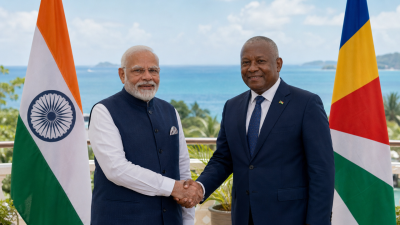
Prime Minister Narendra Modi is on a three‑day State Visit to Seychelles (June 27–29, 2026) as Guest of Honour for the National Day Golden Jubilee. The visit includes handover of an Indian‑made fast patrol vessel, participation of two Indian Navy ships and a defence contingent, and bilateral talks to review cooperation and explore new areas including AI, cyberspace, marine sciences and blue economy.
What is current and why it matters
Current developments
- Visit and matériel: Handover of a fast patrol vessel to the Seychelles Coast Guard; INS Tarkash escorted PS Zoroaster after a GRSE refit and delivered spare parts and stores.
- Military engagement: Indian defence contingent and two Indian Navy ships are present for National Day events; LAMITYE tri‑service exercise held recently in Victoria.
- Policy and finance: India announced a USD 175 million Special Economic Package and adopted the SESEL joint vision; new cooperation areas being explored include AI, cybersecurity, marine sciences and blue economy.
Strategic significance for India in the Indian Ocean Region
- Geography and sea‑lanes: Seychelles occupies a strategic position in the western Indian Ocean—proximate to major east–west sea lines of communication and chokepoints that matter for trade and energy flows.
- Policy fit: Partnership implements Vision MAHASAGAR and SAGAR priorities: maritime security, domain awareness and support to island states to maintain open seas for commerce and fisheries.
- Countering extra‑regional influence: Persistent Indian presence and capacity assistance reduce the strategic vacuum that can invite external military footprints.
- Operational reach and MDA: Patrol vessels, radars, surveillance aircraft and joint exercises extend maritime domain awareness and interdiction reach in the western IOR.
Multi‑faceted defence cooperation: initiatives and operational impact
Key initiatives
| Asset / Initiative | Purpose | Note |
|---|---|---|
| Gifting of patrol vessels (PS Topaz, PS Constant, PB Hermes, PB Boudeuse, PS Zoroaster; new fast patrol vessel) | Coastal patrol, EEZ surveillance, interdiction | New fast patrol vessel handed over during State Visit |
| Dornier maritime patrol aircraft; six Coastal Surveillance Radar Systems | Maritime surveillance, persistent MDA | Improves early detection and response |
| LAMITYE (tri‑service joint exercise) | Interoperability, maritime security operations, counter‑terrorism | 11th edition held in Victoria |
| Naval visits, refit and logistics support (GRSE refit of PS Zoroaster; INS Tarkash visit) | Operational sustainment, logistics, ship maintenance | Spare parts and stores transferred to support readiness |
| Hydrographic surveys (INS Darshak) and defence industry engagement | Safe navigation, capacity building, equipment supply | Hydrographic surveys conducted earlier; defence seminars held |
Operational impact
- Maritime domain awareness: Radars, patrol craft and aircraft create layered surveillance of Seychelles’ EEZ and adjacent oceanic routes.
- Countering transnational crimes: Enhanced capability to address piracy, illegal fishing, narcotics trafficking and human trafficking.
- Interoperability and readiness: Joint exercises and refits improve combined response to maritime incidents and humanitarian crises.
- Force sustainability: Ship repairs, spare parts transfer and training reduce downtime and increase patrol tempo.
New avenues of cooperation and contemporary challenges
- Artificial Intelligence and cyberspace: Collaboration can improve maritime surveillance analytics, automated anomaly detection, and secure communication networks. Cybersecurity cooperation is needed to protect critical maritime infrastructure and ISR systems.
- Marine sciences and blue economy: Joint research, fisheries management and sustainable development projects support livelihoods, resource governance and climate resilience for an island state.
- Economic‑security nexus: SESEL and the USD 175 million package link economic assistance with security cooperation to broaden strategic partnership beyond defence hardware.
- Challenges: Technology transfer limits, dependence on external logistics, need for local maintenance capacity, and the diplomatic balance required as other powers engage in the region.
Partnership under ‘Neighbourhood First’ and regional security implications
- Policy coherence: The partnership is consistent with a neighbourhood‑centred foreign policy that prioritises small island states through capacity building and economic support.
- Regional public goods: Enhanced maritime security contributes to safer sea lanes, disaster response capacity and fisheries protection—benefits for wider Indian Ocean states.
- Soft power and diplomacy: Regular high‑level visits, defence seminars and humanitarian cooperation strengthen political trust and long‑term ties.
- Risk mitigation: To avoid over‑dependence and strategic friction, the partnership must emphasise transparency, local skills development, and multilateral maritime governance involving regional institutions.
Model Questions
1. Analyse the strategic significance of India’s maritime defence partnership with Seychelles for India’s geopolitical objectives in the Indian Ocean Region. [GS-II: International Relations]
India’s partnership with Seychelles secures a strategic foothold in the western Indian Ocean, protecting sea lanes and energy routes. It operationalises Vision MAHASAGAR/SAGAR through MDA, patrol assets and joint exercises, enhancing India’s role as a regional security provider. The relationship reduces scope for extra‑regional military footprints, strengthens regional stability and permits forward logistics and humanitarian response, while requiring calibrated diplomacy to manage strategic competition.
2. Examine the multi‑faceted nature of India‑Seychelles defence cooperation, detailing key initiatives and their impact on maritime security and capacity building. [GS-III: Internal & External Security]
Cooperation combines gifting patrol vessels and surveillance aircraft, installation of coastal radars, hydrographic surveys, ship refits and tri‑service exercises (LAMITYE). These measures raise Seychelles’ EEZ surveillance, interdiction and sustainment capacity. Joint training improves interoperability and response to piracy, illegal fishing and trafficking. Industry engagement and logistics support reduce operational gaps and build local maintenance and operational skills.
3. Discuss the new avenues of cooperation between India and Seychelles such as AI, cybersecurity, marine sciences and blue economy, and explain their relevance to contemporary maritime challenges. [GS-III: Science & Technology]
AI and secure data links can enhance sensor fusion, predictive maritime analytics and automated threat detection. Cybersecurity protects maritime ISR, ports and communication. Marine science cooperation supports fisheries management, seabed studies and climate adaptation. Blue economy initiatives diversify livelihoods and resource governance. Together these avenues address non‑traditional threats, improve resilience of island states and align security assistance with sustainable development.
4. Critically evaluate the India‑Seychelles partnership in the context of India’s ‘Neighbourhood First’ policy and its role in fostering a secure and prosperous Indian Ocean. [GS-II: Governance]
The partnership exemplifies ‘Neighbourhood First’ by combining defence assistance, economic support (USD 175 million package) and SESEL to link growth with security. It builds regional public goods—MDA, disaster response and fisheries protection—strengthening a cooperative security framework. Risks include dependency and strategic friction; mitigation requires capacity transfer, transparency, regional cooperation mechanisms and consistent support for local governance and infrastructure.
Last Modified: June 27, 2026