
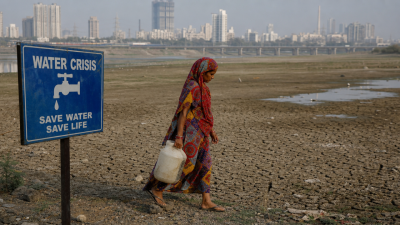
As of 5 July 2026 Indian cities including Bengaluru, Mussoorie and Delhi face acute water stress. Monsoon rainfall showed a sharp June deficit. Major reservoirs hold low storage and most large river basins report water scarcity. Policy action is shifting from supply-only fixes to demand management, reuse and basin-level data-led governance.
Current state of water stress
- Urban shortage: Cities such as Bengaluru and Delhi have large gaps between supply and demand. Delhi’s supply is about 70% of its daily need (≈1,250 million gallons/day).
- Monsoon deficit: A deep rainfall shortfall in June has reduced inflows and raised scarcity risks linked to El Niño.
- Reservoir storage: CWC reports 166 major reservoirs at about 26% of live capacity; some states show critically low or zero levels.
- Basin stress: CEEW finds 11 of 15 major river basins are water-stressed, with per capita annual availability below 1,000 m³ in several basins.
Why this matters
- Public health: Reduced safe water supply raises disease and sanitation risks.
- Agriculture and rural livelihoods: Basin-level scarcity threatens crop water supply, income and food security.
- Urban economy and services: Industry, tourism and daily life face disruptions from rationing and bans.
- Security and social stability: Water stress can lead to inter‑sectoral and inter‑state tensions and displacement of labour.
Key challenges
- Infrastructure deficits: Ageing networks, poor operation and maintenance, and high conveyance losses in distribution.
- Wastewater gap: Insufficient treatment capacity and low reuse of treated effluent.
- Data and accounting: Weak basin-level water accounting and limited real-time leakage and consumption data.
- Financial weakness: Low cost recovery and inadequate O&M funding for utilities.
- Pollution and quality: Source contamination reduces usable water volumes.
- Policy fragmentation: Sectoral silos, weak inter-state basin coordination and unclear institutional responsibilities.
Government initiatives and policy framework
- Jal Jeevan Mission 2.0: Extended to December 2028 with higher budget allocation to strengthen supply and community systems.
- Pradhan Mantri Krishi Sinchayee Yojana: Continues to support irrigation infrastructure and on-farm water use efficiency.
- Local measures: City actions such as Bengaluru’s ban on non-essential use, mandatory water-saving aerators and penalties for misuse.
- Urban finance: Cities such as Visakhapatnam secured funds (₹1,501 crore) under an Urban Challenge Fund for targeted water projects.
Technological and financial solutions
- Smart metering and AI: Smart meters in Delhi and Bhubaneswar and AI-based leakage detection improve loss control and billing accuracy.
- Wastewater reuse: Municipal treated effluent reuse for industrial and landscaping needs (Thane example) reduces freshwater demand.
- Micro‑irrigation: Scaling drip and sprinkler systems and redesigning subsidies to prioritise smallholders improves irrigation efficiency.
- Climate proofing: Infrastructure design norms and operation plans must account for variable monsoon and extreme events.
- Financing models: Blended finance, targeted grants for O&M, user‑charge rationalisation and results‑based aid to utilities to ensure sustainability.
Governance and institutional reforms
- Basin-level planning: Establish statutory basin institutions or strengthen existing bodies for allocation, accounting and dispute resolution.
- Data governance: Mandate public, standardised basin water accounts. Integrate CWC, state agencies and city data with smart-meter feeds.
- Utility reform: Separate bulk supply, distribution and wastewater functions; enforce performance contracts focused on NRW (non-revenue water) reduction.
- Regulation and tariffs: Adopt progressive tariffs, targeted subsidies and service-level standards linked to funding.
- Community and stakeholder roles: Local water security plans, user associations, and urban water conservation bylaws to improve compliance and ownership.
Practical priorities for near term action
| Challenge | Immediate intervention | Medium-term reform |
|---|---|---|
| Low reservoir storage | Demand restrictions and emergency rationing | Basin allocation rules; conjunctive use plans |
| High distribution losses | Smart meters and targeted leak repair | Utility performance contracts; NRW targets |
| Wastewater underuse | Permit reuse for non-potable urban/industrial use | Scale treatment capacity; reuse markets |
| Agricultural overuse | Promote micro-irrigation pilots with farmer support | Redesigned subsidy to smallholders; crop diversification incentives |
Policy trade-offs and risks
- Equity vs efficiency: Tariff increases must protect poor households through lifeline rates or targeted transfers.
- State versus basin authority: Stronger basin institutions may face political resistance from states and local bodies.
- Short-term rationing impacts: Rationing stabilises supply but can harm informal workers and marginal farmers if social safeguards are absent.
- Technology dependence: Smart systems need maintenance, cybersecurity and capacity building to avoid failure or data gaps.
Operational checklist for administrators
- Immediate: Enforce non-essential use bans; deploy rapid leak teams; activate alternative supplies and reuse options.
- Quarterly: Publish basin water accounts; set utility NRW reduction milestones; audit wastewater treatment use.
- Annual: Rework subsidy rules for micro-irrigation; allocate durable O&M funds; negotiate inter-state basin agreements.
Model Questions
1. Critically examine the key dimensions of India’s current water stress and its implications for urban and rural livelihoods. [GS-III: Environment & DM]
India’s water stress comprises a large monsoon deficit, 26% average live reservoir storage, and 11 of 15 major basins below scarcity thresholds. Urban impacts include reduced municipal supply, service interruptions and economic loss. Rural effects include irrigation shortfalls, crop failures and income loss. The distributional outcome hits small farmers, informal workers and poor urban households most. Policy responses must integrate supply management, demand restraint and basin-level accounting.
2. Analyse the governance failures that contribute to India’s water crisis and propose institutional reforms to improve water security. [GS-II: Governance]
Failures include fragmented institutions, weak basin accounting, poor utility O&M and low cost recovery. Reforms: create statutory basin authorities for allocation and dispute resolution; mandate public basin water accounts; separate bulk supply and distribution roles; enforce utility performance contracts tied to NRW reduction; adopt progressive tariffs with targeted support; strengthen inter‑departmental coordination and local user institutions for better implementation.
3. How can technology and financial instruments be used to enhance water security in India? Discuss with examples. [GS-III: Economic Development]
Technology: smart meters and AI leak detection reduce losses; treated wastewater reuse cuts freshwater demand; micro-irrigation improves crop water use. Finance: blended finance and Urban Challenge Funds co‑finance high-impact projects; results-based grants incentivise utility performance; subsidy redesign targets small farmers for micro‑irrigation uptake. Example: smart metering pilots in Delhi and Bhubaneswar, and municipal reuse projects such as Thane, demonstrate immediate gains for scale-up.
4. Suggest a multi-pronged strategy to build long-term structural resilience against water scarcity at city and basin levels. [GS-III: Environment & DM]
Adopt integrated water resource management at basin scale, combine demand management (tariffs, bans, conservation) with supply diversification (reuse, conjunctive groundwater use). Invest in wastewater treatment, smart metering and climate‑proof infrastructure. Reform subsidies for efficient irrigation and fund O&M. Strengthen basin data systems and community participation. Pair emergency measures with medium‑term institutional reforms to balance equity and efficiency.
Last Modified: July 5, 2026