
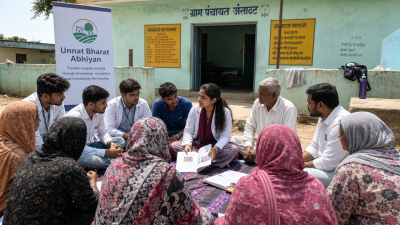
Unnat Bharat Abhiyan (UBA) currently connects higher education institutions with rural communities to co-design solutions for sanitation, livelihoods, health awareness and infrastructure. The programme promotes experiential learning, community engagement and village-scale sustainable development while operating at national scale across all States and UTs.
What UBA is and why it matters
UBA is a Ministry of Education programme that requires Higher Educational Institutions (HEIs) to adopt clusters of villages and work as partners in problem-solving. It matters for governance and development because it:
- Brings technical resources to local problems: HEIs deploy multidisciplinary expertise for practical solutions.
- Reorients higher education: Shifts learning from classroom theory to field-based practice and civic responsibility.
- Supports rural development goals: Targets sanitation, livelihoods, health awareness and basic infrastructure at village level.
Operational framework
- Village adoption: Institutions adopt clusters and map local needs through participatory diagnosis.
- Academic engagement: Departments (engineering, medical, law, agriculture, social sciences) collaborate on context-specific interventions.
- Partnerships: Work with gram panchayats, block officials, NGOs and citizen groups to design, pilot and scale solutions.
- Monitoring: Institutions report outcomes to the national UBA portal and follow agreed metrics for sustainability and replication.
Alignment with National Education Policy 2020
- Experiential learning: UBA operationalises NEP’s emphasis on experiential, project-based learning outside the campus.
- Social responsibility: Integrates community engagement into HEI functions as envisaged by NEP.
- Multidisciplinarity: Encourages cross-faculty projects consistent with NEP’s curricular flexibility.
Impact on higher education
- Student learning: Field exposure improves problem-solving, project management and communication skills.
- Faculty practice: Creates opportunities for applied research, community-based teaching and extension activities.
- Institutional culture: Promotes institutional social accountability and links research agendas to grassroots needs.
Socio‑economic impact on rural communities
- Public health and sanitation: Waste management pilots, hygiene kits and behaviour-change campaigns improve local health outcomes.
- Local infrastructure: Small-scale interventions (smart bins, bacteria-resistant communal surfaces) raise service quality.
- Civic awareness: Youth parliaments and legal literacy build constitutional awareness and citizen capacity.
- Livelihoods and agriculture: Technological solutions and agri-innovation projects support income diversification and productivity.
Illustrative examples
- Jamia Hamdard: Deployed engineering, pharmacy, medical and legal faculties in villages such as Saidul Azaib to implement waste management, repaint a chaupal with bacteria-resistant materials, install smart waste bins and distribute hygiene kits; law students ran youth parliaments for constitutional literacy.
- Central University of Gujarat: Focuses on technological solutions, sustainable development, agricultural innovation and community-engaged research in adopted villages.
- National recognition: A recent research paper (June 2026) describes UBA as a national framework for HEI-led rural development.
Scale and recent status
- Coverage: UBA has grown into a nationwide movement with about 4,600 participating institutions covering roughly 22,000 villages.
- Programme age: The programme completed eleven years of operation in late 2025 and continues to expand institutional participation.
Key implementation challenges
| Challenge | Details |
|---|---|
| Faculty engagement | Limited sustained participation because community work is not always tied to career incentives or workload norms. |
| Funding and continuity | Modest and often short-term funding leads to pilot projects that are not scaled or maintained. |
| Operational constraints | Logistics, travel, coordination with local bodies and seasonal barriers raise implementation costs. |
| Community ownership | Risk of one-off interventions where the village is a recipient rather than a co-designer. |
Measures for enhanced effectiveness and sustainability
- Institutional incentives: Link community engagement to faculty appraisal, promotion criteria and credit-based student internships.
- Dedicated funding streams: Create multi-year grants or pooled funds to support sustained village engagement and scaling.
- Curriculum integration: Institutionalise field projects within course credits to ensure continuous student involvement.
- Local government convergence: Formalise partnerships with panchayats and line departments to embed projects in official service delivery.
- Participatory design: Require co-creation with village actors and use local knowledge systems as design inputs.
- Monitoring and M&E: Use measurable indicators, periodic reviews and third‑party evaluations to assess outcomes and long-term impact.
Way forward for policy and practice
- Scale quality, not only spread: Focus on deep, long-term engagements in selected clusters while documenting models for replication.
- Cross-sectoral platforms: Use state-level UBA cells to coordinate HEIs, state departments and donors for shared priorities.
- Research‑to‑policy feedback: Channel HEI research outputs into local planning and state rural development policies.
- Student pathways: Design internships, field courses and capstone projects that feed directly into village development plans.
Model Questions
1. Critically examine Unnat Bharat Abhiyan’s role in fostering sustainable rural development and transforming higher education in India. Discuss its alignment with the National Education Policy 2020. [GS-II: Governance]
UBA links HEIs with villages for co‑created solutions, promoting experiential learning, multidisciplinary projects and civic engagement. It aligns with NEP 2020 by integrating field-based learning, social responsibility and curricular flexibility. Strengths include applied research and student skill development; constraints include funding, continuity and faculty incentives. Policy focus should be on institutional incentives, multi-year funding and formal convergence with local governance to sustain impact and scale.
2. Despite its objectives, UBA faces challenges in achieving sustained impact. Analyse these challenges and suggest measures for more effective implementation. [GS-II: Governance]
Challenges: limited faculty participation, short-term funding, logistical constraints and risk of one-off projects lacking community ownership. Measures: tie community engagement to faculty appraisal and student credits; establish multi-year grants and pooled funds; formalise convergence with panchayats and departments; mandate participatory project design; institute monitoring, evaluation and knowledge-sharing platforms for scaling successful models.
3. Discuss the socio-economic impact of HEI-led community interventions under UBA with suitable examples. [GS-I: Indian Society]
HEI interventions improve sanitation, public health, livelihoods, civic literacy and small-scale infrastructure. Example: Jamia Hamdard’s work in Saidul Azaib — smart waste bins, bacteria-resistant repainting of communal space, hygiene kits and youth parliaments — raised hygiene, local awareness and constitutional literacy. Central University of Gujarat’s projects show gains in agricultural innovation and community-engaged research, demonstrating how academic inputs can affect income, health and governance capacities.
4. How does the ‘university to village’ model under UBA contribute to experiential learning for students and strengthen local governance through community engagement? Provide recent examples. [GS-II: Governance]
The model provides students with practical field exposure, problem-solving experience and multidisciplinary teamwork. It embeds applied research into local problems, enhancing employable skills and civic responsibility. For local governance, HEIs provide technical inputs, capacity building and participatory planning, as seen in Jamia Hamdard’s waste-management and youth-parliament initiatives. Sustained collaborations and formal convergence with panchayats are needed to translate pilots into institutionalised local governance routines.
Last Modified: July 3, 2026