
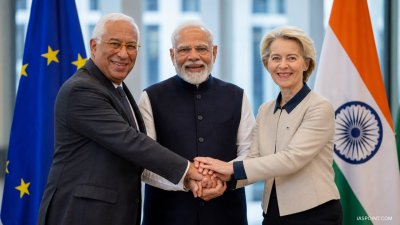
India and the European Union held the third Trade and Technology Council (TTC) ministerial in Brussels on 15 July 2026. The meeting launched formal negotiations for India’s association with Horizon Europe and agreed expanded cooperation across AI, semiconductors, clean technologies, high‑performance computing, quantum and 6G.
Current developments
- TTC meeting and leadership — Third India‑EU TTC held in Brussels; Indian side co‑chaired by S. Jaishankar, Piyush Goyal, Jitin Prasada and PSA Ajay K. Sood; EU delegation led by Henna Virkkunen, Maroš Šefčovič and Ekaterina Zaharieva.
- Horizon Europe — Formal negotiations launched for India’s association with the €93.5 billion research and innovation programme; target to conclude before end‑2026 to enable participation from 2027.
- Research funding and pilots — Joint projects (waste‑to‑green hydrogen, AI marine pollution monitoring, EV battery recycling) moved to pilot‑scale with a €60 million support envelope over four years.
- Industry platforms — First EU‑India Innovation Hub for EV charging announced; EU‑India Startup Partnership launched for deep‑tech clean technologies.
- Semiconductors — Cooperation to link India’s Semiconductor Mission design facilities with EU pilot lines under the EU Chips Act; joint semiconductor roundtable planned at Semicon India 2026.
- Governance work — Agreement to develop a Joint AI Roadmap for responsible AI; expanded activity in quantum, HPC and 6G; commitment to upgrade the TTC by end‑2026.
Why it matters
- Governance — Platform for regulatory dialogue on data, AI and standards that affects domestic law harmonisation and cross‑border cooperation.
- Economy — Access to Horizon Europe funding, EU market integration for startups, and semiconductor collaboration can accelerate India’s high‑tech manufacturing and services exports.
- Security — Diversification of supply chains and trusted‑technology partnerships reduce single‑source dependencies in strategic sectors.
- Environment — Joint clean‑tech pilots support circular economy, decarbonisation and green industrial jobs.
- Technology — Cooperation spans upstream research to commercialisation: AI, quantum, HPC, 6G and chips.
Geopolitical and strategic implications
- Multipolar technology order — The TTC institutionalises a democratic tech partnership that can shape standards, export controls and trusted supply networks outside a single‑bloc paradigm.
- Strategic autonomy — Diversified suppliers and collaborative manufacturing reduce strategic vulnerabilities for India in semiconductors, telecoms and critical electronics.
- Rules and norms — Joint work on AI and data governance offers scope to align regulatory norms among like‑minded partners and influence multilateral standard‑setting.
- TTC upgrade — Planned upgrade by end‑2026 raises the forum’s mandate to handle geo‑economic security and technology policy coordination.
Science, technology and industrial synergy
- Horizon Europe association — Association grants Indian researchers access to competitive funding, EU consortia, and technology networks; expected to unlock joint projects and mobility for scientists.
- Semiconductor integration — Linking India’s Semiconductor Mission design facilities with EU pilot lines supports advanced node design, testing, and pilot production; joint roundtable at Semicon India 2026 will target roadmap, investment and standards.
- Startup and commercialisation pathways — EU‑India Startup Partnership targets market access, investor links and scale‑up for deep‑tech cleantech firms.
- HPC and quantum — Cooperation can accelerate capability building in compute‑intensive research, secure algorithms and prototype quantum devices for industry and defence applications.
Clean technology and circular economy
- Waste‑to‑green hydrogen — Pilot validation aims to convert municipal or industrial waste streams to green hydrogen, reducing methane emissions and creating a low‑carbon feedstock for industry and transport.
- EV battery recycling — Joint pilots focus on material recovery, standards for second‑life batteries and domestic recycling value chains to lower import dependence and environmental risk.
- EV charging systems — Innovation Hub for charging technologies and testing will harmonise interoperability standards and safety protocols, easing EV adoption.
- Marine pollution monitoring — AI‑driven surveillance pilots combine satellite, sensor and ML analytics to detect oil spills, plastics and ecosystem stress in coastal waters.
Regulatory alignment and governance challenges
| Dimension | EU position | India position | Implication |
|---|---|---|---|
| Data protection | GDPR: rights‑centric, strict cross‑border rules | DPDP Act: development‑oriented, conditional flows and operational exceptions | Need operational safeguards and legal bridges for research and cloud services. |
| AI regulation | EU AI Act: risk‑based mandatory obligations | India: pro‑innovation approach with sectoral regulation and permissive R&D environment | Align certification, risk categories and liability rules to enable joint AI projects, especially in healthcare. |
| Semiconductor standards | EU Chips Act: emphasis on pilot lines, resilience and export controls | Semiconductor Mission: incentives for design, fabrication and ecosystem development | Harmonise testing, export compliance and IP arrangements to enable technology transfer. |
| IP and technology transfer | Strong IPR enforcement; conditional support for cross‑licensing | Support for capacity building, industrial policy interventions | Negotiate licensing terms, joint IP pools or co‑ownership models for joint R&D. |
Operational and implementation issues
- Financing and access — Converting Horizon Europe association into funded projects requires administrative readiness in Indian institutes and timely grant matching.
- Standards and testing — Mutual recognition of test labs, certification and interoperability rules for EV chargers and chips is necessary for seamless trade.
- Supply chain security — Secure procurement, dual‑use controls and export licensing need common protocols to avoid fragmentation.
- Human capital — Scale‑up of skilled engineers, test‑beds and joint training programmes will be needed to operationalise pilot outputs.
- IP frameworks — Clear mechanisms for IP ownership, revenue sharing and local manufacture clauses will reduce barriers to industrial collaboration.
Policy recommendations and practical steps
- Legal bridges — Negotiate data adequacy or equivalence mechanisms and research‑specific transfer agreements to allow collaborative projects under Horizon Europe.
- Standard harmonisation — Prioritise mutual recognition for EV charging, battery recycling protocols and semiconductor test standards.
- Joint financing instruments — Create co‑funding windows for commercialisation of pilot projects and blended finance for deep‑tech startups.
- Industrial roadmaps — Synchronise Semiconductor Mission timelines with EU pilot lines, and set milestones for technology transfer and localisation.
- Governance forum — Use upgraded TTC to operationalise export controls, certification regimes and joint procurement where strategic resilience is needed.
Model Questions
1. Examine the strategic and geopolitical implications of the India‑EU Trade and Technology Council in fostering a multipolar technology order and diversifying from single‑source dependencies. [GS‑II: International Relations]
India‑EU TTC institutionalises a democratic tech partnership that supports rules‑based standards, trusted supply chains and joint certification. It diversifies sources for semiconductors, telecoms and critical electronics, reducing strategic dependence. The TTC enables coordination on export controls, research collaboration and investment screening, increasing India’s strategic autonomy while allowing the EU to build resilient supply networks among like‑minded partners.
2. Analyse how India’s association with Horizon Europe and linkage with the EU Chips Act can strengthen its semiconductor and deep‑tech manufacturing ecosystems. [GS‑III: Science & Technology]
Association with Horizon Europe grants Indian researchers access to funding, consortia and mobility, accelerating upstream R&D. Linking Semiconductor Mission facilities to EU pilot lines enables design‑to‑pilot workflows, technology transfer and standards harmonisation. Combined with the EU‑India Startup Partnership and Innovation Hub, these measures provide commercialisation paths, investor access and scale‑up support for deep‑tech manufacturing.
3. Evaluate the environmental and economic potential of India‑EU cooperation in clean technology, focusing on waste‑to‑green hydrogen and EV battery recycling pilots. [GS‑III: Environment & DM]
Waste‑to‑green hydrogen converts waste streams to low‑carbon fuel, reducing emissions and creating industrial feedstock. EV battery recycling recovers critical minerals, lowers import dependence and reduces environmental harm. Pilot validation enables scalable processes, stimulates green jobs and supports India’s climate targets while creating domestic circular‑economy value chains and reducing lifecycle emissions in transport and industry.
4. Discuss the main challenges in establishing a Joint Artificial Intelligence Roadmap between India and the EU, with reference to data privacy, regulatory divergence and IP concerns. [GS‑III: Science & Technology]
Key challenges include reconciling GDPR’s rights‑centric model with India’s DPDP Act and research exceptions; aligning EU AI Act risk categories with India’s sectoral, pro‑innovation approach; and establishing cross‑border data transfer mechanisms for training datasets. IP and liability rules for joint models need clarity. Solutions require mutual standards, research‑specific data agreements and common certification paths for medical and safety‑critical AI.
Last Modified: July 16, 2026