
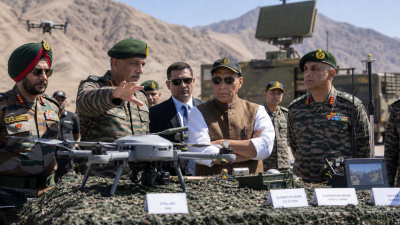
Recent DAC approvals and the National Drone Summit shift India’s defence trajectory towards AI-enabled autonomy. Capital acquisitions of about ₹52,000 crore target anti‑drone systems, EW, surveillance and autonomous platforms. A USD 2+ billion drone procurement and a five‑million drone inventory target by 2028 aim to strengthen deterrence and frontline capabilities.
Strategic context and security imperative
AI and autonomy shorten sensor‑to‑shooter timelines. Democratised drones and loitering munitions lower thresholds for precision strikes. Ukraine’s Delta platform shows how data fusion and automated tasking reduce engagement times. For India, the priority is operational sovereignty: fused situational awareness, resilient comms, and autonomous coordination to deny enemy advantages along the LoC and LAC.
Policy and institutional framework
- Defence procurements: DAC approvals (~₹52,000 crore) prioritise anti‑UAV EW (Akash Tarang), surveillance, counter‑drone systems and jet‑based loitering munitions.
- Budgetary posture: The package is nearly 24% of this year’s ₹2.19 lakh crore capital outlay. Experts recommend allocating ≥40% of the Rs 2 lakh crore modernisation fund (2027) to technological solutions.
- Organisational actors: DRDO, Defence Innovation Organisation (DIO), iDEX, Services headquarters, and DAC will coordinate acquisitions, R&D and industry tie‑ups.
Indigenous development and manufacturing ecosystem
India’s largest military drone procurement (USD 2+ billion) seeks diverse platforms and benefits domestic firms (Adani, Tata Advanced Systems, L&T, ideaForge, Asteria). The Super Sukhoi modernisation, with Virupaksha AESA radar pre‑production, integrates legacy platforms into future networked operations. Policy must balance large prime contractors, MSMEs and startups to scale production and ensure supply‑chain security for sensors, RF components and semiconductors.
Skills, entrepreneurship and human resources
- National Drone Summit outputs: Drone Tech Multi‑State Co‑operative Society Ltd. and “1 Panchayat – 1 Drone Udyami” to widen participation.
- Training: Advanced Skill Centres with NSDC to upskill personnel in AI, robotics, GIS, remote sensing and drone maintenance.
- Innovation: iDEX and DIO should provide fast procurement pathways, testbeds, and funding for startups to mature AI and autonomy prototypes.
Technological imperatives
- Sovereign data‑fusion platform: A domestic equivalent of Ukraine’s Delta is needed for secure multi‑source fusion, automated tasking and swarm coordination under sovereign control.
- Communications and resilience: Hardened, low‑latency C2, mesh networking, anti‑jamming and alternative datalinks are essential.
- Autonomy stack: Perception, path planning, mission management, trust and verification layers, and human‑machine interfaces must be developed and certified.
- Counter‑UAV technologies: EW suites (Akash Tarang), directed energy, RF capture, kinetic interceptors and integrated sensors are required for layered defence.
Operational integration and doctrine
Doctrine must define levels of autonomy, human‑in‑loop conditions, rules of engagement, mission authorisation and escalation control. Inter‑service concepts should cover swarm employment, manned‑unmanned teaming, logistics for mass drone inventories, and basing for forward deployment along LoC/LAC.
Legal, ethical and accountability considerations
- Legal framework: Update defence procurement rules, ROE, and service law guidance for autonomous weapons employment.
- Ethics and IHL: Define human oversight thresholds, target verification standards, and incident investigation protocols.
- Auditability: Require explainable AI modules and immutable logging for mission decisions to enable accountability.
Challenges and mitigation
| Dimension | Challenge | Mitigation |
|---|---|---|
| Technology | Dependence on imported semiconductors, sensors, RF components | Localise critical components, strategic stockpiles, public‑private consortia |
| Data and AI | Data scarcity, bias, adversarial vulnerabilities | Secure sovereign datasets, validation centres, red‑teaming |
| Integration | Interoperability across services and platforms | Common standards, modular open architectures, joint test ranges |
| Regulation | Ambiguous ROE and legal exposure | Doctrine updates, legislative oversight, expert review boards |
| Scale | Logistics and maintenance for five million drones | Decentralised maintenance networks, local entrepreneurship, training hubs |
Policy actions and short‑term priorities
- Fund shift: Reallocate a larger share of modernisation funds to AI, EW and sensors; implement the 40% technology allocation recommendation for 2027.
- Sovereign platform: Fast‑track a national AI analytics platform for data fusion, with secure APIs and service‑level isolation for military use.
- Test and validation: Establish certified test ranges for swarms, EW and loitering munitions to accelerate fielding.
- Industry policy: Incentivise domestic manufacturing, ensure offset clauses support component localisation, and simplify certifications for startups.
- Doctrine and law: Issue interim ROE for autonomous systems and constitute an expert panel for long‑term legal guidance.
Model Questions
1. Examine India’s strategic response to the emergence of AI and autonomous systems in warfare, identifying key initiatives and the principal challenges to developing sovereign capabilities. [GS-III: Internal & External Security]
India has shifted procurement towards AI, EW and autonomous platforms (DAC approvals ~₹52,000 crore). Major drone buys, Akash Tarang, Super Sukhoi upgrades and skill initiatives aim to build sovereign capacity. Challenges include supply‑chain dependence, data platform development, interoperability, doctrine, and ethical/legal frameworks. Mitigations: fund reallocation to tech, localise critical components, create national data‑fusion platform, and fast‑track doctrine and testing regimes.
2. Analyse the role of an indigenous manufacturing and entrepreneurial ecosystem in achieving India’s drone and autonomous warfare objectives. [GS-III: Economic Development]
Domestic industry (Adani, Tata, L&T, ideaForge, Asteria) and startup support via iDEX/DIO are central to scaling production. National Drone Summit measures — Drone Tech Co‑op, 1 Panchayat‑1 Drone Udyami, Advanced Skill Centres — broaden participation. Policy must ensure MSME inclusion, component localisation, incentives for R&D, streamlined procurement for startups, and workforce skilling to sustain a five‑million drone target and export potential.
3. Discuss the implications of recent budgetary and procurement emphasis on AI‑enabled platforms and counter‑drone systems for India’s defence modernisation and deterrence strategy. [GS-III: Internal & External Security]
Allocation of ~₹52,000 crore to tech‑intensive acquisitions (24% of capital outlay) redirects modernisation toward algorithmic warfare. Procurement of drones and counter‑UAV systems strengthens layered deterrence along LoC/LAC. Budgetary shift to technology (recommended ≥40% of modernisation fund) supports combat overmatch via sensors, EW and AI. Risks include sustainment costs and integration delays; these require lifecycle funding and joint operational doctrines.
4. Critically evaluate the need for a sovereign AI‑enabled data analytics platform for autonomous coordination and the human‑machine interface considerations it raises. [GS-III: Science & Technology]
Last Modified: July 6, 2026A sovereign analytics platform is necessary for secure multi‑sensor fusion, automated swarm tasking and mission authorisation. Design must ensure explainability, human‑in‑loop overrides, audit logs and tamper‑resistance. Human‑machine interface rules should set autonomy levels, ROE checks and escalation gates. Technical measures include verifiable models, red‑teaming, and resilient comms. Legal and ethical safeguards must accompany rapid deployment.