
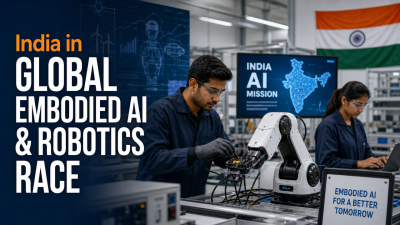
India is an active but uneven participant in the global embodied AI and robotics race. Installations, market growth and domestic achievements coexist with low automation density and dependence on foreign advanced design and mass-manufacturing capabilities.
What is the issue?
Embodied AI combines perception, planning and physical action. Global competition now centres on processors for robots and autonomous systems, software architectures for humanoids, and scalable manufacturing. India’s recent growth in installations and startups contrasts with low robot density and gaps in chip design and mass production capacity.
Why it matters for governance and economy
- Economic growth: Automation can raise productivity in manufacturing and services and upgrade export competitiveness.
- Employment & skills: Rapid adoption will shift job profiles requiring reskilling and active labour policies.
- Health and public services: Domestic surgical robots and telesurgery expand access to specialised care.
- Strategic technology: Edge in embodied AI affects defence, critical infrastructure and sovereign control over AI stacks.
India’s current position and global context
- Installations: India installed 9,100 industrial robots in 2024 (a 7% increase), ranking sixth in annual installations.
- Robot density: Around 10 robots per 10,000 manufacturing workers versus a global average near 132 and South Korea about 1,200.
- Market size: Robotics market grew 17% in 2026 to USD 2.14 billion, the fastest growth among major economies outside China.
- Startups and talent: Roughly 180,000 startups exist, with about 89% integrating AI; India has a large tech workforce and digital infrastructure.
- Notable indigenous example: SSI Mantra, the first indigenous surgical robotic system, has performed telesurgeries.
- Policy push: IndiaAI Mission approved with an allocation exceeding ₹10,300 crore to build AI computing infrastructure and GPU access; Draft National Robotics Strategy proposes a robotics mission combining domestic R&D and international collaboration.
Comparison with global leaders
| Dimension | India | China | United States |
|---|---|---|---|
| Annual industrial robot installations | 9,100 (6th in 2024) | ~295,000 (54% of global installs, operational stock >2 million) | Lower install share but strong in advanced systems |
| Robot density (per 10,000 workers) | ~10 | Higher than India; overall global average 132 | Above India; variable by sector |
| Strength | Startups, talent, digital infra, policy funding | Mass production, scale in humanoids (~85% of global output) | Frontier AI, chip design, software architecture for humanoids |
Strengths and opportunities for India
- Talent pool: A large engineering and AI-skilled workforce and high AI adoption among startups.
- Policy capital: IndiaAI Mission funding and a national robotics strategy provide financial and strategic support.
- Market momentum: Rapid market growth and rising installations create demand for local solutions.
- Demonstration projects: SSI Mantra and national robotics trials (BYKM 2026) show capacity in high-value segments and talent grooming.
- Cost advantage: Potential for competitive manufacturing clusters if upstream capabilities improve.
Challenges and gaps
- Low automation density: Limits productivity gains and slows adoption of robot-assisted processes.
- Chip and hardware design: Limited presence in advanced embodied-AI chip design and constrained access to fabrication for leading-edge nodes.
- Mass-manufacturing and supply chains: India lags China in scale and ecosystem for robot production, especially humanoids.
- Capital and procurement: High upfront costs and limited procurement pull from public sector slow diffusion.
- Standards and regulation: Need for clearer rules on safety, liability, data governance and export controls.
Policy initiatives and institutional mechanisms
- IndiaAI Mission: Funding for domestic AI computing infrastructure, GPU access and shared facilities.
- Draft National Robotics Strategy: Proposal for a robotics mission integrating R&D, manufacturing and international collaboration.
- Skilling and competitions: BYKM 2026 and national trials to identify talent and promote STEM and robotics skills.
- Startup support: Incubation, access to computing resources and funding pathways to scale hardware startups.
- Standards work: Early-stage efforts to define safety and data standards for human-robot interaction and medical robotics.
Socio-economic implications
Employment and skills
- Job reconfiguration: Routine manufacturing roles may shrink while demand rises for technicians, system integrators and AI engineers.
- Reskilling need: Targeted vocational training, apprenticeships and curricula integration are required to reduce mismatch.
- Regional impact: Adoption will be uneven across states and sectors; policy must address regional skill gaps.
Ethics, safety and regulation
- Data and privacy: Robots with sensors raise data governance and consent issues.
- Algorithmic bias: Systems must be tested for fairness, especially in healthcare and public services.
- Liability: Clear rules needed for accidents, software failures and cross-border services such as telesurgery.
Way forward: policy and operational measures
| Area | Action |
|---|---|
| R&D and chips | Fund embodied-AI chip design, support IP creation, subsidise access to high-end GPUs and create centres for hardware-software co-design. |
| Manufacturing & supply chains | Create robotics manufacturing clusters, incentivise scale-up of hardware startups, and use procurement to create demand. |
| Skills & education | Integrate robotics into vocational courses, expand competitions and apprenticeship schemes, and set up industry-academia training hubs. |
| Regulation & standards | Define safety, data governance and liability frameworks; align standards with global norms to enable exports. |
| International cooperation | Negotiate partnerships for technology transfer, joint R&D, and secure supply of critical components while protecting strategic interests. |
Model Questions
1. Evaluate India’s current position and inherent strengths in the global embodied AI and robotics race. [GS-III: Science & Technology]
India shows growing engagement: 9,100 industrial robot installations in 2024 and a robotics market of USD 2.14 billion with rapid growth. Strengths include a large tech workforce, 1.8 lakh startups with high AI uptake, digital infrastructure, IndiaAI Mission funding and indigenous projects like SSI Mantra. Main constraints are low robot density and limited advanced chip design and mass-manufacturing capacity; policy must prioritise R&D and scaling.
2. Examine key policy initiatives and institutional mechanisms adopted by India to foster indigenous capabilities in embodied AI and robotics. [GS-II: Governance]
Key measures: IndiaAI Mission (₹10,300+ crore) for AI computing and GPU access; Draft National Robotics Strategy proposing a national robotics mission; public procurement and demand-creation instruments; skilling via competitions (BYKM) and training hubs; startup support through incubators and access to shared facilities; early work on standards, safety and data governance. Effective coordination, funding execution and industry engagement remain central to delivery.
3. Discuss socio-economic implications of rapid integration of embodied AI and robotics in India, focusing on employment, skill development and ethical considerations. [GS-III: Economic Development]
Automation can raise productivity and create higher-value jobs, but may cause job polarisation and regional disparities. Low current robot density limits immediate large-scale displacement, yet reskilling and vocational training are essential. Ethical issues include data privacy, algorithmic bias, safety and liability. Policy responses should combine active labour-market programmes, targeted training, social protection measures and regulatory standards for safe human-robot interaction.
4. Despite progress, analyse concerns that India may be left behind in the embodied AI race and suggest a way forward to enhance global competitiveness. [GS-II: Governance]
Concerns arise from low automation density, reliance on foreign chip design and China’s mass-production advantage while the US leads in frontier AI. The way forward: expedite IndiaAI Mission, invest in embodied-AI chip design and fabrication access, build manufacturing clusters, scale public procurement, expand skilling and R&D centres, and pursue selective international partnerships with technology-transfer terms. Complement with clear standards, IP protection and incentive schemes to scale domestic capacity.
Last Modified: June 24, 2026