
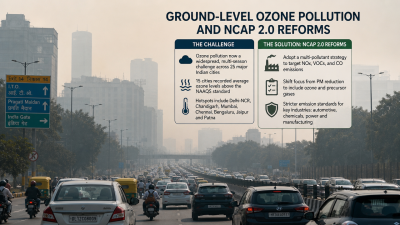
Recent CSE analysis (30 June 2026) shows ground-level ozone (O3) is a widespread, multi‑season problem across 25 major Indian cities. Delhi‑NCR is the largest hotspot; several cities record summertime averages above the NAAQS and increasing night‑time and long‑duration exposures, requiring NCAP 2.0 reforms.
What is ground‑level ozone
Definition and formation
- Nature: O3 at ground level is a secondary, invisible gaseous pollutant distinct from stratospheric ozone.
- Chemistry: Forms when precursor gases — Nitrogen Oxides (NOx), Volatile Organic Compounds (VOCs) and Carbon Monoxide (CO) — react under strong sunlight and high temperature.
- Characteristics: Photochemical, non‑linear formation chemistry, favoured by heat and solar radiation, and prone to regional transport across administrative boundaries.
Current status and trends in India
- Geographical spread: Ozone is no longer confined to North India. Delhi‑NCR, Chandigarh, Jaipur, Ahmedabad, Mumbai, Chennai, Bengaluru and Patna report notable levels.
- Extent: Of 25 cities analysed (March–May 2026), 15 recorded eight‑hour summer averages above the NAAQS of 100 µg/m³.
- Peak values and persistence: Chandigarh recorded the highest summer average (173 µg/m³). Delhi‑NCR had 71 exceedance days; Bhopal 60; Bengaluru 55; Patna 24; Muzaffarpur 21.
- Duration and night‑time rise: Bhopal recorded the longest average daily exposure (17 hours). Night‑time exceedances are rising, notably 46 night‑time exceedance nights in Delhi‑NCR. Mumbai shows high peaks and persistent night‑time ozone.
- Drivers noted: Rising temperatures and growing precursor emissions are converting a winter‑centred PM problem into a year‑round, transboundary summer peak for O3.
Why this matters for governance, economy and society
- Health: Short‑term: coughing, wheeze, asthma exacerbation. Long‑term: reduced lung function and increased respiratory morbidity. Vulnerable groups: children, elderly, outdoor workers.
- Environment and agriculture: O3 damages crops and vegetation, lowering yields and affecting forest health; economic losses in agriculture and ecosystem services follow.
- Economy and productivity: Increased healthcare expenditure, lost work days, reduced labour productivity, and crop loss reduce GDP contribution from affected sectors.
- Industrial and investor implications: Anticipated regulatory tightening under NCAP 2.0 can increase compliance costs for automotive, chemical, thermal power and manufacturing sectors; capital allocation and technology adoption will shift accordingly.
- Security and governance: Transboundary nature requires inter‑state coordination; failure to manage airsheds can create interstate disputes and governance stress.
Comparison: Particulate Matter (PM) v Ground‑level Ozone
| Dimension | PM (PM2.5/PM10) | Ground‑level Ozone (O3) |
|---|---|---|
| Source | Primary emissions (combustion, dust, biomass burning) | Secondary pollutant formed from NOx, VOCs, CO + sunlight |
| Control approach | Direct emission reduction, dust control, fuel quality | Multi‑pollutant precursor control and regional coordination |
| Diurnal/seasonal pattern | Peaks in winter (stable atmosphere) | Peaks in summer; rising night‑time levels in cities |
| Main health effect | Cardio‑respiratory morbidity, mortality | Respiratory irritation, lung function decline, asthma aggravation |
Limitations of the current NCAP
- PM‑centric design: NCAP primarily targets PM reduction; it lacks a systematic strategy for gaseous precursors and secondary pollutants.
- Monitoring gaps: Limited continuous monitoring for NOx, VOCs and CO; sparse speciated VOC data and inadequate night‑time ozone surveillance.
- Fragmented governance: Measures are often city or state specific; limited regional airshed planning and weak inter‑agency coordination reduce effectiveness for transboundary pollutants.
- Sector disconnects: Transport, industrial, energy and urban planning policies are insufficiently integrated around precursor control targets.
NCAP 2.0: Policy and governance reforms
- Adopt a multi‑pollutant strategy: Set explicit targets for NOx, VOCs and CO alongside PM. Use source‑apportionment to prioritise local precursor sources.
- Integrated regional airshed management: Design airshed boundaries by meteorology and emission patterns. Form inter‑state steering committees with clear mandates and funding mechanisms.
- Expand monitoring and data systems: Deploy continuous analysers for O3, NOx, CO and speciated VOC networks. Add night‑time monitoring and public dashboards for transparency.
- Sector‑specific emission controls: Tighten vehicular emission norms and inspection regimes; accelerate electric mobility and cleaner fuels. Enforce industrial VOC controls, low‑NOx burners in thermal plants, and fugitive emissions management in chemical and manufacturing units.
- Urban planning and heat mitigation: Integrate green infrastructure, cool roofing and reduced‑heat urban design to lower photochemical reaction rates and urban heat island effects.
- Regulatory and market instruments: Use emission trading or performance‑based standards for large emitters, targeted subsidies or low‑interest finance for cleaner technology adoption, and compliance timelines aligned with industrial capacity.
- Strengthen institutions: Empower CPCB and state pollution control boards with mandate and resources for airshed planning, compliance audits and joint enforcement actions.
- Public engagement and awareness: Issue health advisories tied to O3 forecasts, protect outdoor workers, and promote behavioural measures that reduce VOC emissions (e.g. solvent use, petrol evaporation control).
- Research and modelling: Invest in regional chemistry‑transport models, urban source‑apportionment studies, and VOC speciation research suited to Indian fuel and industrial mixes.
Implementation challenges
- Technical complexity: Non‑linear chemistry of O3 makes control outcomes sensitive to the NOx/VOC ratio; interventions require localised analysis.
- Data and capacity: Limited monitoring, scarce VOC speciation and weak modelling capacity constrain policy design.
- Administrative coordination: Airsheds cross state boundaries; political and fiscal coordination is difficult without clear institutional incentives.
- Economic transition: Stricter controls impose compliance costs; small and medium enterprises need support to adopt low‑VOC technologies.
- Behavioural factors: Household and transport‑related VOC sources require public buy‑in and sustained behaviour change.
Priority actions for NCAP 2.0
- Immediate: Expand O3 and precursor monitoring in urban hotspots; issue health advisories and worker protection guidelines during high O3 periods.
- Short term (1–3 years): Integrate precursor targets into NCAP metrics; begin regional airshed pilots; tighten vehicle emissions and fuel standards; mandate industrial VOC controls.
- Medium term (3–7 years): Scale inter‑state airshed institutions, deploy national VOC speciation programme, provide finance for technology upgrades in industry and transport.
- Long term: Embed air quality co‑benefits into urban and energy planning; shift to low‑carbon, low‑VOC economies to reduce both PM and O3 burdens.
Model Questions
1. Explain the chemical formation, characteristics and environmental implications of ground‑level ozone. How is it different from particulate pollution and why does this difference matter for policy design? [GS‑III: Environment & DM]
Ground‑level ozone is a secondary pollutant formed when NOx, VOCs and CO react in sunlight and heat. It is gaseous, peaks in summer and has transboundary behaviour. Unlike PM (primary, inert particulates), O3 requires precursor control and regional coordination. Policy must thus add precursor targets, VOC speciation, regional airshed planning and sectoral controls rather than relying solely on PM‑centric measures.
2. Critically evaluate the National Clean Air Programme (NCAP) in the context of rising ozone pollution. What governance reforms should NCAP 2.0 include to address ozone effectively? [GS‑II: Governance]
NCAP’s PM focus leaves a gap for secondary pollutants. NCAP 2.0 should adopt a multi‑pollutant mandate, set NOx/VOC/CO targets, expand continuous precursor monitoring, and create legally backed regional airshed institutions with inter‑state funding and joint enforcement. Strengthen CPCB/SPCB capacity, align transport and industrial policy, and mandate public reporting and compliance timelines.
3. Analyse socio‑economic and industrial implications of rising ground‑level ozone in Indian cities. Suggest measures to integrate air quality goals with sustainable urban and industrial development. [GS‑III: Economic Development]
Rising O3 raises health costs, reduces labour productivity, and damages crops—hurting GDP and livelihoods. Industries face higher compliance and technology costs. Integrate air quality by incentivising cleaner technologies, financing SME upgrades, promoting electric mobility, enforcing VOC controls in manufacturing, and aligning urban planning (green cover, cool surfaces) with emission reduction to protect public health and economic output.
4. Discuss the drivers and geographical spread of ozone pollution in India. Why is integrated regional airshed management necessary and what operational steps should it include? [GS‑III: Environment & DM]
Drivers: rising temperatures, higher precursor emissions from vehicles, industry and households, and strong sunlight. Spread: from northern hotspots to southern and coastal cities, with Mumbai and Delhi‑NCR showing persistent peaks and night‑time exceedances. Airshed management is necessary because O3 is transboundary; operational steps: define airsheds by meteorology, set shared targets, harmonise monitoring, create joint steering bodies, and implement coordinated sectoral controls.
Last Modified: June 30, 2026