
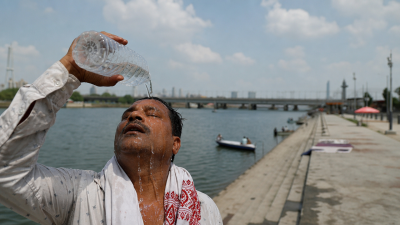
North India is under a severe heatwave with Delhi’s “feels like” temperature at 50.7°C and night minima above 31°C. IMD has issued multi‑hazard alerts. Monsoon arrival is delayed in northwest while heavy rains cause flash floods and landslides in the northeast. Heatwaves lack formal disaster status; HAPs are underfunded; urban drainage is inadequate; nearly all children face climate hazards.
Current issue
Extreme heat and concurrent multi‑hazard events are testing India’s disaster management and urban systems. Prolonged pre‑monsoon heat in the north and simultaneous floods in the northeast show concurrent risks and cascading impacts across health, agriculture, infrastructure and livelihoods.
Why this matters for governance and security
- Human security: Rising heat increases mortality, morbidity and pressures on health systems.
- Economic security: Crop losses, reduced labour productivity and infrastructure damage raise fiscal and growth risks.
- Urban governance: Weak drainage and informal settlements amplify service delivery failures and social unrest risk during extremes.
- Administrative preparedness: Lack of formal policy status for heat limits funding and central coordination.
Impact of climate extremes
- Recent extremes: Three consecutive summers of record temperatures; 2025 recorded extreme events on almost all days, causing thousands of deaths and large crop losses.
- Health: Increased heat‑related illness, heatstroke, exacerbation of chronic disease, and higher overnight temperatures reducing physiological recovery.
- Agriculture: Heat and erratic rainfall damage standing crops and affect sowing cycles.
- Infrastructure: Urban paralysis during intense downpours; roads, power and transport systems disrupted.
Institutional and policy framework gaps
| Gap / Challenge | Effect | Immediate policy measure | Medium‑term reform |
|---|---|---|---|
| Heatwaves not notified under Disaster Management Act | No dedicated emergency funding; weak national coordination | Issue an administrative order recognising heat as a disaster trigger for relief funds | Amend Act or issue notified guidelines to include heat as a disaster category |
| Fragmented HAP implementation | Uneven coverage; gaps in slums and informal settlements | Ring‑fenced funding to scale local HAPs | Integrate HAPs into municipal development plans and health services |
| Weak inter‑agency coordination | Delayed response; duplication | Set clear roles for IMD, NDMA, state DMAs and health departments | Create standing multi‑sectoral heatwave taskforces at state and city level |
Heat Action Plans (HAPs): status and challenges
- Coverage: HAPs exist in 23 states but with variable scope.
- Funding & staffing: Many plans lack dedicated budgets and trained personnel for outreach, surveillance and cooling centres.
- Vulnerable populations: Most HAPs do not sufficiently target slums, informal workers or migrant labour.
- Monitoring: Weak monitoring, evaluation and indicators limit course correction.
Urban infrastructure deficiencies
- Drainage: Over 70% of cities lack adequate stormwater drainage. Result: urban flooding and transport collapse during heavy rainfall.
- Heat adaptation: Low tree cover, heat‑absorbing surfaces, limited public cooling spaces and inadequate building norms for high temperatures.
- Finance gap: Municipal budgets and credit lines are insufficient for climate‑resilient upgrades.
Social vulnerability and specific impacts
- Children: UNICEF report estimates nearly all children are exposed to at least one climate hazard; heat raises dehydration, malnutrition and school absenteeism risks.
- Informal settlements: Poor housing, lack of potable water and absence of cooling increase mortality risk.
- Occupational exposure: Outdoor workers in construction, agriculture and transport face reduced productivity and heightened health risks.
Economic implications
- Productivity loss: Heat reduces effective working hours and cognitive performance in outdoor and unconditioned indoor jobs.
- Agricultural loss: Heat and extreme rainfall impair yields and sowing cycles, increasing price volatility.
- Fiscal cost: Disaster relief, infrastructure repair and health expenditure increase contingent liabilities for states and Centre.
Science, technology and early warning
- IMD role: Central provider of multi‑hazard forecasting and alerts; needs higher spatial resolution and longer lead times for heat advisories.
- Technical tools: Use high‑resolution modelling, remote sensing, urban heat mapping (GIS), and occupational heat stress indices (WBGT, UTCI) for targeted advisories.
- Data integration: Link meteorological data with health, electricity and water supply systems for anticipatory action.
- Communication: Multi‑channel dissemination—SMS, community radios, local languages and employer engagement—to reach informal workers and slum residents.
Operational challenges in disaster management
- Funding shortfall: Absence of earmarked funds for heat adaptation at national and municipal levels.
- Capacity: Limited training and staff at municipal and primary health levels for heat surveillance and response.
- Coordination: Siloed departments (health, environment, urban planning) impede integrated action.
- Equity: Interventions often miss the most exposed groups due to tenure, identification and mobility barriers.
Way forward — prioritized measures
- Policy & finance: Formally recognise heatwaves under the Disaster Management Act or issue clear central guidelines to unlock emergency funds. Create a dedicated Heat Resilience Fund for states and cities.
- Strengthen HAPs: Mandate minimum HAP standards, ring‑fence budgets, build municipal capacity, and require inclusion of informal settlements and occupational groups.
- Urban resilience: Scale stormwater drainage upgrades, mandate cool roofs, increase urban green cover and protect groundwater recharge zones.
- Early warning & tech: Invest in hyper‑local forecasting, integrate health surveillance with IMD alerts, adopt GIS‑based vulnerability maps and real‑time dashboards for officials.
- Community actions: Support community cooling centres, public shade, water distribution plans, workplace heat standards and school protocols for extreme heat.
- Capacity & coordination: Establish state and city heatwave taskforces, train health workers, and set measurable indicators for HAPs with periodic audits.
- Children & social protection: Include heat in school safety plans, expand midday‑rest policies for outdoor work, and use social welfare schemes to finance household cooling for vulnerable families.
- Research & monitoring: Fund regional climate impact studies, occupational heat research and the development of indices linking heat exposure to health and economic loss.
Model Questions
1. Examine the institutional and policy lacunae in India’s disaster management framework that hinder effective response to climate extremes, particularly heatwaves. Suggest measures to strengthen preparedness and mitigation. [GS-III: Environment & DM]
As heatwaves are not formally notified, states lack dedicated emergency funding and central coordination. Gaps include underfunded HAPs, weak municipal capacity and siloed departments. Measures: notify heat under the Disaster Management Act or issue central guidelines; create a Heat Resilience Fund; standardise and fund HAPs; establish state/city heat taskforces; build health and municipal capacity; integrate HAPs into urban planning and social protection programmes.
2. Analyse the escalating human and economic costs of climate extremes in India, with reference to heatwaves and urban flooding. Discuss how inadequate urban infrastructure and social vulnerabilities worsen impacts. [GS-III: Economic Development]
Heatwaves raise mortality, morbidity and reduce labour productivity; floods disrupt urban services and damage assets. Agricultural losses and infrastructure repairs increase fiscal burdens. Poor drainage, low urban green cover and heat‑absorbing surfaces cause urban paralysis. Vulnerable groups—children, informal‑settlement residents and outdoor workers—face higher exposure due to inadequate housing, water and access to cooling, amplifying inequality and economic loss.
3. Despite Heat Action Plans in several states, their effectiveness is limited. Critically evaluate implementation challenges and propose a comprehensive local‑level strategy to build climate resilience. [GS-II: Governance]
Challenges: underfunded HAPs, insufficient staffing, weak monitoring and exclusion of slums and informal workers. Local strategy: mandate minimum HAP standards; ring‑fence municipal funds; train health and municipal staff; deploy community volunteers; use GIS vulnerability maps for targeted actions; ensure workplace and school protocols; establish M&E indicators and integrate HAPs into municipal development and ULB budgets.
4. Recommend science and technology‑driven approaches India can adopt to improve early warning systems and climate adaptation for concurrent extremes such as delayed monsoons and heavy rainfall. [GS-III: Science & Technology]
Adopt high‑resolution regional models, urban heat maps and satellite remote‑sensing for soil moisture and flood risk. Integrate IMD forecasts with health, water and power systems for anticipatory action. Use GIS for vulnerability mapping and mobile/SMS and community channels for targeted alerts. Invest in real‑time dashboards, citizen reporting platforms and occupational heat indices to guide employer and municipal responses.
Last Modified: June 30, 2026