
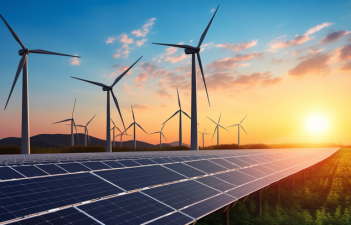
India has rapidly scaled non-fossil electricity capacity to 283.46 GW, with a record annual addition of 55.3 GW and over 50 percent of installed generation from non-fossil sources. Central schemes such as PM Surya Ghar Muft Bijli Yojana and PM-KUSUM underpin this shift and support manufacturing expansion.
What is the issue?
India has reached 283.46 GW of cumulative non-fossil power capacity and ranks third globally in renewable capacity. Solar leads the mix. The country has met its initial Paris NDC target ahead of schedule and must sustain near-50 GW annual additions to reach the 500 GW COP26 Panchamrit target for 2030.
Why it matters for governance, economy and security
- Energy security: Reduced dependence on fossil-fuel imports and oil price exposure; increased domestic supply diversity.
- Economic opportunity: Domestic manufacturing growth (solar module capacity ~172 GW), job creation across installation, operation and supply chains.
- Climate commitments: Progress supports the 45% emissions-intensity reduction target by 2030 and international credibility at climate fora.
- Grid & fiscal governance: DISCOM financial health, inter-governmental coordination and policy stability determine absorption and rollout speed.
Capacity composition and performance
| Source | Installed Capacity (GW) | Notes |
| Solar | 150.26 | Fastest growth; 53-fold since 2014 |
| Wind | 56.09 | Historic single-year addition of 6.05 GW |
| Large hydro | 51.41 | Included in renewable definition for balancing |
| Nuclear | 8.78 | Baseload support |
| Bioenergy | 11.75 | Distributed and grid-connected projects |
| Small hydro | 5.17 | Localised generation |
Key schemes and institutional instruments
PM Surya Ghar Muft Bijli Yojana
- Objective: Rooftop residential solar for one crore households by March 2027.
- Outlay: ₹75,021 crore (central sector).
- Subsidy tiers: Direct central assistance from ₹30,000 to ₹78,000 based on capacity (1–3+ kW) to cut upfront cost.
- Institutional progress: Solarisation of over 53,000 government buildings (855 MW installed) and Utility-Linked Aggregation Model for DISCOM–vendor–consumer coordination.
- Model Solar Villages: ₹800 crore allocation to establish one model village per district for community-level distributed generation.
PM-KUSUM
- Components: (A) Decentralised grid-connected solar plants up to 2 MW; (B) Standalone solar agriculture pumps replacing diesel; (C) Solarisation of existing grid-connected pumps at individual or feeder level.
- Outcome: Farmer energy security, reduced diesel consumption, and rural distributed generation capacity.
Manufacturing and supply-chain dimension
Domestic solar module manufacturing capacity has expanded to approximately 172 GW. Upstream self-reliance is improving but needs scaling in cells, wafers, and critical components. Policy measures and production-linked incentives have attracted investment; logistics, input availability and global demand cycles remain variables for capacity utilisation.
Institutional and regulatory framework
- Role of DISCOMs: State DISCOMs act as legal implementing and regulatory bodies for net metering and are central to Utility-Linked Aggregation operations.
- Grid governance: Inter-state transmission plans, the national load dispatch centre and state load dispatch centres manage integration and scheduling.
- Regulatory levers: Central guidelines on rooftop net metering, tariff design, and payment security mechanisms influence rollout pace.
Challenges
- Grid integration: Intermittency of solar and wind requires forecasting, grid flexibility, ancillary services and storage to maintain stability.
- Storage and balancing: Need for utility-scale batteries, pumped hydro and demand-response mechanisms to provide firming capacity.
- Land and permitting: Acquisition, environmental clearances and multi‑use land policies constrain large-scale projects.
- Financing and investment risk: Capital needs for generation, transmission and storage; DISCOMs’ liquidity risks affect payment certainty.
- Supply-chain resilience: Scaling from module capacity to cell and wafer production and securing inputs such as polysilicon.
- Skill gaps: Technician, operation and maintenance workforce shortages for rapid deployment and upkeep.
Way forward: policy and operational measures
- Scale manufacturing: Incentivise cell/wafer production, import substitution, and backward integration to match module capacity.
- Grid & storage investment: Prioritise inter-state transmission, smart grid technologies, battery storage and pumped hydro projects.
- Financing instruments: Use green bonds, blended finance, viability gap funding and payment security mechanisms to de-risk projects and protect DISCOM cashflows.
- Regulatory certainty: Stable net metering rules, standard contracts and predictable subsidy disbursal to attract private investment.
- Capacity building: Training programmes for installers and plant operators; certification standards for quality assurance.
- Decentralised focus: Expand rooftop, community solar and Model Solar Villages to reduce transmission needs and enhance energy access.
Socio-economic and environmental implications
- Household welfare: Lower electricity bills, increased energy access and livelihood opportunities from rooftop and village-scale projects.
- Agrarian benefits: Reduced diesel use in irrigation, lower operating costs and improved cropping resilience under PM-KUSUM.
- Employment: Manufacturing, construction and O&M create direct and indirect jobs across regions.
- Emission reduction: Contribution to the 45% emissions-intensity target and lower local air pollution from reduced fossil generation.
- International posture: Third-largest renewable capacity strengthens India’s negotiating position in multilateral climate processes and clean-energy partnerships.
Model Questions
- Analyse the drivers behind India meeting its initial Paris NDC ahead of schedule and assess the implications for the country’s energy security and global climate commitments. [GS-III: Environment & DM]
- Examine how PM Surya Ghar Muft Bijli Yojana democratizes access to clean energy and identify institutional mechanisms needed for effective implementation. [GS-II: Governance]
- What are the major challenges to achieving 500 GW of non-fossil capacity by 2030 and suggest a comprehensive policy and operational roadmap to address them. [GS-III: Economic Development]
- Discuss the role of State DISCOMs in India’s renewable energy expansion and the importance of federal cooperation for policy coherence. [GS-II: Governance]
Discuss capacity growth (283.46 GW, 55.3 GW annual addition), policy levers (PM Surya Ghar, PM-KUSUM), manufacturing expansion (~172 GW module capacity), and institutional mechanisms (DISCOMs, aggregation model). Evaluate implications for import reduction, energy supply diversity, emission-intensity targets, and India’s diplomatic leverage in climate negotiations. Conclude with near-term risks to sustaining the trajectory.
Cover scheme design (₹75,021 crore, one crore households), subsidy tiers (₹30,000–78,000), government building solarisation and Model Solar Villages. Explain the role of Utility-Linked Aggregation, state DISCOMs for net metering, vendor coordination, payment processes and capacity-building. Address monitoring, grievance redressal and fiscal safeguards to ensure equity and last-mile delivery.
Identify challenges: grid integration, storage needs, land acquisition, financing, DISCOM solvency, and supply-chain gaps. Propose measures: scale cell/wafer manufacturing, invest in transmission and storage, green bonds/blended finance, payment security for investors, standardised contracts, and skill development. Include performance metrics and phased regulatory reforms to de-risk investment and accelerate capacity additions.
Explain DISCOMs’ functions as implementing/regulatory bodies for net metering, grid integration and aggregation. Analyse how DISCOM financial health, tariff design and state policies affect rollout. Recommend federal-state coordination on transmission planning, subsidy flows, payment security and uniform standards to harmonise implementation while preserving state-specific flexibility.