
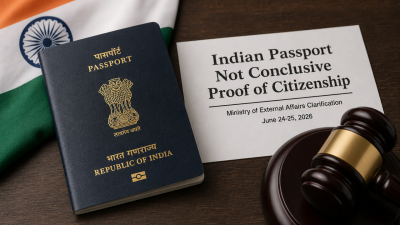
Recently the Ministry of External Affairs clarified that an Indian passport is a travel document and not conclusive proof of citizenship. The government reiterated this legal position and highlighted Section 20 of the Passports Act that permits passports or travel documents for non‑citizens in public interest. The Citizenship Act, 1955 remains the primary statute for determining citizenship.
What is the current issue?
The MEA statement restates the long‑standing legal distinction between a passport and citizenship. The Passports Act, 1967 governs issuance of travel documents; the Citizenship Act, 1955 governs acquisition and loss of citizenship. Recent clarifications and judicial rulings confirm that possession of a passport, Aadhaar or voter ID does not by itself establish Indian citizenship.
Why this matters for governance and security
- Legal clarity: Separates administrative convenience (travel facilitation) from the legal status that confers rights and duties.
- National security: Prevents misuse of travel documents by non‑citizens and aids screening at borders.
- Immigration management: Ensures entry/exit controls rely on substantive citizenship records, not only travel documents.
- Social and welfare delivery: Affects eligibility for state services when citizenship is a criterion.
Legal framework
Passports Act, 1967
- Purpose: Regulates issue, impounding and withdrawal of passports and travel documents.
- Section 20: Empowers Central Government to issue passports or travel documents to non‑citizens in public interest. This provision confirms a passport is not automatically proof of citizenship.
Citizenship Act, 1955
- Purpose: Sole statutory code for acquisition and termination of Indian citizenship.
- Modes: Birth, descent, registration, naturalisation, and incorporation of territory.
- Definitive proof: Citizenship registration certificate issued by the Ministry of Home Affairs is the authoritative administrative proof.
Judicial precedents
- Supreme Court (May 2026): Ruled that Aadhaar, voter ID and passports are not conclusive proof of citizenship.
- Bombay High Court (2013): Earlier held similar position on identity documents and citizenship.
Role of identity documents — comparative table
| Document | Primary purpose | Is it conclusive proof of citizenship? |
|---|---|---|
| Passport | International travel document | No |
| Aadhaar | Identity & resident authentication | No (can be issued to non‑citizens) |
| Voter ID | Electoral registration | No (linked to electoral rolls; not definitive for citizenship law) |
| Birth certificate / land records / PAN / domicile | Evidence of birth, residence, property, taxation | Assistive proof; not singly conclusive |
| Citizenship registration certificate (MHA) | Statutory administrative record under Citizenship Act | Yes — most definitive administrative proof |
Citizenship (Amendment) Rules, 2026 — administrative changes
- OCI administration: Electronic OCI introduced to modernise records and reduce paperwork.
- Biometrics: New consent form for biometric collection under Fast Track Immigration Programme.
- Minors and passports: A minor cannot simultaneously hold an Indian passport and another country’s passport. This affirms policy against dual citizenship for children.
Administrative implications and public interface
- Scale: Passport services expanded significantly — about 1.5 crore passport‑related services delivered in 2025 and 1.39 crore passports issued. Passport Seva Kendras increased to 545.
- Verification burden: Widespread issuance highlights need for robust back‑end checks and coordination with MHA for citizenship verification.
- Vulnerable groups: Persons lacking standard documentary records may face difficulty proving citizenship when required for services or legal processes.
Security, immigration and border management dimensions
- Screening fidelity: Distinction allows immigration authorities to verify legal status beyond the travel document.
- Countering fraud: Section 20 safeguards permit pragmatic issuance, while preserving checks to detect misuse.
- Cross‑border migration: Clear legal tests for citizenship assist adjudication of claims by migrants, refugees and stateless persons.
Administrative challenges
- Fragmented evidence: Multiple document types required across departments create procedural inconsistency.
- Data integration: Lack of a centralized, authoritative digital citizenship registry complicates verification.
- Redress and disclosure: Citizens and OCI holders need clear, accessible processes for dispute resolution and status clarification.
Policy recommendations and way forward
- Clear administrative guidelines: Issue unified protocols for departments that require citizenship verification. Specify acceptable document combinations and escalation to MHA where ambiguity exists.
- Digital citizenship register: Evaluate a secure, auditable registry based on the Citizenship Act, linked to MHA records, with strict access controls and grievance mechanisms.
- Streamline documentary requirements: Design simplified routes for vulnerable groups to establish citizenship, using alternate evidence and community verification where appropriate.
- Inter‑agency coordination: Formalise MEA–MHA procedures for passport issuance where citizenship status is unclear, and for cross‑checking OCI records.
- Public communication: Inform citizens about which documents are definitive and when the MHA certificate is required.
Model Questions
1. Critically examine the legal framework governing passports and citizenship in India. Explain why the distinction between a travel document and proof of citizenship matters for national security and immigration policy. [GS-II: Constitution of India & Polity]
The Passports Act, 1967 regulates travel documents; Section 20 permits passports to non‑citizens in public interest. The Citizenship Act, 1955 alone determines citizenship. The distinction matters because passports facilitate movement while citizenship confers legal status. For security and immigration, reliance on statutory citizenship records prevents misuse, enables accurate screening at borders, and ensures that rights and obligations are accorded according to legal status.
2. Analyse challenges faced by individuals in proving Indian citizenship and propose administrative measures to streamline verification. [GS-II: Governance]
Citizens often lack uniform documentation; Aadhaar and voter ID are insufficient alone. Challenges include fragmented proofs, inconsistent departmental requirements, and barriers for marginalised groups. Measures: publish standard verification protocols, enable MHA citizenship certificate as escalation route, create a secure digital citizenship registry with access controls, provide special simplified verification for vulnerable groups, and set fast grievance redress and appeal mechanisms.
3. Discuss the key changes introduced by the Citizenship (Amendment) Rules, 2026 for OCI cardholders and minors. Evaluate their likely impact on diaspora engagement and the dual‑nationality debate. [GS-II: International Relations]
The 2026 rules introduce electronic OCI, biometric consent for Fast Track Immigration, and prohibit minors from holding Indian and foreign passports simultaneously. Electronic OCI and biometrics modernise administration and improve border processing. The minor passport restriction reaffirms India’s opposition to dual citizenship. These steps may streamline diaspora services but also signal stricter identity controls, affecting expectations around parity of rights for diaspora communities.
4. Trace the historical and judicial basis for treating a passport as a travel document and assess its contemporary relevance for managing migration and border control. [GS-III: Internal & External Security]
Statutory regime under the Passports Act and judicial rulings (including Bombay HC 2013 and Supreme Court May 2026) establish passports as travel documents, not definitive citizenship proof. Historically this preserves administrative flexibility. Today it aids migration management by allowing authorities to treat passports as one piece of evidence, demand corroborative records, and prevent exploitation of travel documents by non‑citizens, thereby strengthening border integrity and internal security.
Last Modified: June 26, 2026