
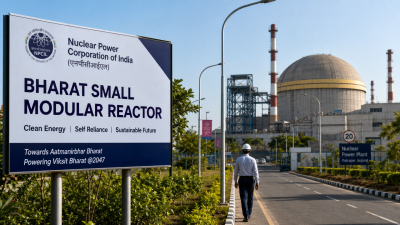
Currently India has no operational small modular reactors (SMRs). The Government has allocated ₹20,000 crore under the Nuclear Energy Mission, set a target of five indigenously designed SMRs by 2033, and assigned BARC, NPCIL and AERB defined roles under the SHANTI Act 2025 and supporting fiscal measures.
What are SMRs and global status
- Definition: Nuclear reactors up to 300 MW per unit, designed for factory manufacture and modular deployment.
- Technical variants: Light-water SMRs, high-temperature gas-cooled reactors (HTGR), fast reactors and floating designs.
- Global deployment: Commercial operation remains limited; only a few demonstration and early commercial units exist internationally.
Why SMRs matter for India
- Energy security: Provide firm, low‑carbon baseload to complement intermittent renewables.
- Grid stability: Support frequency and reserve needs for expanding renewable capacity.
- Decarbonisation of industry: Offer process heat and electricity for energy‑intensive sectors and hydrogen production via HTGRs.
- Coal‑site repowering: Allow staged replacement of coal plants while using existing infrastructure.
- Regional and social benefits: Enable distributed power for remote industrial clusters and district heating in selective geographies.
- Strategic and international: Opens export and cooperation opportunities and raises fuel‑supply and non‑proliferation considerations.
India’s policy and institutional framework
- Nuclear Energy Mission: Central policy for accelerated nuclear capacity expansion, including SMRs; ₹20,000 crore budget allocation.
- Targets: Aim for 100 GW nuclear by 2047 and at least five indigenously designed SMRs operational by 2033.
- SHANTI Act 2025: Modernises legal and regulatory architecture and permits wider PSU and private sector participation.
- Fiscal support: Customs duty exemptions extended in the Union Budget 2026–27 for nuclear projects.
- Implementation roles: NPCIL for deployment, BARC for design and R&D, AERB for licensing and safety oversight.
- Procurement milestone: Bids for the first 220 MWe BSMR‑200 expected within the near procurement window.
Indigenous R&D and manufacturing capabilities
- Designs under development: BARC is developing BSMR‑200 (200 MWe), SMR‑55 (55 MWe) and an HTGR aimed at hydrogen and process‑heat applications.
- Industrial base: Domestic heavy engineering, manufacturing and construction capabilities can support modular fabrication and supply chains.
- Knowledge institutions: NPCIL, BARC, AERB and academic centres form an integrated ecosystem for testing, certification and skills development.
- Analytical input: TERI report on strategic pathways provides scenario analysis linking SMRs to the 2047 development goal.
Key challenges and risks
- Economic viability: Unit costs, factory learning curves, plant factor assumptions and competing low‑cost renewables affect competitiveness.
- Regulatory clarity: Licensing procedures, siting rules and harmonised standards for modular designs require strengthening.
- Fuel supply: Some SMR designs need HALEU or specialised fuels that have limited global supply chains.
- Safety and security: Distributed deployment raises emergency preparedness, transport security and physical protection demands.
- Waste management: Provisions for spent fuel, intermediate and low‑level waste need definite institutional and financial arrangements.
- Financing and business models: State‑led finance, public‑private partnerships or merchant models each carry distinct risks for cost recovery.
| Challenge | Policy / operational response |
| High upfront unit cost | Use demonstration projects, standardised designs, factory fabrication and phased fleet roll‑out to reduce learning costs. |
| Regulatory uncertainty | Strengthen AERB capacity, issue design‑specific licensing guidelines and adopt staged approvals for modular construction. |
| Fuel constraints (HALEU) | Negotiate international supply, consider indigenous enrichment paths and set strategic fuel reserves. |
| Waste and decommissioning | Create dedicated funds, update national waste policy and define long‑term storage and disposal plans. |
Operational and deployment pathways
- Phased approach: Demonstration units → pilot fleet → commercial roll‑out with standardised factories and supply chains.
- Site selection: Preference for brownfield coal sites, industrial clusters and remote grids where grid extension is costly.
- Financing models: State ownership for initial units, concessional finance for pilot projects, then public‑private partnerships for scale.
- Human resources: Tasked training at research reactors, technical institutes and industry for operation, maintenance and regulatory roles.
- International cooperation: Bilateral agreements for fuel, standards, trade and joint manufacturing can address supply and market access.
Policy actions for smoother integration
- Regulatory reform: Fast‑track AERB capacity building and issue SMR design certification routes.
- Financial instruments: Provide viability gap funding, export credit and concessional loans for early projects.
- Fuel strategy: Secure diversified fuel sources and define strategic reserves for HALEU where required.
- Waste governance: Establish clear funding and institutional responsibility for long‑term waste management and decommissioning.
- Public engagement: Transparent risk communication, local benefit sharing and clear emergency arrangements to build acceptance.
Model Questions
1. Assess the potential contribution of small modular reactors (SMRs) to India’s energy transition and ‘Viksit Bharat’ vision. [GS-III: Economic Development]
India’s SMR potential lies in supplying firm low‑carbon power, stabilising grids with high renewable share, enabling industrial decarbonisation and repowering coal sites. Realising this requires demonstration projects, indigenous design deployment (BSMR‑200, SMR‑55), financing support and supply‑chain scale‑up. Targets include five indigenous SMRs by 2033 and policy support under the Nuclear Energy Mission with ₹20,000 crore and duty incentives to bridge initial cost gaps.
2. Examine India’s policy and institutional initiatives for SMR development and the governance challenges they must address. [GS-II: Governance]
India has allocated funds under the Nuclear Energy Mission, enacted the SHANTI Act 2025, and extended fiscal incentives to attract industry. Institutional roles are defined for NPCIL, BARC and AERB. Governance challenges include building regulatory capacity, clear licensing pathways, financing frameworks, public consultation processes and coordination across central, state and local agencies for siting and emergency preparedness.
3. Critically evaluate the main risks associated with SMR deployment globally and their relevance to India. [GS-III: Environment & DM]
Global SMR risks include economic non‑competitiveness, limited specialised fuel supply, safety and security for distributed units, and unresolved long‑term waste. For India these translate into needs for cost reduction through serial manufacture, securing HALEU or alternative fuels, strengthening emergency response and establishing funded, transparent waste management and decommissioning regimes before large‑scale deployment.
4. How can indigenous R&D and a liberalised policy framework position India as a technology provider in SMRs? [GS-III: Science & Technology]
Indigenous R&D (BSMR‑200, SMR‑55, HTGR) combined with SHANTI Act provisions for private and PSU participation and fiscal support can drive design certification, factory manufacture and export readiness. Success requires standardised designs, testing infrastructure, quality assurance, human capital development, international certification and export credit arrangements to convert domestic capability into a competitive technology export pathway.
Last Modified: June 27, 2026