
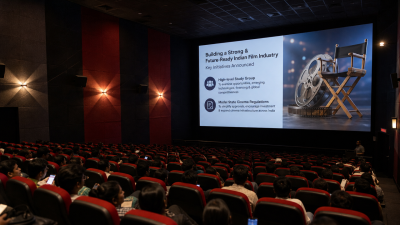
The Ministry of Information and Broadcasting has announced two linked initiatives: a high‑level Study Group on Indian cinema chaired by Prasoon Joshi to report within three months, and Model State Cinema Regulations circulated to all states with Centre assistance to expand cinema infrastructure and raise screen density nationwide.
What is at stake
Issue
India’s film sector combines cultural influence, export potential, employment and local economic activity. Low screen density, uneven access in smaller towns and nascent adoption of new production technologies constrain growth and competitiveness.
Why it matters for governance and economy
- Governance: Film regulation largely sits with states; harmonised rules affect approvals, safety, land use and local employment.
- Economy: Expanded screens and easier finance increase market size, regional investment and ancillary services (logistics, hospitality).
- Technology & international relations: Adoption of AI and virtual production affects global competitiveness and cross‑border collaborations.
Key elements of the initiatives
High‑level Study Group (Prasoon Joshi)
- Mandate: Examine opportunities and challenges for Indian cinema and recommend measures within three months.
- Composition: Industry experts and technology partners to advise on global competitiveness, AI, virtual production and institutional finance.
- Output: Policy suggestions for access to institutional finance, technology adoption pathways and an integrated industry framework.
Model State Cinema Regulations
- Purpose: Standardise and simplify approval procedures for cinema halls across states.
- Target: Increase investment in screens in small towns and rural areas; reduce procedural delays.
- Centre role: Circulated model rules to all states and offered technical and implementation assistance.
Economic and industry implications
- Screen density: Greater screens improve market reach, increase box office and non‑theatrical revenue streams.
- Employment: Production, post‑production, exhibition and allied services create formal and informal jobs across regions.
- Finance: Improved access to institutional finance can de‑risk projects, attract private equity and enable larger productions.
- Exports and soft power: Higher production values and distribution can expand exports, co‑productions and festival presence.
Technology: AI and virtual production
| Dimension | Opportunities | Challenges |
|---|---|---|
| Production | Faster pre‑visualisation, cost savings on sets, virtual locations | High capital cost, need for trained technicians |
| Post‑production | Automated editing, visual effects, dubbing and localisation | Copyright, provenance of synthetic content, quality control |
| Distribution & analytics | Data‑driven marketing, targeted release strategies | Data privacy, algorithmic bias in recommender systems |
Governance, policy and federal dimensions
| Stakeholder | Role |
|---|---|
| Ministry of Information & Broadcasting | Policy guidance, coordination, technical assistance for model regulations |
| State governments | Adoption of model regulations, land and local approvals, incentive schemes |
| Financial institutions | Provision of structured credit lines, film funds, risk‑sharing mechanisms |
| Industry bodies and studios | Investment, skill training, technology deployment |
- Federal challenge: Cinemas and local approvals fall under state competence; adoption of model rules requires incentives and Centre‑State coordination.
- Implementation tools: Conditional central grants, capacity building, single‑window clearances and demonstration projects can speed adoption.
Challenges and implementation risks
- Uneven adoption: States may vary in political will and fiscal capacity to adopt model regulations.
- Financing gaps: Banks and mainstream FIs may see film projects as risky without credit enhancement or dedicated funds.
- Technology adoption: High capital cost and shortfall in trained workforce for AI and virtual production.
- Regulatory gaps: IP, synthetic media, certification and data governance require clear rules to avoid legal uncertainty.
Way forward — actionable measures
- Study Group follow‑up: Fast‑track recommendations into a National Film Policy covering finance, technology adoption, export strategy and skill development.
- Model regulation rollout: Offer conditional matching grants and a standard single‑window proforma to states to ensure uniformity.
- Finance instruments: Create a film credit guarantee facility, encourage bank loan syndication, set up state film funds and tax incentives for rural screens.
- Technology and skills: Establish regional virtual production labs, certification programmes and public‑private training centres.
- Legal framework: Issue guidelines on AI use in content, strengthen IP enforcement and clarify liability for synthetic media.
- Cluster development: Promote film and media clusters outside metros to multiply local employment and value chains.
Model Questions
1. Analyse the significance of the Ministry of Information and Broadcasting’s recent initiatives for boosting the Indian film industry and expanding cinema infrastructure. [GS-II: Governance]
The initiatives combine a Study Group to set policy and model regulations to streamline approvals. Together they address governance gaps, procedural delays and skill/technology deficits. Expected outcomes include higher screen density, standardised state rules, improved access to finance and coordinated Centre‑State action. Effective implementation depends on timely adoption by states, targeted financial instruments and mechanisms for technology diffusion and workforce training.
2. Examine the economic potential of the Indian film industry and how measures on global competitiveness and institutional finance can enhance its contribution to the national economy. [GS-III: Economic Development]
The film sector generates box‑office revenue, exports and employment across value chains. Improving institutional finance reduces project risk, attracts private and foreign investment and enables higher production values for global markets. Policy measures should include credit guarantees, dedicated film funds, tax incentives and export promotion. These will expand market size, create regional jobs and raise cultural exports, thereby increasing GDP contribution.
3. Discuss the opportunities and challenges posed by AI and virtual production for Indian cinema and how their integration can improve global competitiveness. [GS-III: Science & Technology]
AI and virtual production enable cost savings, richer visuals, faster workflows and targeted distribution. Challenges include high capital cost, skill shortages, IP and synthetic‑content governance, and quality assurance. Policy response must combine incentives for technology labs, focused skilling, standards for synthetic media and IP safeguards. Clear rules and capacity building will allow producers to adopt these tools while managing legal and ethical risks.
4. Analyse the federal implications of the Model State Cinema Regulations and the role of Centre‑State cooperation in expanding cinema infrastructure, especially in smaller towns and rural areas. [GS-II: Governance]
Cinema approvals and land use are state subjects; model regulations seek uniformity but require state adoption. Centre can support through conditional funding, technical assistance, single‑window templates and pilot projects. Effective Centre‑State cooperation will reduce regulatory fragmentation, attract investment to underserved areas and ensure equitable screen expansion. Incentive alignment and performance‑linked grants can accelerate implementation.
Last Modified: July 1, 2026