
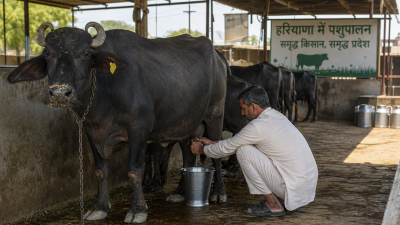
Recent research reported recently in national media shows rising temperatures and humidity are reducing milk production in Haryana. The trans‑Gangetic plains, particularly buffalo herds, face marked yield declines during peak summer; policy responses now need to combine breed choice, climate indices and farm‑level adaptation.
What is the issue?
Milk yield in Haryana has declined because heat and humidity during July–August reduce lactation in buffaloes and cross‑bred cattle. Indigenous Bos indicus breeds (Sahiwal, Hariana) tolerate heat better. Climatic drivers include high temperature, humidity, potential evapotranspiration (PET) and the temperature‑humidity index (THI).
Why it matters
- Rural livelihoods: Dairying is a primary income for many smallholders; yield loss reduces household cash flows.
- Food and nutrition security: Lower milk availability affects local nutrition, especially for children and pregnant women.
- Economy: National milk supply and value chains face supply-side shocks and price instability.
- Resource stress: Climate stress worsens fodder scarcity and groundwater depletion, compounding vulnerability.
Scientific basis and climatic drivers
- Key climatic thresholds: Daytime temperature above 38°C combined with humidity over 70% during July–August correlates with reduced milk yield in buffaloes and cross‑bred cattle; winter temperatures show negligible effect.
- Indices: PET and THI quantify evaporative demand and combined heat–humidity load. PET is strongly correlated with yield loss in buffaloes.
- Physiology: Buffaloes have fewer sweat glands than cattle and lower heat dissipation capacity; heat stress reduces feed intake, metabolic efficiency and milk synthesis.
- Empirical evidence: Analysis across 1,148 villages (2004–2019) covering 4.66 million cross‑bred cattle, 2.86 million indigenous cattle and 35.56 million buffaloes shows measurable yield declines linked to climatic variables.
- Quantified impact: One unit increase in PET is associated with about 1.4 litres per day reduction in buffalo milk yield.
Breed vulnerability and resilience
| Breed/Type | Thermo‑tolerance | Milk response to heat |
|---|---|---|
| Buffalo | Low (fewer sweat glands) | Marked decline; ~1.4 L/day loss per PET unit |
| Cross‑bred cattle | Moderate to low | Reduced yield during high THI; vulnerable in peak summer |
| Indigenous (Sahiwal, Hariana) | Higher | Relatively stable yield at comparable productivity levels |
Economic, sustainability and food‑security implications
- Current loss estimates: Nationally, climate stress accounts for losses estimated at 3.2 million tonnes of milk valued at ₹2,661 crore.
- Projected losses: Losses could rise to 15 million tonnes by the 2050s; some projections suggest up to 25% reduction in milk output by 2085.
- Fodder and water: Rising temperature and erratic rainfall reduce fodder availability and increase irrigation demand, pressuring groundwater.
- Market and value chain: Lower primary production affects processing, value addition and employment in rural dairy sectors.
Adaptation and resilience strategies
Breeding and genetics
- Promote thermo‑tolerant breeds: Support in‑situ conservation and scaled deployment of Sahiwal, Hariana and other Bos indicus germplasm.
- Farmer‑led improvement: Incentivise community breeding programmes, nucleus herds, and participatory selection to retain local adaptation traits.
- Crossbreeding policy: Rebalance programmes to preserve heat‑tolerant traits while improving productivity; research on genomic selection for heat resilience.
Climate information and early warning
- Operational indices: Integrate PET and THI into regional early warning systems for livestock to schedule milking, feed, water and cooling interventions.
- ICT delivery: Use mobile advisories, FPO platforms and extension networks to send actionable alerts to farmers.
Farm‑level and livestock management
- Heat mitigation: Shade, natural ventilation, night cooling, and low‑cost sprinklers for buffalo sheds.
- Feed and fodder: Promote drought‑resistant fodder varieties, fodder banks, silage, and adjusted feeding times to maintain intake.
- Water management: Prioritise efficient on‑farm water use, recharge structures and conjunctive use planning to reduce groundwater stress.
- Animal health: Strengthen veterinary services, heat‑stress monitoring and nutrition supplementation during hot months.
Institutional, financial and market measures
- FPO role: Use FPO Mission‑2026 to aggregate demand for cooling infrastructure, veterinary services, and feed; support value addition and market access.
- Insurance and credit: Develop index‑based insurance linked to PET/THI and improve access to low‑cost finance for adaptation investments.
- Research and extension: Fund ICAR, NDRI and state veterinary institutions for adaptive research and strengthen extension delivery.
Implementation priorities for Haryana
- Targeted breed programmes: Promote Sahiwal and Hariana in heat‑vulnerable districts and support farmer breeding initiatives.
- FPO Mission‑2026 integration: Direct FPOs to procure cooling units, organise fodder banks and negotiate better prices for processed milk.
- Early warning adoption: Operationalise PET and THI thresholds in state livestock advisories and veterinary outreach.
- Water and fodder planning: Combine watershed recharge, rationing of groundwater use for fodder irrigation and cultivation of resilient species.
- Monitoring and evaluation: Establish district‑level metrics for milk yield, herd heat‑stress incidence and groundwater use to guide policy.
Model Questions
1. Analyse the scientific basis of climate change impact on milk production in the Gangetic plains, particularly Haryana. Discuss breed vulnerability and the significance of climatic indices in assessing these effects. [GS-III: Environment & DM]
High temperatures (>38°C) with humidity >70% during July–August lower feed intake and milk synthesis in buffaloes and cross‑bred cattle. Buffaloes’ fewer sweat glands reduce heat dissipation. PET and THI quantify evaporative demand and heat–humidity load; empirical analysis (1,148 villages) links PET rises to about 1.4 L/day loss in buffaloes. Indigenous breeds (Sahiwal, Hariana) show greater heat tolerance and should inform adaptation.
2. Examine the multi‑dimensional challenges climate change poses to India’s dairy sector, focusing on economic ramifications and sustainability in states like Haryana. [GS-III: Economic Development]
Climate stress has caused estimated national milk losses of 3.2 million tonnes (≈₹2,661 crore), rising risks to 15 million tonnes by mid‑century and projections of up to 25% decline by 2085. Reduced fodder and groundwater stress impair production, lower incomes for smallholders, disrupt supply chains and threaten local nutrition. Financial strain affects investment in resilience and market stability.
3. Critically evaluate policy and technical interventions to build climate resilience in the dairy sector, with reference to thermo‑tolerant breeding and farmer‑led programmes. [GS-III: Science & Technology]
Policies should prioritise in‑situ conservation and scaling of Bos indicus breeds, farmer‑managed nucleus herds, and genomic selection for heat resilience. Integrate PET/THI into livestock advisories and early warnings. Support R&D at ICAR/NDRI for heat‑resilient feed, cooling technologies and vaccines. Provide targeted finance, index insurance and extension to ensure farmer uptake and sustained genetic gains.
4. Discuss the role of governance and Farmer Producer Organisations in addressing climate change impact on milk production, with reference to Haryana’s FPO Mission‑2026. [GS-II: Governance]
FPOs can aggregate demand for cooling, fodder procurement and veterinary services, enabling economies of scale and value addition. Haryana’s FPO Mission‑2026 can link smallholders to markets, finance and technology, and coordinate water‑fodder planning. Governance must ensure multi‑sector coordination, embed PET/THI in advisories, fund extension, and create incentive schemes for climate‑resilient practices.
Last Modified: July 6, 2026