
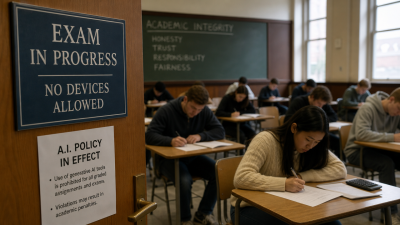
Recent incidents around alleged AI-generated NEET content and widespread student use of generative tools prompted a large re‑examination and administrative measures. Institutions worldwide have revised assessment rules; Indian authorities conducted a re‑examination for NEET‑UG and acted against misinformation while temporary platform restrictions concluded.
What is the issue
Generative AI can create exam questions, model answers and complete assignments with little user effort. Students use “humanizer” and “autotyper” tools to evade authorship checks. Detection systems are unreliable. The result is greater scope for organised malpractice and rapid misinformation that can disrupt national examinations and public trust.
Why it matters
Examination integrity underpins merit, recruitment and public confidence. Large national tests (NEET‑UG attracts over two million candidates) are vulnerable to systemic fraud. Unchecked AI misuse affects fairness, access to professional careers, and the credibility of institutions and regulatory bodies.
Nature of AI misuse in assessments
- Content generation: AI produces plausible question papers, model answers, and plagiarism‑free essays.
- Detection evasion: Tools rewrite AI output to mimic human style or typing patterns.
- Organised networks: Platforms and messaging channels facilitate distribution of leaked or AI‑created material.
- Academic errors: AI can hallucinate citations and produce flawed reasoning, affecting quality of assessments.
Key challenges to examination integrity
- Lowered effort threshold: AI reduces barriers to producing exam‑level work.
- Enforceability: Widespread use makes rule enforcement difficult without new methods.
- Unreliable detectors: False positives and negatives risk unfair sanctions, especially for non‑native English speakers.
- Commercial conflicts: Companies offering both generation and detection tools create ethical conflicts.
- Misinformation: Viral fake leak videos can force large‑scale administrative responses.
Institutional and administrative responses
| Institution/Authority | Measure | Purpose / Effect |
|---|---|---|
| Princeton University | End unsupervised exams; require faculty supervision for in‑person tests | Reduce cheating enabled by remote, unsupervised formats |
| Harvard University | Increase weight of pen‑and‑paper tests in final grades | Prioritise assessments less exposed to generative AI |
| UC Berkeley School of Law | Ban generative AI for graded coursework and during exams | Prevent hallucinated citations and flawed legal analysis |
| State University of New York (SUNY) | Mandate AI literacy; evaluate tools for bias and privacy | Build capacity and protect equity across campuses |
| National Testing Agency (India) | Conduct NEET‑UG re‑examination; act against misinformation | Restore exam credibility; contain organised cheating networks |
| Government (India) | Temporary nationwide restriction on Telegram (short duration) | Disrupt channels used for coordination and misinformation |
Limitations of AI detection tools
- Accuracy: High rate of false positives and negatives undermines reliability.
- Language and style bias: Non‑native speakers face disproportionate risk of misclassification.
- Transparency deficit: Proprietary detectors lack explainability and audit trails.
- Adversarial evolution: Students use humanizer/autotyper tools to defeat detectors.
- Institutional pushback: Several universities have deprecated or discouraged detector use.
Ethical dimensions
- Academic honesty: AI challenges the norm of original student work.
- Equity: Detection errors and access to AI tools create uneven advantages.
- Data privacy: Student data used by AI vendors raises consent and storage issues.
- Conflict of interest: Vendors offering generation and detection services create regulatory dilemmas.
- Institutional duty: Universities must balance discipline with fair adjudication methods.
India‑specific operational challenges
- Scale: Large candidate pools make proctoring and forensic checks resource‑intensive.
- Digital divide: Unequal access to technology affects both misuse patterns and counter‑measures.
- Legal gaps: Existing laws on exam malpractice need explicit clauses for AI‑assisted offences.
- Platform governance: Cross‑border messaging apps complicate takedown and investigation.
Recommended measures — policy, pedagogy and technology
- Assessment redesign: Emphasise in‑person supervised exams, viva voce, project work, and open‑book tasks that test process and reasoning.
- Clear AI policies: Define permissible use, mandatory disclosure, and penalties for misuse in syllabi and codes of conduct.
- AI literacy and ethics: Integrate mandatory training for students and faculty on capabilities, limits, bias and privacy.
- Secure exam delivery: Invest in tamper‑resistant question papers, biometric verification, CCTV and controlled digital platforms.
- Forensic and legal capacity: Build labs for digital forensics; update laws to address AI‑assisted malpractice and organised networks.
- Detection R&D and standards: Fund transparent, auditable detection research and set accuracy standards before deployment.
- Vendor accountability: Require data‑protection clauses, audit rights and limits on dual commercial roles for AI firms.
- Collaboration: Coordinate institutions, examination bodies, law enforcement and platforms for rapid response to leaks and misinformation.
- Pedagogic shift: Design assignments requiring local context, reflections and oral defence to reduce utility of generic AI output.
Implementation priorities for Indian authorities
- Immediate: Strengthen proctoring, run audits of recent exams, prosecute misinformation spreaders and restore candidate confidence.
- Short term: Issue model AI policy for central and state boards; mandate AI literacy modules for professional course aspirants.
- Medium term: Update examination law to define AI‑assisted fraud, establish forensic capacity and standardise platform takedown procedures.
- Long term: Invest in assessment R&D, international cooperation on platform governance and public‑interest audits of AI vendors.
Model Questions
1. Analyse how generative AI challenges examination integrity in India and suggest administrative and institutional measures to preserve fairness. [GS-II: Governance]
Generative AI enables rapid production of answers and question papers, and tools can mask AI origin. Challenges include organised networks, unreliable detectors, scale of national tests and misinformation. Measures: supervised in‑person exams, weighted pen‑and‑paper assessments, strict AI policies, AI literacy, forensic capacity, legal provisions for AI‑assisted fraud, platform accountability and inter‑agency coordination to detect and disrupt organised malpractice.
2. Examine the ethical dilemmas posed by AI use in academia and propose a framework for responsible integration of AI in education. [GS-IV: Ethics, Integrity and Aptitude]
Ethical issues: erosion of academic honesty, unequal access, detector bias against non‑native speakers, data privacy and vendor conflicts. Framework: clear rules on permissible use, mandatory AI literacy and ethics courses, disclosure requirements for AI assistance, transparent audit trails, vendor accountability for data handling, grievance mechanisms, and institutional oversight boards to review AI tool approvals and incidents.
3. Assess the limitations of current AI authorship detection tools and explain how institutions are adapting assessment and policy responses. [GS-III: Science & Technology]
Detectors suffer false positives/negatives, language bias and low transparency; adversarial tools reduce effectiveness. Institutions respond by deprioritising detectors, increasing supervised and pen‑and‑paper exams, banning AI in graded work (as in some law schools), mandating AI literacy, and investing in secure delivery and forensic analysis rather than sole reliance on detection software.
4. Critically evaluate the administrative and technological responses to the NEET‑UG incident and recommend further steps to safeguard national examinations from AI‑driven malpractice. [GS-II: Constitution of India & Polity]
Responses: NTA conducted a re‑examination, dismissed fake leak videos and initiated action; temporary Telegram restrictions aimed to disrupt coordination. Effectiveness: immediate restoration of examination continuity but systemic gaps remain. Further steps: legal amendments for AI‑assisted fraud, forensic labs, secure logistics, mandatory AI literacy for aspirants, platform cooperation for rapid takedowns, and international cooperation on cross‑border channels.
Last Modified: June 23, 2026