
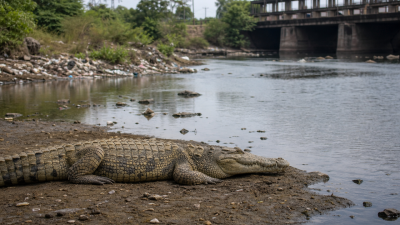
As of July 2026, investigations have established that the banned organochlorine pesticide Aldrin caused deaths of mugger crocodiles in the Chandraloi river, Kota district. Traces of Aldrin were recorded above IS 10500 limits; the NGT-constituted joint committee confirmed contamination while the Forest Department acknowledged presence but declined responsibility.
Current issue and significance
What is the problem
- Contaminant: Aldrin, a banned organochlorine pesticide, detected in Chandraloi river (0.049 µg/l at Ramkhedli Puliya).
- Impact: Deaths of mugger crocodiles (Crocodylus palustris), a Schedule I (C) species under the Wildlife Protection Act, 1972.
- Legal action: NGT took suo motu cognisance and formed a joint committee including CPCB, Rajasthan SPCB, Chief Wildlife Warden and WII.
Environmental and ecological impact of Aldrin
- Persistence and bioaccumulation: Aldrin resists degradation. It accumulates in sediments and biota, magnifying through the food chain.
- Trophic effects: Apex-predator loss (mugger crocodiles) alters fish community structure, may increase algal blooms and disease vectors, and disrupts nutrient cycling.
- Direct toxicology: Neurotoxic effects cause convulsions, behavioural disorientation and death in wildlife; sublethal exposure impairs reproduction and immune function.
- Human health and livelihoods: Water contamination above IS 10500 drinking limit poses risks to communities using river water and to fisheries-based livelihoods.
Status of mugger crocodiles and legal protection
- Protection: Mugger crocodile listed in Schedule I (C) of the Wildlife Protection Act, 1972 — highest legal protection and penalties for harm.
- Population stress: Recurrent mortality incidents (industrial waste event earlier and now pesticide) reduce local population viability and genetic resilience.
- Conservation measures needed: Emergency rescue, necropsy-based cause identification, post-mortem monitoring, captive care protocols and habitat protection.
Legal and institutional response
- NGT intervention: Suo motu action led to constitution of a joint committee and on-site inspection. Committee detected Aldrin traces.
- Role of agencies: CPCB and Rajasthan SPCB responsible for pollution investigation and source attribution; Chief Wildlife Warden and WII for species assessment and recovery.
- Departmental stance: Rajasthan Forest Department accepted contaminant detection but disclaimed responsibility for pollution control, citing jurisdictional limits.
Governance gaps and inter-agency coordination challenges
- Mandate ambiguity: Overlap and gaps between agriculture, pollution control and wildlife mandates delay source identification and enforcement.
- Enforcement weakness: Banned substances persist decades after prohibition due to illegal use, legacy stockpiles, improper disposal and inadequate monitoring.
- Operational gaps: Lack of predefined joint protocols, weak chain-of-custody for samples, and inadequate forensic capacity for persistent organic pollutant (POP) tracing.
- Response design: Awareness campaigns alone do not substitute for investigative action plans, remedial measures, or prosecution where applicable.
Technical challenges in source identification and monitoring
- Analytical requirements: Detection of Aldrin requires accredited laboratories using GC-MS and validated methods for sediments, biota and water.
- Source pathways: Potential sources include illegal agricultural use, contaminated industrial effluent, disposal of obsolete stockpiles, and contaminated sediments remobilised by floods.
- Evidence chain: Effective legal action requires timely sampling, strict chain-of-custody, repeated testing, upstream tracing and corroborative ecological forensics (tissue analysis of fauna).
- Monitoring gaps: Absence of continuous baseline monitoring for POPs in many river stretches impedes early detection and trend analysis.
Policy, legal and institutional measures for pesticides and banned chemicals
- Regulatory framework: Insecticides Act, 1968 and rules govern pesticide registration, manufacture and disposal; persistent organic pollutants are also addressed under environmental laws and Stockholm Convention obligations.
- Enforcement needs: Strengthen SPCBs and CPCB capacity for POP monitoring, interlink registers of obsolete pesticide stocks, and apply punitive measures for illegal manufacture, sale or use.
- Disposal and cleanup: Establish protocols for secure collection and disposal of obsolete pesticides. Where sediments are contaminated, consider targeted remediation and containment after technical assessment.
Integrated river-basin and wildlife management: action priorities
- Immediate: Conduct forensically sound source-tracing; expand sampling upstream and in soils/sediment; perform necropsies and tissue analyses of affected fauna.
- Short-term: Declare contamination-sensitive zones; restrict water extraction and fisheries where contamination exceeds standards; launch targeted rescue and rehabilitation of surviving crocodiles.
- Medium-term: Establish permanent POPs monitoring at sentinel sites; mandate inter-agency rapid response protocol with clear roles and timelines; inventory and remove obsolete pesticide stockpiles.
- Long-term: Adopt integrated river-basin management covering agricultural runoff control, industrial discharge norms, waste management, habitat restoration and community stewardship.
| Recommended action | Lead agency | Deliverable |
|---|---|---|
| Forensic source identification (water, sediment, tissue) | CPCB & Accredited Labs in coordination with SPCB | Chain-of-custody compliant report and upstream source map |
| Rapid wildlife response and rehabilitation | Chief Wildlife Warden & WII | Rescue protocol, necropsy records, captive-care plan |
| Remove obsolete stocks and regulate pesticide movement | Central Insecticides Board, SPCBs | Inventory and secured disposal programme |
| Integrated river basin monitoring and management | State Government (nodal river-basin authority) with CPCB | Monitoring network, pollution control plan, community engagement |
Practical indicators of success
- Short-term: Verified cessation of detectable Aldrin inputs and documented rescue/rehabilitation outcomes.
- Medium-term: Regular POPs data showing declining concentrations in water and sediments; absence of new wildlife mortality linked to pesticides.
- Institutional: Functional inter-agency protocol, clear accountability, and completed prosecution or administrative action where violations occurred.
Model Questions
1. Examine the environmental and ecological implications of persistent organic pollutants such as Aldrin on aquatic ecosystems and Schedule I species, with reference to the Chandraloi river incident. [GS-III: Environment & DM]
Aspects to cover: toxic persistence, bioaccumulation, trophic magnification; direct effects on mugger crocodiles (neurotoxicity, mortality, reproduction); ecosystem-level consequences (predator loss, altered fish populations, human health risks); measurement evidence (0.049 µg/l vs IS 10500 0.03 µg/l); need for tissue analysis and long-term biomonitoring.
2. Analyse governance and inter-agency coordination failures revealed by the Aldrin contamination in Kota and propose institutional reforms to ensure timely pollution investigation and wildlife protection. [GS-II: Governance]
Cover: mandate overlaps between agriculture, SPCB and forest department; Forest Department’s disclaimer and absence of action plan; need for statutory rapid-response protocol, empowered joint investigation teams, clear sample custody rules, enhanced SPCB/CPCB capacity, and a nodal river-basin authority for integrated action.
3. Assess the role of judicial bodies such as the National Green Tribunal in environmental governance, citing their suo motu action and joint committee formation in the Chandraloi river case. [GS-II: Governance]
Cover: NGT as enforcement catalyst where administrative response is weak; powers to constitute expert committees, order investigations and remediation; limitations—reliance on administrative follow-through and technical capacity; recommendation for judicially monitored timelines and mandatory agency compliance mechanisms.
4. Propose a framework for integrated river-basin management and wildlife habitat protection for vulnerable stretches like Chandraloi river, addressing both industrial and agricultural pollution sources. [GS-III: Environment & DM]
Cover: components—continuous water and sediment POP monitoring, strict effluent norms, obsolete pesticide disposal, agricultural best practices, habitat buffers, wildlife rescue protocols; institutional measures—river-basin authority with SPCB, forest and agriculture representation; community participation and periodic independent audits.
Last Modified: July 11, 2026